Remote hiring still works in 2026, but only if your process matches the job post. I’d treat this as the short version: define the remote model up front, screen for writing, use async steps, lock legal and pay rules before sourcing, and onboard with clear written steps.
Here’s the core of it in plain English:
- Be clear about the role type: fully remote, remote-eligible, hybrid, or distributed across U.S. time zones
- Build the funnel for remote work: written screening, async tasks, structured scorecards, and limited live calls
- Check for writing skill early: remote work runs on docs, updates, and handoffs
- Set legal, tax, and payroll rules first: multi-state hiring can trigger registration and withholding duties before day one
- Pick one pay policy: role-based or location-based, then apply it the same way
- Budget past base pay: home office stipend, gear refresh, internet, learning budget, and team travel
- Avoid remote hiring mistakes: timezone bias, office-first signals, vague overlap hours, and puzzle-style live tests
- Keep remote engineers longer: publish communication rules, document decisions, and avoid HQ-first habits
A few numbers stand out. 79% of developers prefer hybrid or remote work, while only 64% have that option. And 45% of U.S. developers reported working fully remote. That gap still gives hiring teams room to win talent - if the role is set up the right way.
If I were pressure-testing a remote hiring plan, I’d ask:
- Does the job post match the interview process and offer letter?
- Do candidates know the required overlap hours before they apply?
- Is written communication scored, not just “noticed”?
- Can a new hire make a first contribution within 30 days?
- Are compliance and pay decisions done before outreach starts?
Quick comparison
| Area | What to do |
|---|---|
| Remote model | State the exact setup and any limits |
| Screening | Use short written prompts first |
| Technical assessment | Use job-like tasks, not whiteboard puzzles |
| Interview rounds | Keep it to 3–4 rounds, with 1–2 live calls |
| Time zones | Publish overlap hours and rotate schedules |
| Hiring model | Match worker type to tax, payroll, and control level |
| Compensation | Use one clear pay rule |
| Onboarding | Ship hardware early and pre-set access |
| Retention | Run async-first with written norms |
In short: remote hiring is less about saying “remote-friendly” and more about proving it at each step. That’s the lens I’d use for the rest of this playbook.
Build a hiring funnel designed for remote roles
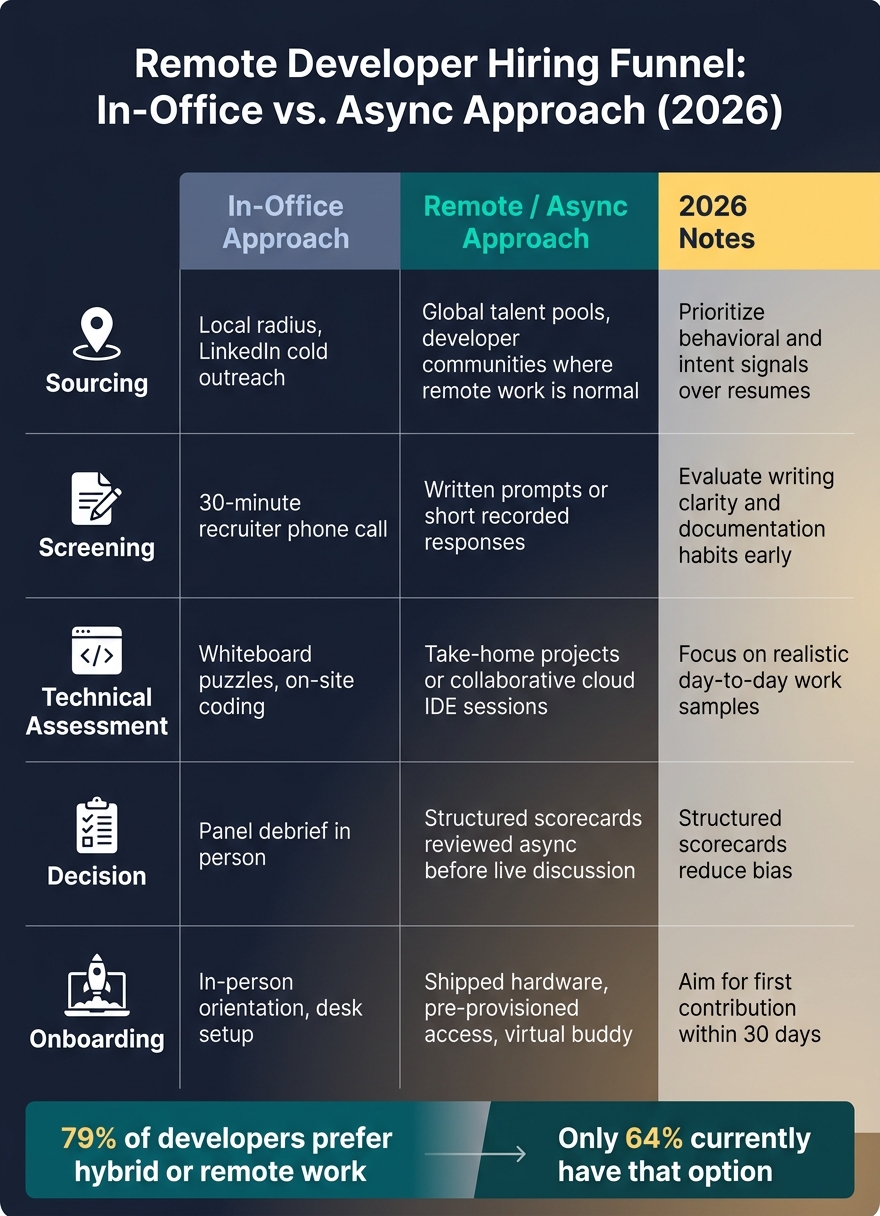
Old hiring playbooks were built for people who lived near the office. Remote hiring changes almost everything: sourcing, screening, evaluation, and onboarding. And candidates can spot a fake “remote” setup fast. So each step needs to show that the role is actually distributed.
| Stage | In-office approach | Remote/async approach | Notes for 2026 |
|---|---|---|---|
| Sourcing | Local radius, LinkedIn cold outreach | Global talent pools, developer communities where remote work is normal | Prioritize behavioral and intent signals over resumes |
| Screening | 30-minute recruiter phone call | Written prompts or short recorded responses | Evaluate how naturally they document work and communication clarity early |
| Technical | Whiteboard puzzles, on-site coding | Take-home projects or collaborative cloud IDE sessions | Focus on realistic, day-to-day work samples over nonwork puzzles |
| Decision | Panel debrief in person | Structured scorecards reviewed async before live discussion | Structured scorecards |
| Onboarding | In-person orientation, desk setup | Shipped hardware, pre-provisioned access, virtual buddy | Aim for first contribution within the first 30 days |
Find engineers open to remote roles using stronger intent signals
Cold outreach to passive candidates usually works worse for remote roles. People who are honestly open to remote work often show that before they ever reply to a recruiter. You can see it in where they spend time, what they read, how they collaborate, and whether they already operate well in distributed spaces.
That’s why sourcing strategy matters so much. daily.dev Recruiter is built on the daily.dev network, so it surfaces developers using behavioral signals, not resumes alone. Outreach happens through candidate-approved introductions, which means candidates have already shown they’re open before a recruiter reaches out. You can apply custom screening criteria, reach developers across the U.S. and around the world, and send results straight into your ATS. For remote roles, this kind of intent-based sourcing cuts wasted outreach and can help improve response rates.
Once someone shows remote intent, the next thing to test is simple: how they communicate in writing.
Run async interviews and evaluate written communication
Trying to copy an on-site process over Zoom often misses what predicts remote success. What matters more is how clearly someone writes, how they deal with ambiguity without a fast hallway chat, and whether they document their thinking in a natural way.
A better setup is to start with 2–3 written questions tied to the role. After that, use a short take-home task or a paired coding exercise, then score it with the same rubric for every reviewer. Save live conversations for the final stage. In 2026, a common best practice is three to four total rounds, with only one or two live calls.
Async hiring frameworks also suggest giving written communication about 20% of the total evaluation for remote developers, putting it alongside major technical skills. That’s a big change from how many teams still score candidates.
Manage time zones and virtual onboarding that works smoothly
Timezone bias is easy to miss, but it shows up all the time. If interviews always happen from 9:00 AM to 5:00 PM Eastern Time, and every async deadline assumes a U.S. morning, candidates in other regions start dropping out quietly. The hard part is that you may never see the pattern in your funnel data. To reduce that friction, publish the required overlap, rotate interview times, and use async steps when live scheduling isn’t needed.
That same discipline should carry into onboarding. A new hire can’t just turn to a teammate or grab their manager in the hallway. If something is missing, work stalls.
A practical checklist looks like this:
Before Day 1: Ship hardware at least 5 business days before the start date and confirm it arrived. Pre-provision access to code repositories, communication tools, and documentation. Assign a named onboarding buddy and set up an intro call. Share written async norms, including how standups work, which tools are used for what, and expected response times.
First 30 days: Set clear written goals for the first contribution, first independent task, and first production change. Schedule weekly manager check-ins during the first month.
Sort out legal, tax, and pay decisions before you hire
Set your legal, tax, and pay rules before sourcing begins. If you change them late, offers drag, compliance problems pile up, and candidates start to lose faith.
Choose the right hiring model for each worker type
The best model depends on three things: where the worker lives, how much control you’ll have over their work, and whether your team can handle the compliance load.
A single remote employee in a state where you don’t already operate can trigger tax and payroll registration duties there before you issue the first paycheck. And if you hire across multiple states, you may need to set up withholding, unemployment insurance, and new-hire reporting in each work state before payroll starts.
Contractors can be faster to bring on, but that speed comes with risk. If a contractor joins the same standups, uses company equipment, and works only on your main product, regulators may view that person as an employee no matter what the agreement says. Unintentional misclassification can lead to back taxes, penalties, and IP ownership disputes. So this isn’t just a paperwork choice. It’s a legal call.
| Model | Legal Complexity | Payroll & Tax Handling | Compliance Risk | Common Use Case |
|---|---|---|---|---|
| U.S. W-2 (In-state) | Low | Standard internal payroll | Low | Core team, long-term IP-heavy roles |
| U.S. W-2 (Multi-state) | High | Register in each state | Medium | Distributed U.S. teams |
| Domestic Contractor | Low | 1099; no withholding | High (misclassification) | Short-term tasks, non-core work |
| International EOR | Medium | Handled by EOR provider | Low | Scaling global teams without a local entity |
| International Contractor | Low | Direct payment; no withholding | High (local labor laws) | Exploratory or non-core projects |
Once you pick the worker model, your compensation policy needs to line up with it.
Set a pay philosophy candidates can trust
Use one pay rule and state it plainly. Role-based pay ignores location. Location-based pay changes by local market. If you blend both without a written policy, people notice fast, and trust takes a hit.
Developers now look at the full value of a job, not just the base salary. A clear remote policy with no hidden return-to-office plan can make a lower number easier to accept - but only if candidates can see that tradeoff up front. If your remote policy feels fuzzy, most people will ignore it and zero in on cash.
After that, the rest of the offer package comes into play.
Budget for remote benefits, equipment, and team gatherings
Base salary is only one part of the cost of a remote offer. Employers should budget for:
- a one-time home office setup stipend
- an annual equipment refresh budget
- monthly internet reimbursement
- a learning and development fund
- travel for occasional team meetups
These costs support productivity and retention.
Remote developers look at the whole package before they say yes, as outlined in our guide to hiring remote developers. Put these benefits in writing before final interviews so candidates can see the full offer early.
These choices also affect your recruiting tools, interview format, and scheduling rules.
Use the right tools and fix common remote hiring mistakes
Once pay and compliance are in place, your hiring stack starts to shape the candidate experience. The tools matter only if they support one async process from start to finish. If they don't, they just create drag.
Pick tools that support async recruiting
A remote hiring stack tends to work best when it covers six core categories: video interviewing, async coding assessments, collaborative coding tools, scheduling automation, documentation tools, and ATS integration. But having all six isn't enough. Each tool should hand off cleanly to the next step.
A practical async-first flow looks like this: application → ATS screen → recruiter screen → async coding task → video technical interview → written exercise → offer.
The async coding task should give candidates a 72-hour start window for a 60–90 minute task. The written exercise should test writing with something short and job-related, like a design prompt or a PR description.
The biggest mistake? Adding more tools to a weak process. Start with ownership. Decide who moves candidates forward, use the same templates each time, and require scorecards before every advance. That keeps async evaluation steady and makes writing signal easier to track across the full funnel.
Avoid timezone bias, availability bias, and misleading remote messaging
Even a good stack falls apart when the rules behind it are off.
| Mistake | Why it hurts | Better practice | Team impact |
|---|---|---|---|
| Timezone bias - filtering for candidates in convenient U.S. time zones | Shrinks the talent pool and cuts against one of the main reasons to hire remotely | Put overlap hours in the ATS, calendar invites, and assessment instructions | More remote-open applicants |
| Availability bias - rewarding fast replies during U.S. hours over actual output | Punishes candidates in other regions and signals a presence-first culture | Measure shipped features and documented outcomes, not response speed | Fewer late-stage drop-offs |
| Skipping async communication assessment - no written exercise in the funnel | Remote work runs on writing; conversation alone can't test it | Use the same written prompt in the assessment workflow and score it in the ATS | Fewer knowledge silos, lower rework rates |
| Misleading remote messaging - remote-friendly on paper, rigid hours in practice | Candidates spot the mismatch fast; it hurts employer brand and offer acceptance | Keep job posts, interview invites, and offer letters aligned on the same remote model | Builds candidate trust, reduces late-stage drop-off |
| LeetCode-style live tests - whiteboard sessions for senior roles | Pushes away experienced engineers and doesn't match day-to-day work | Use realistic tasks, like extending a small API or working through a backlog item | Higher signal on architectural thinking and debugging |
One issue deserves extra attention: inconsistent messaging across tools. If a job post says remote-first, but the assessment invite says candidates must be available 9:00 a.m.–5:00 p.m. EST, people notice right away. It feels like a bait and switch.
Keep your templates in one place and line them up with your actual remote model: core overlap hours, travel expectations, and async norms. Review them together, not one by one.
Share the process page before the first interview, and keep the timeline fixed.
Build a remote engineering culture that keeps people around
Once hiring, pay, and tools are in place, culture becomes the thing that decides whether remote engineers stick around. Most developers don’t judge a remote company by polished policy docs. They judge it by what a normal Tuesday afternoon feels like.
Set communication norms remote engineers can count on
One shift tends to make the biggest difference: move to an async-first way of working. That means written updates, documented decisions, and clean handoffs handle most day-to-day work. Meetings are then saved for live teamwork, conflict, and urgent issues.
Publish a one-page communication charter that covers channels, response times, async vs. live topics, overlap hours, and quiet hours. Put it into onboarding from day one. As a team habit, it cuts down the guesswork that often leaves remote engineers feeling out of the loop after the first month.
Keep a light decision log with the context, options, rationale, and date. When architecture choices and process changes live in records people can search, remote engineers can keep moving instead of waiting for yet another call.
You also need to push back on leadership proximity bias. Written promotion criteria, public project wins, and demos or retrospectives that give remote engineers equal airtime help level the field.
Treat remote as the operating model, not a perk. If people are stuck dealing with constant overlap demands and HQ-first habits, trust starts to wear down fast.
Key takeaways for hiring remote developers in 2026
Use this checklist to pressure-test whether your remote setup matches the promise in your job posts.
- Hire clearly. Job posts, assessments, and offer letters should describe the same remote model.
- Pay consistently. Explain whether your approach is location-based or role-based, and apply it the same way to everyone.
- Onboard deliberately. Use a 30/60/90 plan, a named buddy, and an access checklist.
- Work asynchronously. Documented decisions and meeting discipline help remote engineering work over time.
- Retain through culture. Engineers who can do excellent work without fighting the system every day tend to stay longer.
For implementation details, see these resources: best practices for hiring remote technical talent, how remote hiring behavior signals candidate intent, and a practical guide to hiring remote developers.
FAQs
How do I choose the right remote hiring model?
Choose the setup that fits your project’s timeline, scope, and how closely the work needs to be managed.
- Use contractors for short, focused tasks.
- Use senior engineers for core product work and tighter screening.
- Consider nearshore partners when you need a full team that can handle frequent iterations.
Be clear about remote work expectations from the start. Spell out overlap hours and whether the role is fully remote, hybrid, or async-first. Move fast, but stay transparent.
What should I assess first for remote engineers?
Start by spelling out what the role calls for. List the must-have skills, the day-to-day work, and what your project needs from this person. Before you test anyone, get your team on the same page about how you’ll judge candidates.
Then put more weight on real work and how people show up than on a static resume. At the same time, confirm the basics early, like time zone fit and core working hours.
How can I avoid timezone bias when hiring remotely?
Don’t let time zone overlap become the main thing you judge. If you do, you can end up favoring convenience over skill.
A better approach is to use a standard process with the same technical rubrics and scorecards for every candidate. That keeps the focus on what matters: their ability to do the job, not whether they can mirror your local workday.
It also helps to lean on async tools. Recorded coding assessments and video interviews give people a fair shot without forcing awkward scheduling. When you do need live sessions, spell out any required overlap hours up front and let candidates self-schedule.
That small shift can make the process feel a lot more fair and a lot less arbitrary.
.png)