If I want better developer hires, I need a fixed interview loop with shared questions, scorecards, and a clear debrief. Structured interviews predict job performance better than loose interviews, with research showing about r = 0.42–0.51 for structured formats vs. r = 0.19–0.38 for unstructured ones.
Here’s the short version:
- I use the same interview stages for each candidate.
- I assign one main skill to each stage.
- I require interviewers to score with evidence, not gut feel.
- I cut steps that add noise, like trivia, whiteboard hazing, and long take-homes.
- I track results with pass-through rate, candidate NPS, calibration variance, and offer acceptance rate.
- I review outcomes at 90 days against ramp speed and independent task completion.
A standard loop usually includes:
- Recruiter screen for pay range, work authorization, timing, and level fit
- Hiring manager screen for core technical fit and role match
- Technical assessment for coding, debugging, and code quality
- System design for trade-offs, scale, and data modeling
- Behavioral interview for communication, ownership, and teamwork
- Hiring debrief for an evidence-based hire/no-hire call
| Stage | What I check |
|---|---|
| Recruiter screen | Pay, timing, work authorization, level fit |
| Hiring manager screen | Technical basics, problem-solving, role fit |
| Technical assessment | Coding skill, debugging, code quality |
| System design | Architecture, scale, trade-offs, data modeling |
| Behavioral interview | Communication, ownership, teamwork |
| Debrief | Score review, bias checks, final decision |
The main idea is simple: I make each round do one job, score it the same way every time, and remove overlap. That gives me a cleaner hiring process, a better candidate experience, and hiring calls I can explain.
How to build a standard developer interview loop
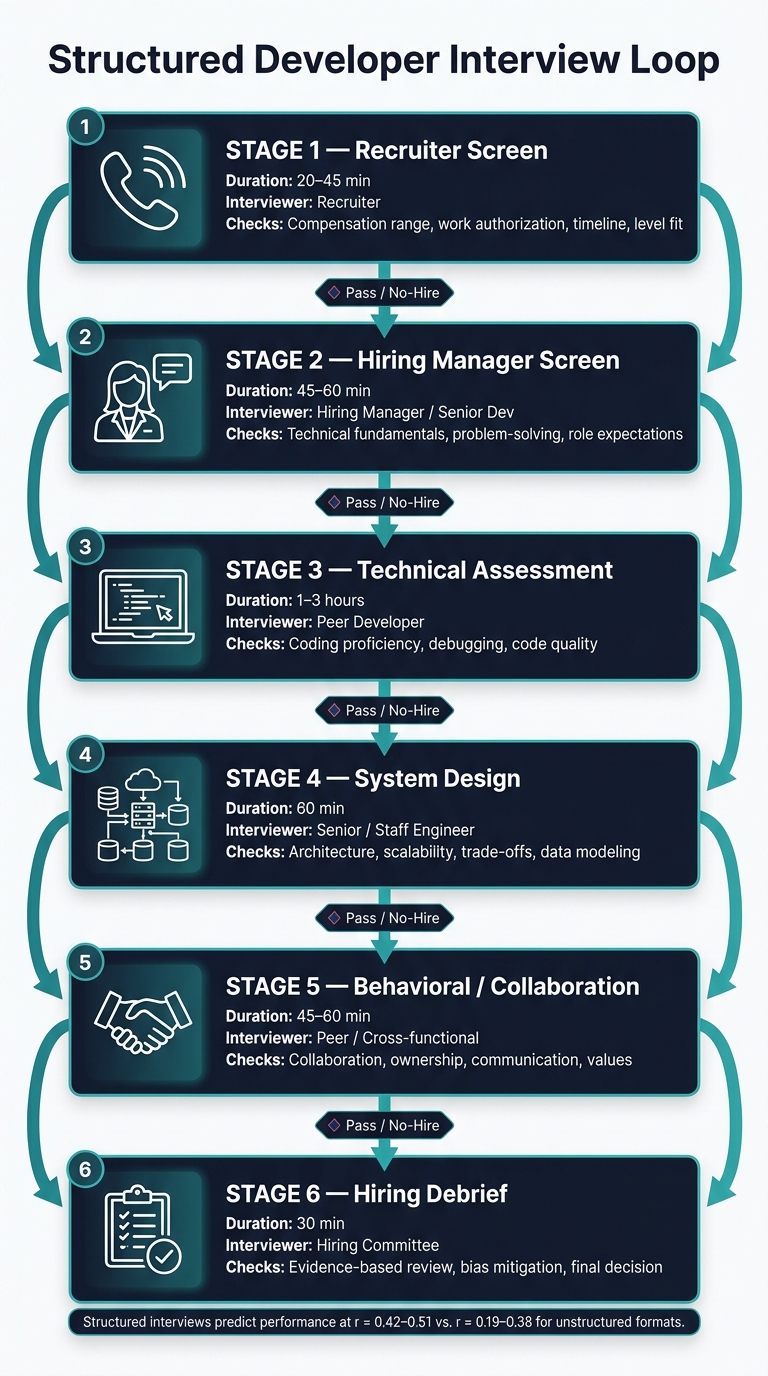
A strong developer interview loop follows a set sequence, with a clear pass/fail decision after each stage. The point is simple: collect enough signal to make a confident hire or no-hire decision.
| Stage | Duration | Interviewer | Competencies Evaluated |
|---|---|---|---|
| Recruiter Screen | 20–45 min | Recruiter | Compensation range, work authorization, timeline, level calibration |
| Hiring Manager Screen | 45–60 min | Hiring Manager / Senior Dev | Technical fundamentals, problem-solving, role expectations |
| Technical Assessment | 1–3 hours | Peer Developer | Coding proficiency, debugging, code quality |
| System Design | 60 min | Senior / Staff Engineer | Architecture, scalability, trade-offs, data modeling |
| Behavioral / Collaboration | 45–60 min | Peer / Cross-functional | Collaboration, ownership, communication, values |
| Hiring Debrief | 30 min | Hiring Committee | Evidence-based review, bias mitigation, final decision |
Each stage should reduce uncertainty. It shouldn't recycle the same test in a slightly different format. Start with this as your default loop, then assign clear rubrics and interviewer ownership for every stage.
Phone screens: recruiter and hiring manager
The recruiter screen is where you confirm compensation range, work authorization, timing, and level fit. It also sets the tone for the rest of the process. This round should check for a basic match and explain what comes next.
Candidates who pass move to a hiring manager or senior developer screen. That conversation goes deeper into technical fundamentals and role-specific expectations. It should tell you whether the person can do the job you're hiring for, not just whether they sound good on paper.
Technical assessment and system design
Pick the best developer assessment tools and exercise format based on the role and seniority. The goal here is to verify hands-on coding ability, not to play gotcha. You want to see how the candidate writes code, debugs issues, and thinks about code quality under normal interview constraints.
After that, run a 60-minute system design interview. This round tests architecture judgment, trade-off thinking, scalability, and data modeling. In plain English: can this person think beyond a single function and reason about how a system should work as a whole?
Behavioral interviews, cross-functional collaboration, and hiring debrief
This stage focuses on collaboration, ownership, and communication. A peer developer or cross-functional partner should run it. That setup helps you see how the candidate may work with teammates, not just how they perform in front of a manager.
Once all interview stages are done, the hiring committee meets for a 30-minute debrief. This is an internal decision step, not a candidate-facing round. The group reviews the evidence, checks for bias, and aligns on a final hire/no-hire call.
Next, map each stage to a rubric so interviewers score the same competencies the same way.
Design each stage with rubrics, interviewers, and calibration
A structured interview loop falls apart if each interviewer uses a different bar. The fix is simple: score the same evidence against the same rubric. That also helps you avoid a common mess where two rounds end up judging the same skill twice.
Map role-critical skills to each interview stage
Give each skill one clear home. Coding should sit in the technical assessment, which can include pair programming or work-sample reviews. System design should sit in the system design round. Each round should focus on one main skill, balancing technical and soft skills across the loop.
That keeps the loop clean and makes feedback easier to trust.
Backend roles usually put more weight on design, data modeling, problem solving, and ownership. DevOps roles tend to put more weight on automation, reliability, and cloud infrastructure.
Build scorecards that require evidence, not gut feel
Use this scorecard format for every interviewer. The point isn't just to give a rating. It's to tie that rating to what the candidate actually said or did.
| Competency | Weighting | Rating Scale | Strong answer example | Evidence to capture |
|---|---|---|---|---|
| System Design | 25% | 1–5 | Designs for scale and names the main trade-offs. | Record the trade-off discussed. |
| Coding/Craft | 30% | 1–5 | Writes modular, testable code and catches edge cases unprompted. | Note specific logic patterns or code structure. |
| Collaboration | 15% | 1–5 | Seeks feedback during pair-programming and iterates on it. | Note how they responded to a specific suggestion. |
| Ownership | 20% | 1–5 | Gives a clear STAR example of owning a production failure. | Document the STAR example. |
| Communication | 10% | 1–5 | Explains technical trade-offs clearly to a non-technical audience. | Note how they adapted their explanation to the audience. |
A scorecard like this pushes people away from gut feel. Instead of writing “strong engineer” or “good communicator,” they have to point to something concrete. That small shift can save a team from a lot of fuzzy debate later.
Run calibration sessions before interviewers score candidates independently
Even a solid scorecard can drift if interviewers read the rubric in different ways. Calibration sessions help get everyone on the same page. Bring the panel together, review sample answers, and compare how each person scores the same response against the same example of a strong answer.
If two interviewers give the same answer very different scores, that's a sign the rubric needs work. Maybe the wording is too loose. Maybe the bar isn't clear. Either way, fix that before people start scoring on their own.
Once scoring is lined up, cut any interview step that adds noise instead of signal.
Cut anti-patterns and tailor the loop by developer role
Once the rubric is set, cut the interview formats that throw it off.
Drop whiteboard hazing, trivia questions, and oversized take-homes
Some interview formats add noise instead of signal. Abstract puzzles might look clever, but they often miss the point. A task-based assessment does a much better job of showing how a candidate works through an actual problem.
Use a shared coding environment so every candidate works in the same setup . That keeps the process more even and makes results easier to compare. And keep take-home assignments under 4 hours. Anything longer starts to test free time and stamina, not just skill.
Fix shifting bars and inconsistent evaluation criteria
When interviewers wing it, the bar moves from one candidate to the next. That's where good hiring goes sideways.
The fix is pretty simple: use a shared set of questions tied to your rubric, then require scorecards before any group discussion. Every candidate should get the same core questions, scored against the same standards, with evidence attached. That way, feedback comes from what happened in the interview, not from whoever spoke first in the debrief.
After that, tune the loop by role instead of building a different process for every team.
Loop templates for backend, frontend, data, DevOps, and engineering managers
Keep the loop structure fixed and change the emphasis by role. In practice, that means using the same stages across developer roles while shifting the weight of each skill area.
| Role | Primary Focus | Key Evaluation Signal |
|---|---|---|
| Backend Engineer | API design, data modeling, reliability | Trade-off judgment |
| Frontend Engineer | UI decisions, state management, accessibility | User-facing judgment |
| Data Engineer | Pipelines, data quality, modeling | Data-flow judgment |
| DevOps Engineer | Automation, incidents, reliability | Operational judgment |
| Engineering Manager | People leadership, delivery, cross-functional alignment | Priority and trade-off judgment |
For junior roles, put about 70% of the weight on correctness. For senior roles, give at least 50% of the weight to how candidates deal with ambiguity, errors, and documentation .
Protect candidate experience and track the metrics that matter
Once the loop is set and aligned, the next step is simple: check if it actually works.
A bad interview experience can hurt your employer brand and make future outreach harder. People talk. And if the process feels messy, slow, or unfair, that reputation can stick.
Set a clear communication schedule from the first contact
Tell candidates what to expect from the start. Share a developer hiring checklist or full interview plan upfront, including how many stages there are and the timeline for each step.
Then follow through. After each stage, send a short update so candidates know where they stand and what comes next. Even a brief note can ease a lot of stress.
Give structured feedback without overexplaining
If a candidate doesn’t move forward, connect the feedback to the documented competencies you assessed. A short note that points to the gap is far better than a vague rejection.
Use the same competency names from your rubric - coding craft, system design, ownership - so the link between evaluation and communication stays clear. That consistency matters. It shows candidates the decision came from a defined process, not gut feel.
Track pass-through rates, calibration scores, candidate NPS, and offer acceptance
Communication and feedback shape the candidate experience. These metrics help you see whether the loop is also leading to better hiring decisions.
| Metric | Definition | How to Measure | Action |
|---|---|---|---|
| Pass-Through Rate | % of candidates advancing from one stage to the next | (Candidates at Stage B / Candidates at Stage A) × 100 | If low at the technical screen, narrow the job description or simplify the test |
| Candidate NPS | Candidate perception of fairness and quality | Post-interview survey on a 1–10 scale | If low, improve communication cadence or provide better prep resources |
| Calibration Score | Variance in ratings between interviewers for the same competency | Standard deviation of scores across interviewers | If high, run norming sessions to align on what a "3" versus a "4" looks like |
| Offer Acceptance Rate | % of extended offers that are accepted | (Offers Accepted / Total Offers Extended) × 100 | If low, review salary benchmarks or gather candidate experience feedback |
At 90 days, compare interview scores with ramp speed and independent task completion .
FAQs
How do I build a structured interview loop from scratch?
Start by working with engineering leads to define clear success criteria and scoring rubrics for the role. Then map out a standard hiring process so each stage measures a different skill.
A simple setup might look like this:
- Recruiter screen
- Technical assessment
- Pair-programming session
- Behavioral or team-fit interview
Use a 4-point scoring scale to cut down on gray areas. Ask interviewers to submit independent feedback within 24 hours, and keep candidates updated every 48 hours.
What should a developer interview scorecard include?
A developer interview scorecard should spell out which skills you're judging, define each one in a clear, measurable way, and use a shared scoring system, such as a 4-point scale.
It should also leave room for observable evidence from the interview and require independent scoring before the debrief to cut bias. For more consistency, you can add stage-specific rubric weights and pass/fail criteria.
How can I tell if my interview loop is actually working?
Track stage-by-stage pass-through rates and your offer acceptance rate.
Here’s why that matters: if only 1 in 5 candidates make it through a technical stage, there’s a good chance the test is too hard, too vague, or just not lined up with what the role needs. And if offer acceptance drops below 80%, the problem may sit with candidate experience, compensation, or both.
It also helps to tighten up how interviews are scored. Use independent interviewer scoring with clear rubrics, then compare scores across stages to check for consistency. If one stage keeps producing results that don’t match the rest, that’s a sign to take a closer look.
Short post-interview surveys can help too. Ask candidates about clarity and fairness while the experience is still fresh. Those quick responses often show where friction is building long before it shows up in your hiring numbers.
.png)