Recruiters face more challenges than ever in 2025. With application volumes tripling since 2021 and IT leaders still reporting skill shortages, hiring the right developers is harder and slower. AI tools are changing the game by automating repetitive tasks, improving candidate sourcing tools, and speeding up the hiring process.
Here’s how AI can help:
Automating Tasks: Resume screening, interview scheduling, and communication can now take minutes, saving hours per week.
Finding Better Talent: AI uses semantic search and scans platforms like GitHub to identify skilled candidates, even those not actively job hunting.
Improving Decisions: Predictive analytics rank candidates by potential success, helping recruiters focus on the best matches.
Enhancing Assessments: AI-powered assessment tools simulate coding tasks and flag irregularities during evaluations, ensuring fair and efficient skill validation.
Companies using AI report hiring time reductions of up to 60% and significant cost savings. The key is to integrate AI thoughtfully, keeping human judgment at the center.
::: @figure 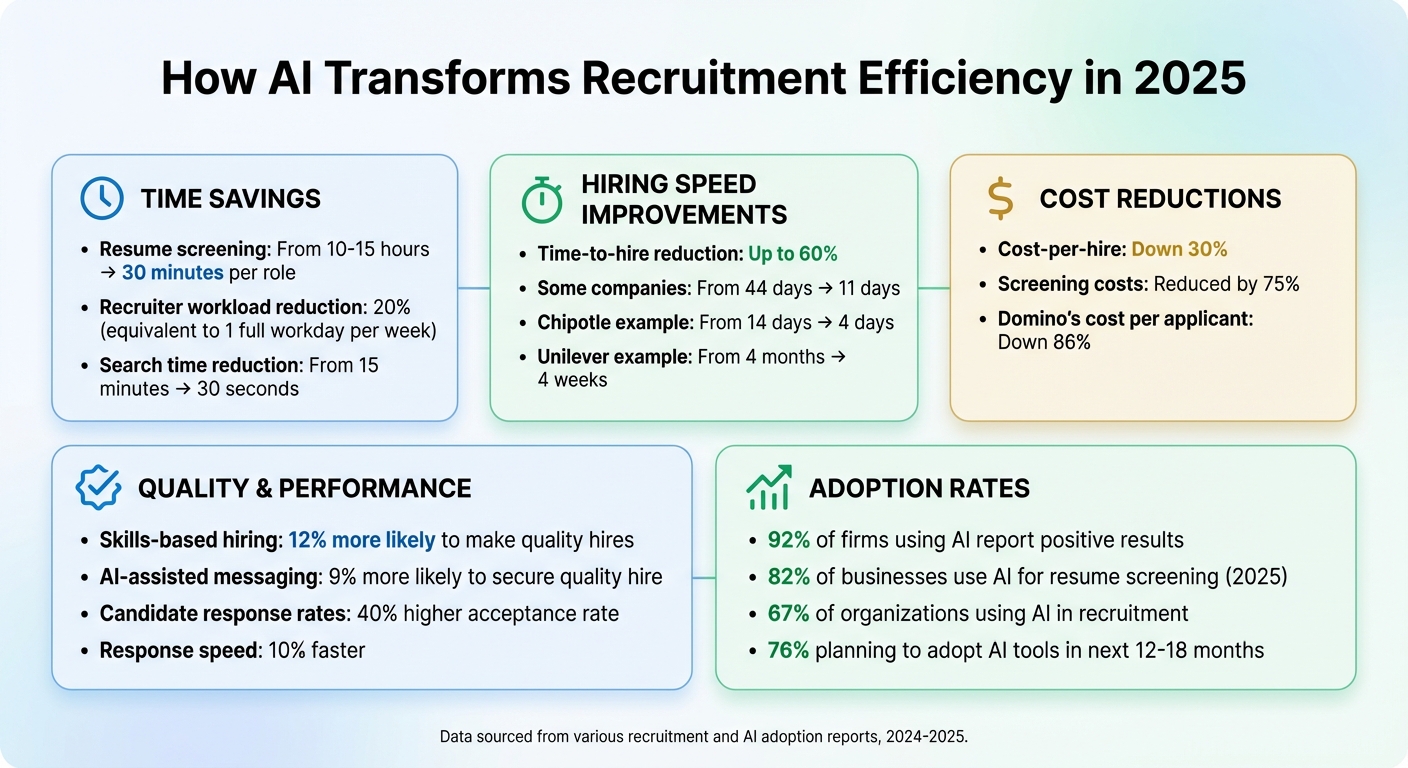 {AI Impact on Recruitment Efficiency: Key Statistics and Time Savings}
Where AI Improves Developer Recruitment
AI is reshaping how companies recruit developers by streamlining processes, reducing errors, and focusing on areas that deliver quick and meaningful results.
Automating Repetitive Tasks
One of AI's biggest advantages is its ability to take over time-consuming administrative tasks. It can handle resume parsing, rank candidates, and even schedule interviews. What used to take recruiters 10–15 hours per role now takes just about 30 minutes . Natural Language Processing (NLP) plays a key role here, identifying skills in context - for instance, recognizing that "building REST APIs" relates to API development. AI can also help prepare for interviews by suggesting questions to test developer soft skills.
Companies like Chipotle have seen major improvements with AI. Their conversational assistant, “Ava Cado,” slashed their time-to-hire from 14 days to just 4 . Similarly, Unilever incorporated AI into their graduate hiring program, cutting the process from four months to four weeks and saving over 50,000 recruiter hours annually . AI chatbots also keep candidates engaged around the clock, answering questions about certifications, salary expectations, and work authorization . Recruiters using generative AI tools save, on average, 20% of their workweek - essentially gaining back one full workday every week .
By automating these tasks, AI allows recruiters to focus on finding and securing the best talent.
Finding Better Candidates
AI doesn’t just speed up recruitment - it also improves the quality of talent discovery. Traditional keyword searches often miss qualified developers who phrase their skills differently. AI, through semantic search, understands context and synonyms, making it easier to find candidates with the right capabilities . Beyond resumes, AI scans platforms like GitHub, developer forums, and even social media to uncover passive talent - those who aren’t actively job hunting but might be open to new opportunities .
For example, one AI-powered recruitment system processed 250,000 job applications annually, reducing time-to-hire from four months to just two weeks while increasing workforce diversity by 16% . Domino’s also leveraged AI for automated job advertising, which helped them handle high-volume recruitment and cut their cost per applicant by nearly 86% . Companies using AI for skills-based hiring are 12% more likely to make better-quality hires .
"AI-powered tools can analyze vast amounts of data to identify candidates with the highest likelihood of success, offering predictive insights that go beyond resumes and conventional interviews." – Salma Rashad, Global Executive Vice President of Talent Acquisition, Siemens
This smarter approach to finding talent ensures companies don’t overlook exceptional candidates.
Making Better Decisions with Data
AI doesn’t just improve recruitment - it makes the entire process smarter. By turning raw data into actionable insights, AI gives recruiters a clear picture of what's working and what isn’t. You can track where candidates drop out of the hiring process, which sourcing channels bring in the best hires, and how long each stage takes. AI consolidates data from across your recruitment tools, pinpointing bottlenecks and inefficiencies by channel, team, or individual recruiter .
Predictive analytics also rank candidates based on their likelihood of success, using clear, data-driven criteria. Some platforms have reported a 78% reduction in time-to-hire and a 65% drop in cost-to-hire . Recruiters using AI-assisted messaging are 9% more likely to secure a quality hire, and 89% of talent acquisition professionals agree that measuring the quality of hire is becoming increasingly important .
"AI will transform how we think about quality of hire by enabling more data-driven, predictive, and unbiased decision-making." – Fabien Desmangles, Talent Acquisition Manager, Dassault Systemes
Finding Passive and Specialized Developer Talent with AI
AI isn't just about automating tasks anymore - it’s reshaping how companies find and connect with specialized talent.
The reality is, the most skilled developers aren’t browsing job boards; they’re already employed and not actively looking for new opportunities. This is where AI steps in, transforming outreach from a guessing game into automated candidate sourcing. By analyzing public data - like the projects developers are working on or their evolving skill sets - AI pinpoints the right people to approach and the best time to do so . Instead of sending out generic cold messages, you can focus your efforts on developers who might actually be open to a conversation. It’s a smarter, more efficient way to connect with top talent.
Using AI-Powered Developer Networks
Traditional hiring methods often fall short when it comes to engaging developers in real time. Enter daily.dev Recruiter, a platform that connects recruiters with developers in the spaces they naturally frequent. The platform uses a double opt-in system, meaning both you and the developer have to express interest before any interaction takes place. This ensures that every conversation starts with mutual intent, cutting down on unwanted messages and wasted effort. It’s a seamless addition to an AI-driven recruitment strategy, helping you focus on candidates who are genuinely interested in engaging.
Matching Skills Automatically
AI has the ability to do more than match keywords - it understands context. Through natural language processing (NLP), it can analyze unstructured text in profiles and project descriptions, uncovering both specialized and related skills that might otherwise go unnoticed . For instance, if a candidate mentions "building microservices architectures", AI can infer expertise in distributed systems as well.
Here’s a real-world example: In June 2024, Victoria Söderlind, a Senior Recruitment Specialist at Toyota Material Handling Europe, used LinkedIn’s AI-Assisted Search to compile a list of 65 targeted candidate profiles in just 30 seconds - a task that used to take 10 to 15 minutes . Companies leveraging skills-based searches are also 12% more likely to make quality hires .
Keeping Talent Pipelines Current
AI doesn’t just help you find candidates - it keeps your talent pool up to date. Platforms like Agentic AI continuously refresh your database, eliminating the need for manual updates . This is particularly vital when you build a tech talent pipeline from the ground up. It can even revisit past applicants, identifying those whose skills have grown to match new roles . AI-driven outreach also delivers results: messages sent with AI assistance have a 40% higher acceptance rate, and candidates respond 10% faster .
Faster Screening, Assessment, and Scheduling with AI
Once you've identified strong candidates, the next challenge is moving them through the hiring process quickly and efficiently. Building on AI-driven sourcing improvements, let's dive into how AI enhances screening, assessments, and scheduling.
AI Resume and Profile Screening
AI tools for screening resumes and profiles go beyond basic keyword matching. Using semantic analysis, they grasp context and identify transferable skills, even if candidates describe their experience in unconventional ways. For example, a developer mentioning "architecting distributed systems" can easily be matched to microservices roles, despite the difference in terminology.
In 2025, AI-powered matching reduced time-to-placement by 25% and doubled candidate response rates, saving recruiters over six hours each week . These tools rank candidates automatically, surfacing the top 10% of your talent pool almost instantly. Instead of combing through hundreds of applications, recruiters can focus on pre-qualified candidates who meet the job requirements. AI even generates concise summaries of technical achievements, making it easier and faster to review profiles.
The results speak for themselves: a 30% drop in cost-per-hire and a 25% faster time-to-fill. Some companies have cut their hiring timelines from 44 days to as few as 11 days, with screening costs slashed by up to 75% . By 2025, 82% of businesses relied on AI for resume screening, and 64% used it for candidate assessments .
Automated Technical Assessments
Technical assessments have come a long way from theoretical quizzes. Modern AI-powered platforms now simulate real-world coding tasks, giving candidates the chance to showcase their skills in scenarios that mimic actual job challenges. Some platforms even allow candidates to use AI tools for coding and debugging, offering recruiters insights into how effectively they leverage such technologies . To ensure fairness, these platforms use AI suspicion scores to flag any irregularities during remote assessments .
Organizations using AI-based assessments have seen hiring times drop by as much as 75% . Companies that automate sourcing and screening processes report an average 30% faster hiring timeline . For example, a professional services firm managed to make over 1,000 hires in just six weeks using a combination of AI screening and high-volume automation .
"The primary difference between AI screening and manual screening is speed and volume. With AI screening, the same recruiter can easily screen 10X more candidates without burning out."
– Pragadeesh Natarajan, Recruiterflow
However, while AI excels at evaluating technical skills objectively, human judgment is still critical for assessing broader qualities like cultural fit. It's important to use AI as a tool to assist, not replace, human decision-making. Opt for explainable AI systems that provide clear reasoning for candidate rankings, so you know exactly why a particular individual stood out .
With technical skills quickly validated, the next step is ensuring smooth and timely communication with candidates.
AI Chatbots for Candidate Communication
Answering candidate questions and scheduling interviews can eat up a significant chunk of your day. AI chatbots take over these repetitive tasks, keeping candidates engaged while freeing up your time. Tools like Paradox's "Olivia" are available 24/7, providing instant responses to common inquiries.
These chatbots work across multiple communication channels, meeting candidates where they feel most comfortable. They sync directly with calendars, enabling instant interview scheduling and rescheduling, which eliminates the usual back-and-forth that can lead to delays or candidate drop-off. With support for over 100 languages, these bots ensure a seamless experience for candidates worldwide .
The impact is clear: AI-driven communication processes speed up hiring by 31% and boost response rates by 30–40% compared to manual methods . They also reduce the time-to-apply by 58%. For instance, 7-Eleven saved its stores 40,000 hours per week on recruiting tasks by using conversational AI .
Finding the right balance between automation and a personal touch is essential. While AI handles FAQs, basic qualification checks, and scheduling logistics, recruiters can focus on meaningful, strategic conversations that build rapport and trust. By late 2025, 67% of organizations were using AI in recruitment, and 99% of hiring managers had integrated AI into some part of their process . The question is no longer whether to use AI but how to implement it thoughtfully to maintain efficiency while delivering a great candidate experience.
Improving Recruiter Performance with AI Analytics
AI analytics is reshaping the hiring landscape, allowing recruiters to fine-tune their processes from start to finish. By turning mountains of hiring data into clear, actionable insights, these tools help identify bottlenecks, predict outcomes, and streamline workflows like never before.
Monitoring Recruitment Metrics
AI-powered platforms track essential hiring metrics such as time-to-hire, cost-per-hire, candidate drop-off rates, and conversion rates by source. These tools don’t just collect data - they highlight issues in real time. For instance, if candidates are consistently dropping out after the first interview, AI can flag the trend, prompting you to evaluate whether the process is too long or unclear .
The cost of manual resume screening can climb to nearly $20,000 per year in recruiter hours . With AI, sourcing time drops dramatically - from 15 minutes per search to just 30 seconds - saving recruiters significant time week after week . On average, recruiters using AI report a 20% reduction in workload , enabling them to handle nearly three times as many applications per role compared to just a couple of years ago .
"Clean data is the foundation of a recruiter's credibility. It elevates their recommendations from subjective opinions to objective, strategic counsel."
– Shannon Castleman, Senior Technical Recruiter, Greenhouse
AI’s impact is already being felt: 61% of talent acquisition professionals believe it enhances how quality of hire is measured . Among firms using AI in recruitment, 92% report positive results, with over 10% seeing productivity gains above 30% .
Predicting Hiring Outcomes
AI doesn’t stop at tracking current metrics - it also forecasts future trends. Predictive analytics can estimate offer acceptance rates, predict how long certain roles will take to fill, and identify potential skill gaps your team might face in the near future . By analyzing past data, AI can pinpoint patterns among top-performing employees, helping prioritize candidates who share those traits . Companies focusing on skills-based hiring - where candidates are matched based on verified abilities rather than degrees - are 12% more likely to make successful hires .
Take the example of a Berlin-based SaaS startup in 2025: using AI-driven matching, they cut their time-to-hire for software engineers from 35 days to just 11, all while maintaining a 96% retention rate over a year . AI adoption in recruiting surged from 26% to 53% within a single year, reducing time-to-fill by up to 45% .
"AI will transform how we think about quality of hire by enabling more data-driven, predictive, and unbiased decision-making."
– Fabien Desmangles, Talent Acquisition Manager, Dassault Systemes
Refining AI Tools Over Time
AI tools aren’t set-it-and-forget-it solutions - they need regular adjustments to stay effective. Recruiters should routinely review AI prompts, screening criteria, and workflow settings to ensure alignment with hiring goals. If the system is filtering out strong candidates, tweaking filters and parameters can help strike the right balance . Post-hire surveys and performance reviews also provide valuable data for fine-tuning AI models .
Start small by testing AI analytics on a single workflow - like resume screening for one role - and focus on one key performance indicator before expanding its use . Regular evaluations and human oversight are essential to keeping AI tools aligned with your broader hiring strategy .
"AI is a tool to augment human judgment, not replace it. Successful organizations will find the right balance - using AI to handle routine tasks while preserving meaningful human interaction."
– Glen Cathey, SVP, Consulting Principal, Randstad
As AI takes over repetitive administrative tasks, the need for recruiters skilled in building relationships has skyrocketed - up 54 times . The goal isn’t to replace human involvement but to shift it toward strategic, high-impact activities that AI can’t replicate. This shift is essential to fix what’s broken about developer hiring and rebuild candidate trust.
Adding AI to Your Recruitment System
Bringing AI into your recruitment process requires a thoughtful approach. Start by standardizing your current workflows before scaling up. Map out every step, from job requisitions to onboarding, and identify areas that slow things down - like duplicate resume reviews or endless email threads. These bottlenecks are prime candidates for automation . Gradual integration helps create a more streamlined and connected recruiting system.
Connecting AI to ATS and Other Tools
For AI to be effective, it needs to integrate seamlessly with your Applicant Tracking System (ATS), HRIS, and communication platforms. Without proper connectivity, you’ll find yourself manually transferring candidate data between systems, which undermines the whole point of automation . Look for AI tools that sync candidate records automatically, update statuses in real time, and organize data consistently. For example, AI scribes like MetaView and Otter can record screening calls and update ATS records without human intervention .
In 2024, IBM introduced "AskHR", an AI agent powered by IBM watsonx Orchestrate, which managed 11.5 million interactions during the year. This tool allowed managers to complete HR tasks 75% faster than traditional methods .
Start small - try automating one workflow, such as interview scheduling or resume deduplication. Track a single key performance indicator (KPI) to measure success before expanding . Companies that use automation for sourcing and screening have reported up to a 30% reduction in time-to-hire . The ultimate goal is to minimize manual tasks and ensure a smooth flow of information across systems.
Deciding What AI Should Handle
Once integration is underway, figure out which tasks AI should take over. Focus on automating repetitive, high-volume tasks like resume parsing, eligibility checks, interview scheduling, and summarizing calls . However, leave tasks that require empathy, judgment, or personal interaction - like cultural fit assessments, relationship-building, and final hiring decisions - to your team .
"The most significant ROI right now comes from using AI to remove busywork, not to replace judgment." – Alan Price, Director of Talent Acquisition, Deel
To prepare for AI implementation, standardize your processes. Use structured developer job descriptions, consistent interview scorecards, and clear feedback templates. Clean, organized data makes AI more effective . Automating repetitive tasks allows recruiters to focus on higher-level strategy. For instance, AI chatbots can handle 67% of initial candidate inquiries without human input , but recruiters are still essential for more nuanced conversations.
Setting AI Policies and Maintaining Transparency
Building trust with candidates and staying compliant with regulations requires clear AI policies. Develop a formal policy outlining how AI is used, who is accountable, and when human oversight will be applied . Be upfront with candidates about AI involvement and offer alternative options for those who might struggle with automated systems, such as neurodivergent applicants .
To ensure fairness, conduct biannual bias audits by reviewing random rejected resumes. This helps confirm that qualified, diverse candidates aren’t being unfairly filtered out . Additionally, complete Data Protection Impact Assessments (DPIA) to identify risks, especially when handling sensitive data like biometrics or large-scale profiling . Transparency doesn’t just meet regulatory requirements - it also reinforces a candidate-first approach.
"AI is a powerful tool, but human oversight is what ensures it's used responsibly and effectively." – Jackye Clayton, VP of Talent and DEIB, Textio
Regular reviews and active oversight are essential to keeping AI aligned with your hiring goals and ensuring compliance .
Conclusion
AI is reshaping the way recruiters hire developers, turning recruitment into a proactive, forward-thinking process. By automating routine tasks like resume parsing, scheduling interviews, and managing candidate communications, AI can free up to 20% of a recruiter's time. This extra time allows recruiters to focus on what truly matters - building strong relationships, advising hiring managers, and identifying top talent even before they apply .
But it’s not just about saving time. AI is also raising the bar for candidate evaluation. Instead of relying on keyword matches, AI tools can now identify transferable skills and assess a candidate’s intent. Beyond that, AI delivers data-driven insights to measure the quality of hires and predict long-term success, replacing subjective judgments with objective analysis. Companies using AI for tasks like sourcing and screening report hiring up to 30% faster , and an impressive 92% of firms already see measurable benefits from AI adoption .
"AI is enabling recruiting teams to be more human, not less. And... it also allows them to be more strategic, focusing on high-impact efforts like improving quality of hire."
– Greg Lewis, Data-Driven Content Strategist, LinkedIn
To make the most of AI, start small. Automate a few processes, track the results, and expand from there . Map out your recruitment workflows to identify bottlenecks, and always ensure final decisions stay in human hands. As you scale AI adoption, regularly audit for bias and fine-tune your approach to keep improving.
The recruiters who succeed in this new era will be those who see AI as a partner, not a replacement. With 76% of companies planning to adopt AI recruitment tools in the next 12–18 months , now is the time to build your AI expertise and rethink how you hire. The future of recruitment isn’t about choosing between efficiency and the human touch - it’s about using AI to enhance both. Let AI be your ally in transforming recruitment and driving success.
FAQs
How does AI speed up the hiring process for developers?
AI has the potential to dramatically speed up the hiring process for developers by taking over repetitive tasks and simplifying workflows. For instance, AI-driven resume screening tools can sift through thousands of applications in no time, pinpointing candidates who meet the required skills and experience. These tools even rank applicants for review, slashing the time spent on manual screening. On top of that, AI chatbots take care of routine candidate interactions - answering FAQs, scheduling interviews, and staying in touch - freeing up recruiters to focus on higher-level strategies.
Beyond that, AI boosts efficiency by automating tasks like posting job ads, coordinating interviews, and conducting initial skill evaluations. These systems integrate smoothly with applicant tracking tools, cutting down on delays and eliminating the need for manual data entry. Using predictive analytics, AI can spot top talent early in the process, helping recruiters prioritize outreach and move qualified candidates through the pipeline faster. The result? A shorter hiring cycle that doesn’t compromise on quality or consistency.
What recruitment tasks should you automate with AI to boost efficiency?
To boost efficiency in recruitment, start by automating those repetitive, time-consuming tasks that eat up your day. For example, AI-powered resume screening can sift through thousands of applications in no time, flagging top candidates and filtering out duplicates or irrelevant submissions. AI tools can also take over routine activities like posting job ads, scheduling interviews, and sending follow-up emails. This frees up recruiters to focus on tasks that require a human touch, like building relationships and crafting hiring strategies.
When it comes to sourcing talent, AI algorithms can comb through social media profiles, job boards, and professional networks to pinpoint qualified candidates, including those who aren’t actively job hunting. On top of that, AI chatbots can connect with potential candidates instantly, answering their questions and keeping them engaged throughout the hiring process. These tools not only save time but also create a smoother, more engaging experience for candidates.
AI also plays a big role in decision-making. It can match candidates to job requirements, identify skill gaps, and even help reduce bias in rankings. Plus, AI tools can summarize interview notes into actionable insights, making it easier for recruiters and hiring managers to compare candidates and make quicker, data-driven hiring decisions.
How can AI help recruiters find and evaluate top developer talent?
AI is transforming how recruiters work by processing massive amounts of data - like resumes, social media profiles, and even code repositories - to pinpoint candidates with the right mix of skills and experience. By leveraging machine learning, it goes beyond simple keyword matching, identifying top talent that might otherwise slip through the cracks. This not only saves time but also broadens the talent pool, enabling recruiters to connect with a more diverse range of candidates.
When it comes to evaluation, AI brings data-driven precision to the table. It scores candidates on measurable factors such as technical expertise, alignment with team dynamics, and predicted job performance. By removing irrelevant biases, AI helps ensure hiring decisions are fairer and more objective. Tools powered by generative AI can also summarize interview discussions, highlight areas where a candidate may need development, and provide consistent recommendations. The result? Faster, smarter hiring processes tailored to the demands of tech roles.
.png)