Recruiter feedback loops are a game-changer for hiring teams. They ensure timely, clear communication between candidates, recruiters, and hiring managers, helping refine recruitment strategies and improving outcomes. Yet, many companies overlook this critical system, leading to missed opportunities and inefficiencies.
Here’s why feedback loops are so impactful:
- Streamline Processes: Real-time feedback helps recruiters fine-tune candidate searches and reduce hiring delays.
- Boost Candidate Experience: Constructive feedback increases satisfaction, even for rejected candidates, and encourages them to reapply or refer others.
- Improve Hiring Quality: Data-driven adjustments lead to better alignment between job expectations and hires.
Despite their importance, only 16% of candidates report receiving actionable feedback after rejection. Structured systems - like using scorecards, analytics, and quick feedback timelines - can transform hiring processes. For example, companies implementing these loops have seen offer-acceptance rates rise by 11% and time-to-fill drop by 12%.
The takeaway? Feedback loops create a continuous cycle of improvement, benefiting recruiters, candidates, and overall hiring success.
::: @figure 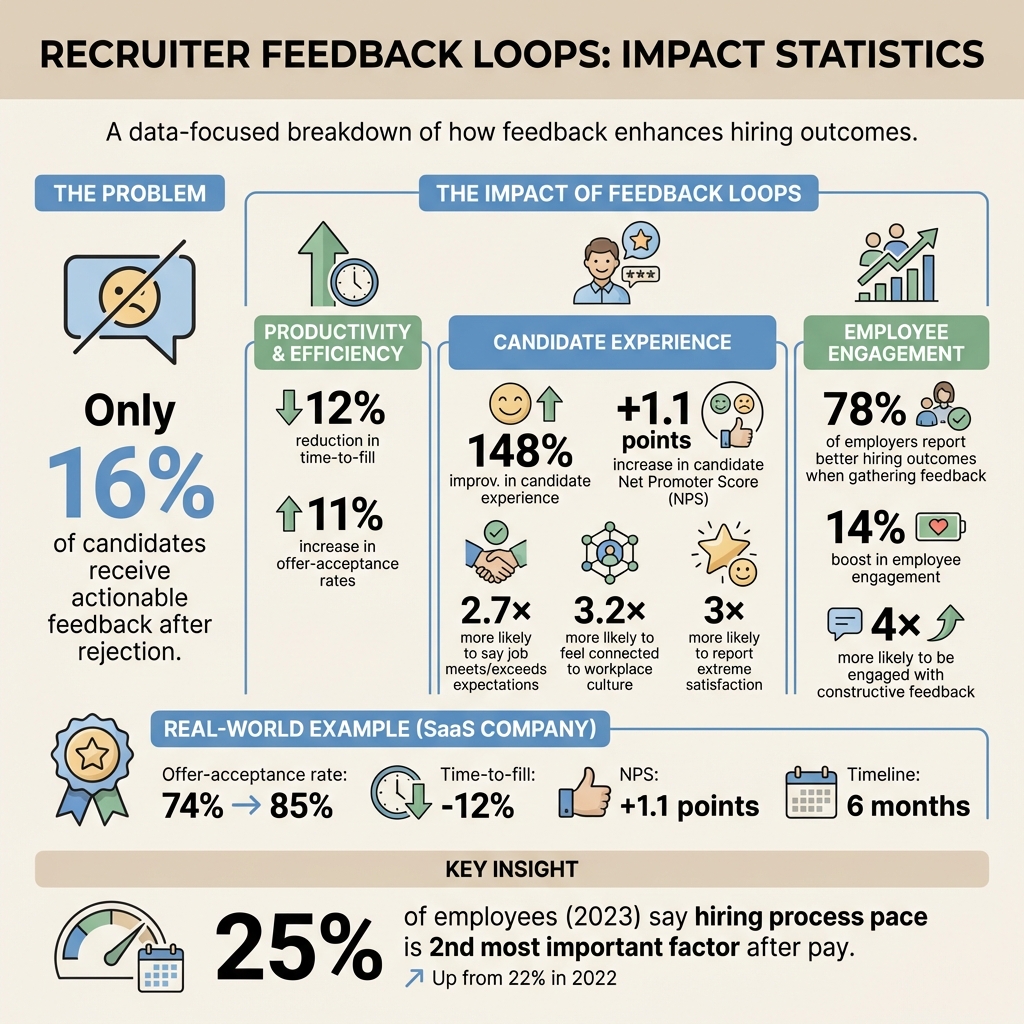 {Impact of Recruiter Feedback Loops: Key Statistics and Outcomes}
What Are Recruiter Feedback Loops?
Recruiter feedback loops are systems designed to gather and analyze input from candidates, hiring managers, and recruiters to improve hiring processes. Essentially, they transform every hiring interaction into a chance to learn and refine.
Matthew Deutsch from Top Echelon highlights their value:
"Feedback loops ensure that every stakeholder in the recruitment process has a voice, and their perspectives are used to create actionable improvements."
These loops function by collecting insights at every stage - from using coding-focused candidate sourcing tools to onboarding - to make real-time adjustments. For example, feedback from a hiring manager about a missed shortlist or a candidate’s negative interview experience can lead to updates in job descriptions, search criteria, or interviewer training.
Core Components
Effective feedback loops depend on three key elements: data collection, analysis, and iterative improvement. Data is gathered through tools like candidate surveys, interview scorecards, and recruiter observations. Once collected, the data is analyzed to spot patterns - such as recurring skill gaps, process inefficiencies, or mismatched role expectations. Finally, these insights are used to implement changes, like improving job postings or streamlining interview processes.
A mid-sized SaaS company in Germany offers a great example of this approach. Over six months ending in 2024, they introduced structured debriefs and standardized scorecards for every candidate. By reviewing aggregated data quarterly, they made targeted adjustments to their hiring process. The results? A jump in offer-acceptance rates from 74% to 85%, a 12% reduction in time-to-fill, and a 1.1-point increase in their candidate Net Promoter Score .
This cycle of feedback and improvement drives better outcomes at every stage of recruitment.
How Feedback Loops Work in Recruitment
Feedback loops integrate insights into every step of the hiring process, creating a continuous cycle of refinement. During the sourcing phase, hiring managers can review and provide feedback on initial shortlists, helping recruiters fine-tune search parameters and clarify what makes a candidate "qualified" for the role. In the interviewing phase, structured debriefs and scorecards ensure better alignment on success criteria, reducing subjective judgments like "not a culture fit."
Candidate feedback after interviews is equally valuable. It can uncover issues like technical glitches in the application process or delays in communication, which might otherwise go unnoticed. Post-hire, metrics such as 90-day retention rates and quality of hire provide a clearer picture of how well hiring decisions align with job performance, offering insights to refine future recruitment strategies.
Elizabeth Parker from Hirebee.ai emphasizes the broader benefits:
"Feedback loops establish a continuous learning process, promoting agility and adaptability in automated recruitment systems."
The goal isn’t to get everything perfect from the start. Instead, it’s about creating a system where every experience - whether successful or not - paves the way for smarter, more informed decisions in the future.
Research Findings: How Feedback Loops Affect Recruitment
Studies reveal that feedback loops significantly enhance productivity, candidate satisfaction, and hiring quality. A meta-analysis of 435 studies found that feedback has a medium effect size of 0.48 on learning and performance outcomes, showing it consistently leads to noticeable improvements when done right . However, a review of 131 studies highlighted that about one-third of feedback interventions can backfire if poorly structured, emphasizing the importance of providing clear and specific feedback . These effects are particularly evident in three key areas: recruiter productivity, candidate experience, and hiring outcomes.
Increasing Recruiter Productivity
Feedback loops help recruiters work more efficiently by flagging bottlenecks and eliminating unnecessary tasks. Feedback from hiring managers, for instance, helps clarify the profile of the "ideal candidate", allowing recruiters to focus their search and avoid wasting time on unsuitable leads . As Matthew Deutsch from Top Echelon explains:
"Feedback loops ensure that every decision is informed by data and insights rather than assumptions" .
Timely feedback is essential. Setting service-level agreements (like delivering first-interview feedback within 24 hours and final-interview feedback within 48 hours) and using automated tools like applicant tracking systems (ATS) to capture and share insights quickly can keep the hiring process moving . Platform Recruitment highlights the urgency of this approach:
"Every day you delay giving feedback increases the chance of losing top talent to faster-moving competitors. A healthy feedback loop supports momentum and ensures no one is left waiting" .
Improving Candidate Experience
Feedback loops are just as important for candidates, shaping their perception of the hiring process. Transparent communication through feedback loops plays a key role here. According to Gallup's 2023 research, new hires who experienced an outstanding recruitment process are twice as likely to strongly agree that their job responsibilities match what was promised . They’re also 2.7× more likely to say their job meets or exceeds expectations, 3.2× more likely to feel connected to their workplace culture, and 3× more likely to report being extremely satisfied with their role .
The speed of feedback matters too. In 2023, 25% of employees said the pace of the hiring process was the second-most important factor (after pay) in their decision to accept a job offer, up from 22% in 2022 . Research by Nitya Chawla from the University of Arizona also found that well-structured feedback helps job seekers manage their emotions and reduces negative thought patterns, enabling them to approach their job search more effectively . Even candidates who don’t get the job are more likely to reapply or recommend the company if they receive constructive feedback .
Better Hiring Outcomes
Feedback loops don’t just improve individual performance - they also elevate the overall quality of hiring. Research published in The Leadership Quarterly shows that actionable feedback, such as specific rankings and clear improvement suggestions, leads to better outcomes than vague or absent feedback .
Fast feedback is another critical factor. Gallup warns:
"When organizations fail to make timely decisions, they lose momentum, allow a candidate's excitement about a role to wane, and allow more time for candidates to explore other opportunities" .
Additionally, implementing structured feedback loops can improve the candidate experience by 148%, creating a stronger foundation for retention and alignment with company values from the very beginning .
How to Implement Feedback Loops in Recruitment
Building effective feedback loops in recruitment requires a structured approach at every stage of the hiring process. Without this, you risk missing opportunities to improve and could even harm your employer brand . Let’s break down how analytics, stage-specific feedback, and team training can help drive continuous improvement.
Using Analytics to Spot Trends
Real-time analytics are essential for identifying issues before they escalate. Instead of waiting months to analyze hiring data, use your applicant tracking system (ATS) and a data-driven recruitment checklist to tag rejection reasons - like skill mismatches, process inefficiencies, or poor alignment with company values. By aggregating these tags, you can uncover patterns . For instance, if your "interviews per hire" metric exceeds four candidates, it might indicate unclear job requirements between recruiters and hiring managers . As Lou Adler, CEO of The Adler Group, points out:
"If you can't assess quality of hire until six to 12 months after the person is employed, you're doomed before you even begin" .
Another key metric is assessment variance. If scores vary by more than 0.5 on a five-point scale, it’s a sign that evaluation methods need better alignment . A mid-sized SaaS company in Germany recently showcased the impact of structured analytics. By standardizing scorecards and reviewing rejection data quarterly, they saw their offer-acceptance rate rise from 74% to 85%, reduced time-to-fill by 12%, and increased their candidate Net Promoter Score by 1.1 points over six months . These insights are invaluable for tailoring feedback at every step of the hiring process.
Adding Feedback to Each Hiring Stage
Once trends are identified, feedback should be tailored to each phase of the hiring process. After phone screens, ask candidates about the clarity of the job description and the recruiter’s communication. For technical assessments, focus on the relevance of the tests and the usability of tools. After final interviews, evaluate how well interviewers represented company values and their level of preparation .
To keep things moving, set internal service-level agreements (SLAs) for feedback. For example, require interviewer feedback within 24 hours after first interviews and 48 hours after final rounds . Use frameworks like STAR and standardized scorecards to ensure feedback is clear and actionable, avoiding vague comments .
When rejecting candidates, provide brief but respectful feedback. This not only protects your employer brand but also encourages candidates to refer others or reapply in the future. As the Talent Board puts it:
"Rejection without feedback is a double loss: the candidate misses development, and the employer repeats avoidable errors" .
Training Teams for Continuous Improvement
After establishing analytics and feedback mechanisms, the next step is training your team to use these insights effectively. Recruiters and hiring managers need guidance on interpreting feedback data and turning it into actionable improvements. Create a multi-level review schedule: analyze rejection reasons after each hiring cycle, review trends on a monthly basis, and hold quarterly cross-functional debriefs to adjust selection criteria .
Training should also highlight the importance of psychological safety - ensuring candidates feel comfortable providing honest feedback without fear of consequences. Aim for a candidate response rate above 70% and a feedback quality score of at least 3.5 out of 5 .
Meaningful feedback doesn’t just benefit candidates; it also boosts employee engagement. Research shows that employees who receive constructive feedback are 4× more likely to be engaged than those who don’t, making this an investment in long-term hiring success .
Hiring engineers?
Connect with developers where they actually hang out. No cold outreach, just real conversations.
How daily.dev Recruiter Supports Feedback-Driven Recruitment
Creating effective feedback loops requires tools that capture essential data at every stage of the hiring process. Building on the importance of continuous feedback, daily.dev Recruiter is designed to connect recruiters with pre-qualified developers while emphasizing the quality of engagement over sheer quantity. Instead of relying on outdated profiles or impersonal cold outreach, the platform seamlessly integrates feedback into the recruitment workflow.
High-Context Introductions
With its warm, double opt-in system, daily.dev Recruiter ensures that every introduction starts on the right foot. Developers on the platform have already expressed interest in engaging, so recruiters only connect with candidates who are open to conversations. This approach minimizes negative experiences stemming from unwanted outreach. Since developers are pre-qualified and actively involved, recruiters gain valuable insights right from the start - covering job descriptions, salary expectations, and role specifics. This targeted feedback helps recruitment teams refine their strategies and focus on meaningful interactions with genuinely interested talent.
Tracking Engagement through ATS Integration
daily.dev Recruiter’s integration with Applicant Tracking Systems (ATS) makes it easy for recruiters to track candidate interactions throughout the hiring process. Automated dashboards replace the need for manual tagging and time-consuming reviews by highlighting emerging trends. This streamlined data flow promotes accountability and supports ongoing improvements, helping teams achieve measurable goals - like maintaining a feedback response rate above 70% . These integrations not only provide performance insights but also allow recruiters to tweak their strategies in real time, ensuring they stay on track.
Data-Driven Decision Making
The platform offers valuable insights to help recruiters identify which sourcing methods yield the best results. By analyzing engagement data - such as response rates, interaction lengths, and where candidates drop off - recruiters can refine their outreach and messaging . For instance, if candidates from a specific technical community consistently advance further in the hiring process, recruiters can allocate more resources to that channel. Real-time feedback loops sharpen recruitment strategies, ensuring each cycle improves upon the last . This data-driven approach underscores the platform’s focus on continuous improvement and informed decision-making at every stage of recruitment.
Conclusion
Recruiter feedback loops play a crucial role in creating a recruitment strategy that delivers strong results. As Matthew Deutsch from Top Echelon emphasizes:
"Feedback loops are not just a nice-to-have feature - they are an essential component of a high-performing recruitment strategy" .
The numbers back this up. Research indicates that 78% of employers who actively gather candidate feedback report better hiring outcomes. Additionally, companies that act on this feedback see a 14% boost in employee engagement .
But it’s not just about the numbers. The broader advantages of feedback loops add immense value to the recruitment process. When feedback is used to make data-informed tweaks at each stage, recruiters see improvements in efficiency, and candidates experience greater satisfaction. These loops help pinpoint issues, refine communication, and align recruitment efforts with hiring managers' expectations. Plus, when candidates receive thoughtful feedback - even if they aren’t selected - they’re more likely to apply again or recommend the company to others, strengthening the employer brand in the long run.
Platforms like daily.dev Recruiter integrate this feedback-driven approach right into their systems. By monitoring engagement and providing real-time analytics, recruiters gain the tools to identify trends and fine-tune their strategies on the fly.
The real key is to treat feedback as a continuous process, not a one-time activity. Setting clear timelines for responses, using structured methods like the STAR framework for actionable insights, and holding regular review sessions can ensure feedback is effectively implemented. This ongoing cycle of insights and adjustments enhances recruitment outcomes, improving metrics like time-to-fill, quality of hire, and overall candidate experience.
At its core, feedback loops shift recruitment from a transactional approach to a trust-based, adaptive system. This continuous learning process benefits everyone involved, driving better results across the board.
FAQs
How do recruiter feedback loops improve the candidate experience?
Recruiter feedback loops turn the hiring process into a genuine two-way conversation by collecting, analyzing, and acting on candidate feedback. Offering clear and timely updates - even after an interview doesn’t go as planned - shows candidates they’re respected and valued. This thoughtful approach not only leaves a positive impression but also increases the chances that candidates will reapply or recommend the company to others.
When done right, feedback loops can highlight problem areas, like unclear job descriptions or long response times, giving recruiters the chance to make quick improvements. By prioritizing transparency and trust, these loops create a more seamless and engaging experience for everyone involved, cutting down on frustration and candidate drop-offs. Tools like daily.dev Recruiter make it easy to integrate feedback loops, offering developers actionable insights while helping recruiters build stronger, more meaningful connections.
What makes a recruiter feedback loop effective?
An efficient recruiter feedback loop plays a key role in creating a hiring process that's smooth, transparent, and focused on the candidate. It begins with prompt and clear feedback from interviewers after each interaction. This feedback is shared with the recruiting team to ensure consistency and structure in decision-making. Then, regular debriefs between recruiters, hiring managers, and other stakeholders help align everyone on hiring criteria, combine feedback, and determine next steps. Finally, respectful and direct communication with candidates - whether they’re moving forward or not - enhances their experience and boosts the employer's reputation.
To keep this process dependable, recruiters should set clear feedback objectives, use structured tools like scorecards or automated tags, and establish clear expectations with all participants from the start. Tools such as daily.dev Recruiter simplify these efforts with features like built-in scorecards, automated notifications, and candidate-friendly messaging, ensuring a smooth and positive experience for everyone involved.
Why are feedback loops important in recruitment?
Feedback loops are key to refining recruitment efforts, promoting clearer communication and smarter decision-making. They enable hiring teams to fine-tune their strategies, cut down on time-to-hire, and provide candidates with a smoother, more engaging experience.
When recruiters consistently exchange and act on feedback, they can pinpoint top talent more efficiently, make candidates feel appreciated, and achieve better-informed hiring choices. The result? Stronger placements and lasting success for both employers and candidates.
.png)