Recruiters often measure effort - like the number of resumes screened or emails sent - but these don’t guarantee hiring success. To improve outcomes, focus on metrics that track results, not just activity. Key metrics include:
- Response Rate: Measures how many candidates reply to outreach. Aim for 30%+ for developer roles. Personalize messages with salary and tech stack details to improve developer response rates.
- Time-to-Fill: Tracks how quickly roles are filled. Developer roles take ~42 days; faster processes help secure top talent.
- Candidate Engagement: Monitors meaningful interactions, like interview scheduling. High engagement shows genuine interest but requires valuing candidates' time.
- Offer Acceptance Rate (OAR): Reflects how many offers are accepted. Healthy OAR is 80–90%; shorten the gap between interviews and offers to improve this.
- Quality of Hire (QoH): Evaluates long-term success through retention and performance.
Core Metrics That Predict Hiring Success
If you want to predict hiring success, focus on metrics that track outcomes instead of just measuring effort. Think about things like what developers want, how quickly roles are filled, and how engaged candidates remain throughout the process.
Response Rate: Measuring Candidate Engagement
The response rate is calculated by dividing the number of replies by the total outreach messages sent, then multiplying by 100. For example, if you get 35 replies out of 100 messages, your response rate is 35%. For developer roles, anything above 30% is considered strong.
Why is this important? Developers are quick to spot generic outreach. In fact, 64% of developers think recruiter messages are just copy-pasted templates . Without trust in your message, developers are unlikely to reply.
To improve your outreach, include key details like salary and tech stack upfront. Research shows that 69% of developers want salary information in the first message, and 71% want to know the tech stack and role scope right away . On the flip side, 19% will ignore your message if salary details are missing .
Once you’ve nailed your outreach, it’s time to look at how efficiently your hiring process moves candidates forward.
Time-to-Fill: Reducing Hiring Cycle Length
Time-to-fill measures how many days pass between posting a job and getting an accepted offer. For developer roles, this timeline can vary based on seniority. For instance, data scientist roles take about 60 days on average, while other technical roles fill in around 42 days. By comparison, many business roles fill in closer to 32 days .
A shorter hiring cycle is crucial because in-demand tech talent typically stays available for only 10 days. If your process is slow, you risk losing top candidates to faster-moving competitors. Thanos Markousis, VP Operations at Workable, highlights the need for proactive hiring to keep pace with company growth .
Open roles can cost 1.5–3 times the employee's annual salary in lost productivity. For example, in 2025, Frasers Group cut its time-to-hire for retail roles from 23 days to just 9 days by streamlining interviews and ensuring hiring managers responded faster . You can adopt similar strategies by setting 24-hour feedback deadlines after interviews, using standardized scorecards for quicker decisions, and leveraging tools like daily.dev Recruiter to connect with pre-qualified candidates and skip the cold outreach phase.
Candidate Engagement Levels: Tracking Interaction Quality
Beyond response rates and hiring speed, another key metric is how engaged candidates are throughout the process. Candidate engagement tracks meaningful actions like replying to messages, scheduling interviews, completing assessments, or asking questions about the role. It’s useful to monitor how candidates move through the pipeline - from initial contact to phone screens and technical interviews.
High engagement often signals genuine interest. However, 67% of developers rate recruiter respect for their time as a 0–2 out of 5 . Spammy messages and irrelevant roles are common complaints. When developers feel their time isn’t valued, engagement drops - and so do your chances of hiring them.
To keep candidates engaged, respect their time. Avoid lengthy application forms and make next steps clear. Tools like daily.dev Recruiter help you connect with developers who are already active in the community. When candidates trust that you understand their needs, they’re more likely to stay engaged, boosting your hiring success in the process.
Hiring engineers?
Connect with developers where they actually hang out. No cold outreach, just real conversations.
Additional Metrics for Better Hiring Predictions
In addition to tracking initial engagement, incorporating these metrics can help ensure both short-term and long-term hiring success.
Offer Acceptance Rate: Predicting Final Hire Success
While engagement and hiring speed are essential, tracking tech recruitment metrics adds another layer to refining your strategy.
Offer acceptance rate (OAR) is calculated by dividing the number of accepted offers by the total number extended, then multiplying by 100. For example, if you make 10 offers and 8 are accepted, your OAR is 80%. For developer roles, a healthy range typically falls between 80% and 90%.
From 2021 to 2024, the average OAR was 78% . In 2023, it climbed to 81% , and by early 2025, it reached 84% . However, technical roles lag behind, averaging 73%, compared to 84% for business roles .
Timing is critical here. Candidates who accept offers usually do so within 2 days, while declines take closer to 6 days . Shortening the gap between the final interview and formal offer can capture candidate enthusiasm and improve acceptance rates.
Tools like daily.dev Recruiter can help by connecting you with candidates already active in the developer community. High-context job descriptions that highlight technical challenges and team dynamics resonate better than generic postings, increasing the likelihood of offer acceptance.
While OAR reflects immediate hiring success, long-term success is tied to quality of hire metrics.
Quality of Hire: Measuring Long-Term Performance
Beyond initial metrics, quality of hire (QoH) gauges the long-term impact of your hiring decisions.
QoH evaluates new hires based on performance and retention. Key indicators include first-year retention rates, time-to-productivity (how quickly a new hire starts making meaningful contributions), and hiring manager satisfaction scores.
This is no small matter: 20% of employees leave within their first 45 days , and top performers can deliver up to four times the output of average employees . Hiring developers who ramp up quickly and stay engaged can significantly boost team effectiveness.
With daily.dev Recruiter, you gain access to pre-screened candidates through a double opt-in model. These developers are already active in the community and have shown interest in new opportunities, making them more likely to align with your technical needs and workplace culture. This upfront filtering reduces mismatches and helps improve retention over the long term.
How to Improve Your Recruitment Metrics
::: @figure 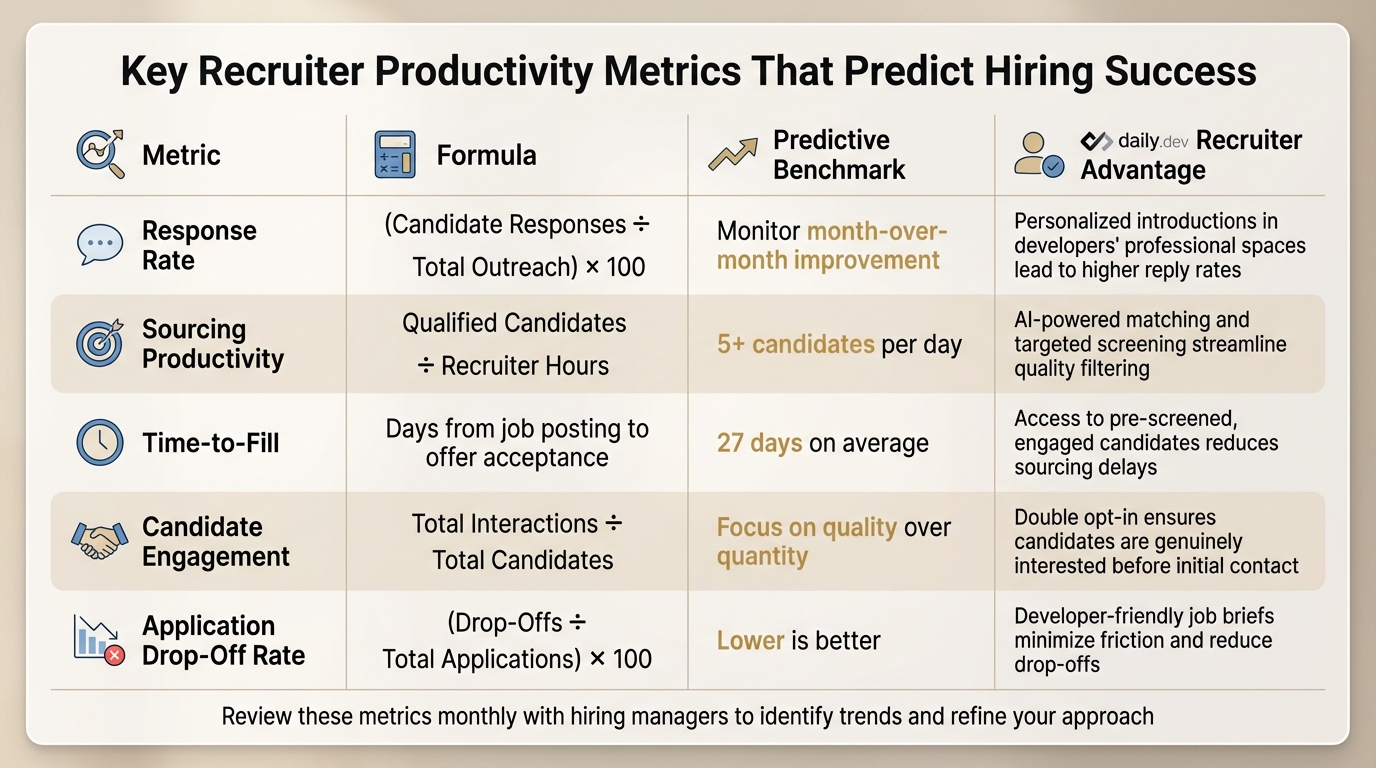 {5 Key Recruiter Productivity Metrics with Formulas and Benchmarks}
Tracking recruitment metrics is a good start, but the real value lies in using that data to refine your hiring process. With the right strategies, you can hire faster without cutting corners on quality. Below are actionable tips tied to the metrics mentioned earlier, designed to improve developer recruitment outcomes.
Sourcing Productivity: Increasing Recruiter Efficiency
Sourcing productivity reflects how many qualified candidates your team identifies per hour of work. To calculate it, divide the total number of qualified candidates sourced by the total recruiter hours spent on sourcing. Monitoring this ratio weekly can reveal patterns and areas for improvement.
For developer recruitment, aim to source at least 5 qualified candidates per day . This target helps ensure a steady flow of vetted talent, which directly reduces time-to-fill.
To enhance sourcing productivity:
- Audit each stage of the hiring process.
- Set clear service-level agreements (SLAs) for screening, interviews, and approvals.
- Eliminate unnecessary steps or bottlenecks.
- Focus on skills-based hiring to prioritize candidates with the right expertise .
Tools like daily.dev Recruiter simplify this process by connecting you with a global network of pre-screened developers. Its double opt-in model ensures you're engaging only with developers who are both active and genuinely interested, saving time on cold outreach and unresponsive leads.
Tracking and Improving Metrics with daily.dev Recruiter
Once you've fine-tuned your sourcing process, use integrated tools to track and measure the results. daily.dev Recruiter provides built-in features to monitor the most critical metrics for developer hiring.
For example:
- Response rates improve because daily.dev connects you with developers in their professional environment, where personalized introductions replace generic cold emails, leading to better engagement.
- Time-to-fill averages at 27 days, with 85% of companies filling roles within four weeks . By leveraging pre-screened candidates, you can reduce delays in the early stages of sourcing.
Here's a quick breakdown of key metrics, their formulas, and how daily.dev Recruiter helps optimize them:
| Metric | Formula | Predictive Benchmark | daily.dev Recruiter Advantage |
|---|---|---|---|
| Response Rate | (Candidate Responses ÷ Total Outreach) × 100 | Monitor month-over-month improvement | Personalized introductions in developers' professional spaces lead to higher reply rates |
| Sourcing Productivity | Qualified Candidates ÷ Recruiter Hours | 5+ candidates per day | AI-powered matching and targeted screening streamline quality filtering |
| Time-to-Fill | Days from job posting to offer acceptance | 27 days on average | Access to pre-screened, engaged candidates reduces sourcing delays |
| Candidate Engagement | Total Interactions ÷ Total Candidates | Focus on quality over quantity | Double opt-in ensures candidates are genuinely interested before initial contact |
| Application Drop-Off Rate | (Drop-Offs ÷ Total Applications) × 100 | Lower is better | Developer-friendly job briefs minimize friction and reduce drop-offs |
Make it a habit to review these metrics monthly with your hiring managers. This regular review helps identify issues early, allowing you to make adjustments before they turn into significant delays . By staying proactive, you can keep your recruitment process efficient and on track.
Conclusion
The metrics that truly count in developer recruitment go beyond surface-level numbers - they provide real insights into how effective your hiring process is. Metrics like response rates reveal how well your outreach resonates with developers, time-to-fill highlights the efficiency of your recruitment pipeline, candidate engagement measures early interest, offer acceptance rates reflect the appeal of your employer brand, and quality of hire ensures you're bringing in talent that delivers long-term value.
These metrics work together to paint a full picture of your recruitment success. For example, high response rates won't mean much if candidates lose interest midway or if your offers are frequently declined. Similarly, a quick hiring process is only beneficial if it results in hires who are a great fit for the long haul.
Tools like daily.dev Recruiter make the hiring process smoother by connecting you with pre-screened developers using a double opt-in approach. This not only reduces time-to-fill but also boosts offer acceptance rates. Developer-friendly job briefs further keep candidates engaged, naturally improving your key metrics.
Make it a habit to review these metrics monthly with your hiring managers. This helps you identify trends early and refine your approach. By focusing on outcomes that matter, rather than just activity, you’ll set your team up for consistent hiring success. The best hiring teams don’t leave things to chance - they measure, adapt, and improve with every hire.
FAQs
Which recruiter metrics best predict developer hires?
When it comes to understanding what drives successful developer hires, a few key metrics stand out: time-to-fill, offer acceptance rate, candidate quality, and source of hire. These metrics not only reflect the efficiency of the hiring process but also provide valuable insights into what strategies are yielding the best results. By keeping a close eye on these indicators, recruiters can refine their methods and focus on what truly works.
What should I do if my response rate is under 30%?
If your response rate is under 30%, it’s time to refine your approach by prioritizing relevance and personalization in your outreach. Start by tailoring your messages to align with the developer’s specific skills, interests, and past projects. Mention technologies or contributions they’ve worked on to show you’ve done your homework.
Be upfront about key details like salary, work model, and role expectations - this transparency can make a big difference. Also, pay attention to indicators of genuine interest, such as activity on GitHub or other platforms. Use these signals to craft intent-driven, personalized communication that builds trust and encourages engagement.
How can I improve quality of hire without slowing time-to-fill?
To improve the quality of hire without slowing down the hiring process, pay attention to metrics like candidate quality and engagement levels. Leverage data to pinpoint where delays or inefficiencies occur and adjust your screening methods accordingly. By fine-tuning these aspects, you can achieve better hiring outcomes while keeping the process efficient.
.png)