Hiring bootcamp graduates is becoming a smart move for tech teams. By 2026, nearly 80% of tech leaders are open to candidates without computer science degrees. Bootcamp grads bring practical skills, professional experience, and a commitment to learning. But hiring them effectively requires a tailored approach.
Here’s what you need to know:
- Bootcamp grads are career changers: Most are 30 years old, hold a bachelor’s degree, and have 6-7 years of work experience.
- Programs vary widely: Top bootcamps focus on coding fundamentals, while others prioritize portfolio-building. Look for CIRR-verified outcomes to assess quality.
- Starting salaries average $70,698, with specialized tracks like data science and cybersecurity reaching $128,000+.
- Diversity is a strength: Bootcamps attract more women and underrepresented groups than traditional CS programs.
- Evaluate differently: Focus on portfolios, growth potential, and hands-on technical assessments over degrees.
- Support is key: Onboarding, mentorship, and clear growth paths help bootcamp grads succeed.
Bootcamp grads can bring fresh perspectives and skills to your team when hired and supported the right way.
The Bootcamp Landscape in 2026
By 2026, the bootcamp industry has reached a new level of maturity, offering a variety of programs tailored to different needs and goals. These programs are designed to fast-track career changers into job-ready developers, with the average cost sitting at $13,584 . However, not all bootcamps are created equal, and understanding their differences is crucial for hiring skilled graduates.
Transparency has become a major factor in evaluating bootcamps. Leading programs now report their results through CIRR (Council on Integrity in Results Reporting), which provides independently audited data on graduation and placement rates . Without CIRR verification, claims like "93% placement" might include jobs outside traditional software engineering roles, making it essential to dig deeper into the numbers.
Let’s take a closer look at the formats and curriculums shaping these programs.
Types of Bootcamps and Their Curriculums
Bootcamps now come in several formats to fit different schedules and learning styles:
- Full-time immersive programs: Lasting 12–16 weeks with 60–80 hours of weekly work, these simulate the intensity of real-world engineering environments .
- Part-time programs: Spanning 6–12 months, these are ideal for students balancing other commitments.
- Self-paced options: Allowing learners to progress at their own speed.
Curriculums have evolved beyond basic web development to include specialized tracks in areas like AI/ML, cybersecurity, cloud computing, and data science. Many programs now integrate tools like GitHub Copilot and ChatGPT to prepare students for modern workflows .
Top-tier bootcamps emphasize foundational computer science concepts - such as data structures, algorithms, and system design - rather than just teaching framework syntax. For instance, Hack Reactor is known for its technical rigor, with students often coding for over 11 hours a day . On the other hand, some programs prioritize portfolio-building over deep theoretical knowledge.
When it comes to cost, bootcamps offer a range of financial models, including upfront payments (ranging from $2,124 to $24,000), deferred tuition, and Income Share Agreements. Nonprofit options also exist for those seeking more affordable alternatives .
How to Evaluate Bootcamp Employment Outcomes
To truly assess a bootcamp’s quality, it’s important to go beyond surface-level placement rates. Look for programs that provide detailed CIRR reports, which include metrics like:
- Median time-to-hire: Typically 3–6 months after graduation.
- Average starting salaries: Around $70,698, with specialized tracks like data science and cybersecurity offering medians between $128,000 and $131,000 .
Instructor quality is another critical factor. Programs with instructors who have at least five years of industry experience and a student-to-instructor ratio of about 10:1 tend to produce better-prepared graduates . One-on-one mentorship also makes a big difference. For example, Springboard offers mentorship from experienced engineers and a tuition-refund guarantee if students don’t land a job, while Hack Reactor collaborates with over 2,000 hiring partners to connect graduates with opportunities .
Partnerships with industry leaders add another layer of credibility. Programs like Ada Developers Academy, which includes structured internships, boast a 94% placement rate, with 66% of interns transitioning to full-time positions .
"The difference between a good bootcamp investment and a $17,000 mistake comes down to three things: which program you choose, whether you can afford the total cost, and how hard you're willing to work after graduation."
- Emily Nakamura, Education Editor, Kinja
Finally, the financial model a bootcamp uses can indicate its confidence in student success. Programs offering deferred tuition or money-back guarantees - where students only pay after securing a job with a salary of at least $70,000 - align their incentives with student outcomes. These verified results can give employers the confidence to hire bootcamp graduates who are ready to hit the ground running.
What Bootcamp Graduates Bring to Your Team
Bootcamp graduates can be a valuable addition to your engineering team. Their intensive training not only equips them with coding expertise but also hones their ability to learn quickly and adapt to new challenges. These qualities, combined with their diverse professional backgrounds, can significantly contribute to your team's success.
Fast Learning and Ability to Adapt
Bootcamps are designed to compress months of technical training into just 12 weeks of intense, hands-on learning. This rigorous approach enables graduates to grasp complex concepts swiftly. In fact, some companies have reported that bootcamp alumni are capable of tackling infrastructure and software development tasks independently within weeks of onboarding .
"Bootcamp students go through 12-weeks of intensive, full days. That was enough to convince us to try hiring."
- Amanda Marburger, Director of Software Engineering, Atria Senior Living
Employers like Checkr emphasize the importance of continuous learning over static skill sets. Bootcamp graduates' ability to quickly acquire and apply new skills positions them well for the technical challenges ahead.
Diverse Backgrounds and Different Perspectives
Bootcamp graduates often come from a wide range of industries, including education, marketing, and beyond. This variety of experiences allows them to bring unique skills - like classroom management or strategic planning - that can enhance the dynamics of tech teams . Their diverse perspectives often lead to more innovative problem-solving and creative collaboration.
How to Assess Bootcamp Graduates
When evaluating bootcamp graduates, it's important to focus on their ability to grow and adapt rather than their formal education. As Pieter DePree, Tech Recruiting Lead at Stack Overflow, advises:
"Hire for trajectory and testability, not what college they've graduated from when you're looking at junior developers; that's the most important thing" - Pieter DePree, Tech Recruiting Lead, Stack Overflow
Portfolio Reviews: What to Watch For
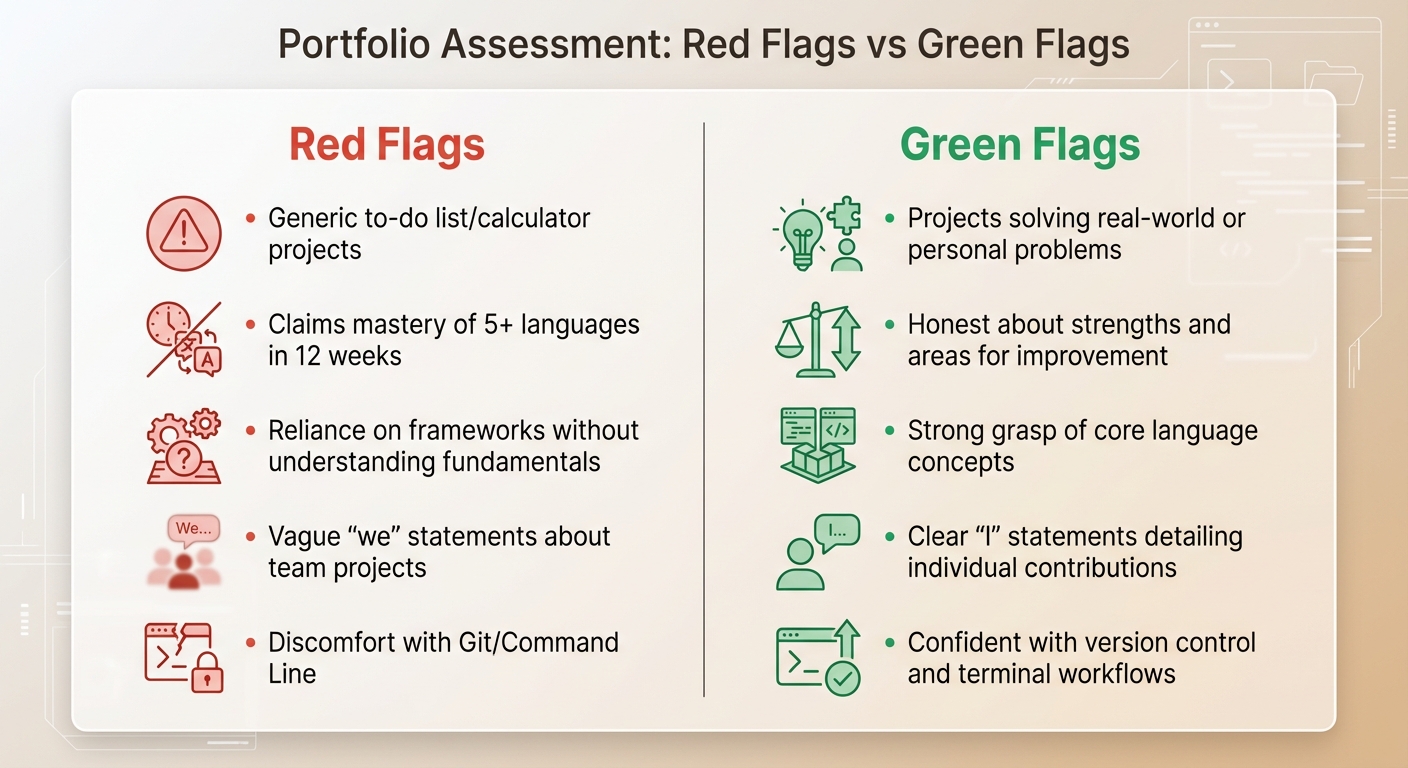
A bootcamp graduate's portfolio offers a window into their problem-solving skills, learning process, and creativity. Green flags include projects that go beyond the bootcamp curriculum, tackle real-world problems, and showcase thoughtful decisions about technology use. Evidence of ongoing learning, such as experimenting with AI tools or improving prompt engineering skills, is another strong indicator of potential .
On the flip side, red flags can signal a lack of readiness. These include portfolios filled with generic projects like calculators or to-do lists, claims of mastering multiple programming languages in a short time, or vague descriptions of their role in team projects. Beware of candidates who can't explain their work without relying on frameworks like React or who struggle with basic tools like Git and the command line .
| Red Flag | Green Flag |
|---|---|
| Generic to-do list/calculator projects | Projects solving real-world or personal problems |
| Claims mastery of 5+ languages in 12 weeks | Honest about strengths and areas for improvement |
| Reliance on frameworks without understanding fundamentals | Strong grasp of core language concepts |
| Vague "we" statements about team projects | Clear "I" statements detailing individual contributions |
| Discomfort with Git/Command Line | Confident with version control and terminal workflows |
These insights from portfolios can guide your technical evaluations and help identify candidates with the right skills and mindset.
Technical Assessments for Bootcamp Grads
When designing technical assessments, align them with the environments bootcamp graduates are familiar with. Instead of abstract algorithm tests, use code-pairing sessions to observe how candidates think, ask questions, and respond to feedback. Focus on tasks that involve the programming languages they learned during bootcamp to create a comfortable setting where they can demonstrate their abilities .
Another effective method is mob interviews. In this setup, a panel provides candidates with a coding challenge to complete and demo within a week. This approach mirrors real-world team collaboration and allows you to evaluate their problem-solving process. Challenges that don't rely on frameworks test their understanding of core programming principles rather than library-specific knowledge .
Beyond technical skills, pay attention to their personal projects and career stories. These can reveal their enthusiasm for learning and their ability to take initiative.
Evaluating Learning Ability and Growth Mindset
For bootcamp hires, the ability to learn quickly is often more important than their current technical expertise. As Vannaro Lim, Engineering Lead at Checkr, puts it:
"Hire for potential, not just current knowledge." - Vannaro Lim, Engineering Lead, Checkr
Understanding why candidates transitioned into software development can provide insight into their motivations. Those driven by curiosity and passion tend to adapt more effectively than those primarily motivated by financial goals. Jane Jaxon, VP of People at Wistia, emphasizes this point:
"Look for the really curious, smart and passionate people... Pick the curious person who is genuinely passionate about what they do and wants to learn. If they genuinely geek out about the craft of coding, it's a great start!" - Jane Jaxon, VP of People, Wistia
Side projects built outside the bootcamp curriculum are another strong indicator of initiative and problem-solving skills. Candidates who view their first role as an opportunity to continue learning often excel in the long run .
Setting Bootcamp Graduates Up for Success
Bootcamp graduates bring a unique blend of rapid learning ability and practical skills to the table. But hiring them is just the first step. To help them thrive and grow into productive mid-level developers, companies need a well-thought-out approach to onboarding, mentorship, and continuous learning.
Structured Onboarding and Mentorship
A solid onboarding process begins with assigning manageable tasks. Start by identifying tasks that junior developers can tackle successfully - like fixing small bugs, tweaking CSS, or making text changes. These tasks help them familiarize themselves with the codebase without feeling overwhelmed. For example, when Chris Atoki joined Neat as a front-end developer after graduating from Lambda School, his team paired him with a senior developer. He started with smaller tasks, which helped him master pull requests and review workflows while filling gaps in his React and front-end knowledge .
Pairing bootcamp graduates with internal mentors is another critical step. Ideally, match them with senior developers who are interested in transitioning to management roles. Jane Jaxon, VP of People at Wistia, highlights the mutual benefits of this practice:
"Pair bootcamp grads with a great mentor who is interested in becoming a manager. It's a great way to get two people exactly what they need in order to grow their careers" .
Weekly one-on-one meetings between mentors and mentees provide a dedicated space for questions and feedback .
Hiring bootcamp graduates in cohorts rather than individually can also ease the transition. A peer group offers support and reduces the intimidation of entering a new technical environment. To guide junior developers, use task management tools to label "good first issues" so they can easily find tasks that match their skill level .
Once onboarding is underway, the focus naturally shifts to creating clear pathways for career growth.
Career Growth Paths for Junior Developers
After onboarding, it's essential to provide clear career paths to help bootcamp graduates see their future within the company. Create post-onboarding training programs that allow them to specialize in their role or tech stack. Since many bootcamps focus on a single stack like full-stack JavaScript, offer a roadmap for mastering additional technologies or internal practices .
Set milestones to mark their progression from junior to mid-level roles. For example, include a final skills assessment at the end of onboarding to evaluate their readiness for more complex responsibilities. This provides both a tangible goal for the graduate and a way to measure their development .
Encourage them to work on personal side projects to build experience in designing software from scratch and gathering requirements. Celebrate their progress by giving them opportunities to push new code - not just bug fixes - so they can see the real-world impact of their work on customers .
Creating a Learning-Focused Environment
To support ongoing growth, companies should foster a learning-oriented workplace. As Jane Jaxon puts it:
"If you view the early employment of coding school graduates as an extension of learning, you'll be much better positioned" .
Dedicate at least 10% of their working hours to continued education and professional development .
A phased onboarding approach can help prevent information overload. For example, use the first week for administrative setup, workspace orientation, and initial skills assessments to identify training needs. This "Week Zero" strategy lays a strong foundation before diving into more complex tasks .
Finally, create an inclusive environment that values the diverse experiences bootcamp graduates bring. Tools and practices that minimize unconscious bias help ensure all hires feel empowered to contribute. It's worth noting that 80% of bootcamp students already hold a bachelor's degree or higher, and the average bootcamp graduate is around 30 years old . These individuals bring maturity and life experience, which deserve acknowledgment and respect in their learning journey.
Using Bootcamps to Build a Diverse Talent Pipeline
The Demographics of Bootcamp Cohorts
Bootcamps have become an effective way to attract a broader range of talent compared to traditional computer science programs. For instance, in 2020, women accounted for 41% of bootcamp graduates, a significant jump from the 14–21% seen in traditional CS degree programs . Bootcamps also show greater representation among other groups, with 17% Asian, 8% Hispanic/Latino, and 6% Black/African American graduates .
One key factor behind this diversity is the financial accessibility of bootcamps. With an average tuition of $11,400 - far less than the $33,480 yearly cost of private colleges - bootcamps provide an affordable path for career changers and those from low-income backgrounds . The payoff is substantial: low-income students (earning $30,000 or less before enrolling) report an average salary increase of $35,914 after completing a program . Kristi Riordan, COO of Flatiron School, highlights the impact of this diversity:
"Racial and gender diversity are things that ultimately create cognitive diversity, which is something that creates a better learning environment in a bootcamp and ultimately a better work environment" .
Some bootcamps go even further by tailoring their programs to support underrepresented groups. For example:
- Ada Developers Academy focuses on women and gender-expansive individuals.
- Pivot Technology School, The Black Codher, and G{Code} offer pathways for minorities, Black women, and women and non-binary people of color .
- Next Chapter provides full scholarships to formerly incarcerated individuals for programs like Hack Reactor and Flatiron School, along with a year of wraparound support .
These initiatives not only enhance diversity within bootcamp cohorts but also provide companies with an opportunity to expand their talent pipelines by tapping into these nontraditional sources. This approach is a key component of building a tech talent pipeline from the ground up.
Expanding Your Talent Pool Beyond Traditional Pathways
Heather Terenzio, CEO and Co-founder of Techtonic Group, puts it plainly:
"We're always talking about technology disrupting this and that, but nobody thinks about disrupting the pipeline process; what ends up happening, then, is companies end up fighting over the same couple people instead of actually expanding the pool of diverse candidates" .
Bootcamp graduates offer a chance to rethink hiring strategies. Many bring prior experience from industries like healthcare, education, finance, or retail, equipping them with transferable soft skills such as communication, project management, and customer service. These skills, paired with technical training, add fresh perspectives and problem-solving approaches to teams.
To connect with diversity-focused bootcamps, consider partnering with programs that offer scholarships, like Tech Elevator's "Represent Tech" (up to 85% off tuition) or Code Fellows' full-ride scholarships for Black Americans . You can also use resources like the Council on Integrity in Results Reporting (CIRR) to evaluate employment outcomes and salary improvements across different groups . Finally, eliminating degree requirements from job postings can open doors to the diverse talent pool cultivated by bootcamps, ensuring your hiring process aligns with the inclusive ethos of these programs.
Building Partnerships with High-Performing Bootcamps
How to Identify Quality Bootcamps
When looking for bootcamps to partner with, focus on those that consistently produce job-ready developers. A good starting point is to review CIRR-audited outcomes, which provide verified placement and salary data. This is far more reliable than marketing claims alone .
Top-performing bootcamps often report placement rates ranging from 80% to 93%, with graduates earning an average starting salary of $70,698 . For instance, Evolve Security Academy reports a verified placement rate of 93%. Similarly, App Academy and Hack Reactor boast placement rates exceeding 85%, though their selective admissions processes have acceptance rates of around 5% . These figures can give you a clear picture of whether a bootcamp's training effectively leads to employment.
Another key factor is how aligned the bootcamp's incentives are with graduate success. Programs offering deferred tuition or Income Share Agreements (ISAs) only receive payment once graduates secure jobs, ensuring their goals align with student outcomes . It’s also worth checking how frequently the bootcamp updates its curriculum. The best programs refresh their tech stacks quarterly, incorporating tools like React, Python, and SQL to match current employer demands .
When evaluating potential partners, request detailed data. Specifically, ask about placement rates within 180 days of graduation and how they define a "qualifying role." Some bootcamps may include any tech-adjacent position, while others only count software engineering roles. This distinction is crucial if you're aiming to build a strong pipeline of developers .
Once you've identified quality bootcamps, the next step is establishing partnerships that work for both sides. Using a developer hiring checklist can help ensure no steps are missed during this transition.
Creating Partnerships That Benefit Both Sides
After verifying quality metrics, the focus shifts to building collaborative relationships. Effective partnerships go beyond simply posting job openings. For example, Hack Reactor connects companies with graduates through a network of over 2,000 hiring partners, including major players like Google and Amazon. They also host dedicated hiring events, providing direct access to talent .
You can take these partnerships further by offering curriculum input. Many bootcamps welcome feedback from employers to ensure their graduates are trained in the specific tech stacks you use . Another option is to create structured internship programs with clear mentorship and evaluation checkpoints. This approach is effective - around 66% of interns transition into full-time roles, making internships a proven hiring pathway .
Engaging directly with bootcamp students can also strengthen your employer brand. Consider sponsoring student projects, hosting guest lectures with your engineering team, or co-hosting demo days. These efforts give students early exposure to your company culture and values. As Matt Mayo, Owner and CEO of Diamond IT, puts it:
"The bootcamp didn't make him an expert, but it gave him structure, accountability, and a jump-start into thinking like a developer" .
Finally, track the performance of your partnerships. Metrics like intern-to-full-time conversion rates, time-to-hire, and retention can help you refine your strategy. Surprisingly, only 43% of employers currently track intern-to-full-time conversion rates, which represents a missed opportunity . Additionally, monitor how quickly bootcamp hires reach productivity milestones compared to other junior developers to optimize your developer hiring pipeline.
How daily.dev Recruiter Helps You Find Bootcamp Talent
Using daily.dev Recruiter for Talent Discovery
daily.dev Recruiter is designed to connect you with bootcamp graduates who are active on the platform, creating a natural and seamless way to meet potential candidates. These developers are already immersed in technical content, sharpening their skills, and engaging with a community of like-minded professionals.
The platform uses a double opt-in method, meaning both you and the developer must agree to connect. This ensures that bootcamp graduates review your role details and express interest before any interaction takes place. From the start, you’re engaging with candidates who are genuinely interested, paving the way for more meaningful conversations.
This approach works particularly well with bootcamp talent. These developers are often highly driven, eager to learn, and actively involved in professional communities. Instead of sifting through outdated LinkedIn profiles or static resume databases, you’re engaging with developers in real time - people actively seeking opportunities to grow. By referencing their specific technical interests or projects on the platform, you can establish rapport quickly and demonstrate that you’ve done your research.
Connecting with engaged developers through daily.dev Recruiter doesn’t just simplify talent discovery - it also helps you build trust with potential hires from the very first interaction.
Building Your Employer Brand with Bootcamp Alumni
Bootcamp graduates are keenly aware of how companies treat developers during the hiring process. With daily.dev Recruiter, you can position your company as developer-friendly by steering clear of overly aggressive recruiting tactics. The platform’s community-focused approach allows developers to see you as a trusted part of their professional network.
To make the most of this opportunity, keep your role descriptions clear and concise - aim for under 150 words. Highlight your tech stack and the specific challenges your team is tackling. This transparency helps bootcamp grads make informed decisions during the opt-in process, fostering trust even before your first conversation. When developers feel respected during recruitment, they’re more likely to view your company positively, even if they don’t accept the role.
Additionally, the platform gives you access to passive talent - those who may not be actively job hunting but are focused on learning and growing within the developer community. For bootcamp graduates, this is especially important. Many are building skills and establishing their reputation while staying open to the right opportunity. By connecting through a trusted network instead of cold outreach, you start the relationship from a place of credibility and mutual respect.
Conclusion
Hiring bootcamp graduates means adjusting your evaluation methods - not lowering your standards. Top bootcamps produce developers with impressive results: an average starting salary of $69,079, which can grow to $95,000 by their third job, often backed by 6–7 years of prior professional experience .
To identify quality candidates, rely on verified CIRR data and state licensing as key benchmarks . Shift your focus to portfolio quality, a candidate's learning journey, and their growth mindset rather than traditional credentials. As Pieter DePree puts it, prioritize “trajectory and testability” when hiring .
Once you've found the right candidates, structured support is essential for their success. Mentorship, clear development plans, and thoughtful onboarding can turn bootcamp hires into dedicated, high-performing contributors. Providing manageable tasks early on helps them build confidence and get comfortable with your codebase. This combination of thorough evaluation and strong mentorship ensures a smooth transition and fosters long-term growth for your team .
For a streamlined recruiting process, platforms like daily.dev Recruiter can help. It connects you with bootcamp graduates who are already active in the developer community - reading technical content, improving their skills, and pursuing professional growth. With a double opt-in system, you’ll only interact with candidates who have reviewed your role and shown genuine interest, cutting through the noise of cold outreach and building trust from the start.
Looking to strengthen your team with motivated developers? Start building your bootcamp recruiting pipeline on daily.dev Recruiter today.
FAQs
How do I tell if a bootcamp is legit?
When assessing if a bootcamp is worth your time and money, start by looking at its job placement rates and alumni success stories. Programs that are upfront about how many graduates land jobs in their field are usually more trustworthy.
You’ll also want to see if the curriculum aligns with industry needs. Bootcamps with strong partnerships and positive alumni feedback often have a better track record of preparing students for the workforce.
Don’t forget to check for transparency around costs. A clear breakdown of fees, along with experienced instructors and solid career support, are all signs of a program that’s serious about your success.
What’s the best technical test for bootcamp grads?
When evaluating bootcamp graduates, the most effective technical tests focus on practical, hands-on coding tasks. These assessments should mirror the kind of work they'll encounter in a professional role. Here are some great options:
- Algorithm challenges: These test problem-solving skills and coding logic.
- Debugging exercises: A great way to see how candidates identify and fix issues in existing code.
- Small project builds: Assigning a mini-project related to real job responsibilities can showcase their ability to build functional, clean, and maintainable code.
Another useful approach is pair programming or live coding sessions. These formats give insight into how candidates think through problems, communicate their ideas, and perform under pressure.
The key is to focus on practical assessments rather than theoretical questions. This approach provides a clearer picture of their readiness for real-world development work.
How long until a bootcamp hire is productive?
Bootcamp hires usually hit their stride and become fully productive within 6 to 8 months, though this can vary based on the role and the quality of the onboarding process. The first 90 days are especially important, as this period is all about learning the ropes, building relationships, and integrating into the team. During this time, mentorship, a well-structured onboarding plan, and clearly defined growth opportunities are essential to set them up for success.
While new hires might start contributing earlier, reaching full independence and making a significant impact often requires more time - particularly in roles that involve complex technical responsibilities.
.png)