Recruiting in 2026 is a paradox: while layoffs have flooded the market with skilled tech workers, hiring budgets are tighter than ever. This creates unique challenges for recruiters, who must justify every hire's value while navigating limited resources. Here's how companies can hire smarter, not harder:
- Focus on high-impact roles: Prioritize AI and machine learning positions or critical roles that directly affect revenue or efficiency.
- Adopt skills-based hiring: Evaluate candidates by their contributions (e.g., GitHub projects) rather than resumes or big-name employers.
- Leverage cost-effective sourcing: Use employee referrals, professional communities, and platforms like daily.dev Recruiter to find top talent without overspending.
- Build a strong business case: Tie each hire to measurable business outcomes like revenue growth, risk reduction, or cost savings.
- Streamline processes: Simplify applications, automate repetitive tasks, and maintain a talent pipeline for faster hiring when budgets allow.
Key takeaway: Tight budgets demand precision. Recruiters who align hiring with business goals, optimize sourcing channels, and maintain strong candidate relationships will emerge stronger when the market rebounds.
The Paradox: More Available Talent, Fewer Open Positions
Here's a curious situation: there’s a growing pool of skilled developers, yet companies are slowing down on hiring. But this isn’t your typical recession where hiring freezes across the board. Instead, it’s a shift in focus. Businesses are scaling back on traditional software roles and channeling resources into AI infrastructure and machine learning platform development . Let’s dig into why these layoffs create a rich talent pool and how companies can still hire standout developers even with tighter headcounts.
Why Layoffs Create a Pool of Experienced Developers
In early 2026, over 55,000 tech workers lost their jobs, with 20% of those layoffs tied to advancements in AI and automation .
However, being laid off doesn’t necessarily reflect an engineer’s skill or contributions. As riem.ai points out:
"A layoff from a major tech company tells you almost nothing... The resume doesn't distinguish between [excellent infrastructure builders and those coasting on brand equity]" .
The best way to identify top-tier talent? Focus on contribution-based hiring. This means evaluating what developers have actually done - like the quality of their pull requests, the code they’ve shipped, and their behavior in code reviews - rather than relying solely on years of experience or big-name employers. It’s a proven approach: 94% of employers say skills-based hiring is a better predictor of job performance, and it helps fill roles about 25% faster . By prioritizing skills, companies can avoid costly hiring mistakes and get new hires up to speed more quickly.
How to Hire Top Talent Despite Limited Headcount
Even with a surplus of talent, hiring the right people within tight constraints requires a focused strategy.
Interestingly, the most sought-after engineers often aren’t the ones actively looking for jobs. As riem.ai notes:
"The engineers hardest to find right now are the ones who haven't been laid off... They're building things. Their GitHub is full of real work. They're exactly who you want" .
To connect with these high-performing developers, companies need to be proactive. Instead of waiting for applications, they should explore coding-focused candidate sourcing tools and public contributions on platforms like GitHub. Reviewing a candidate’s work history - specific commits, projects, or repositories - before reaching out can make outreach more personal and effective, increasing the chances of engaging top talent.
When resources are tight, it’s also helpful to divide hiring priorities into three categories: “protect the core,” “unlock growth,” and “experiment.” Focus on the first two categories to ensure that key business functions are maintained and growth opportunities are captured . This targeted approach helps companies make impactful hires while staying mindful of budget constraints.
Building the Business Case for Critical Hires
When budgets are tight, every new hire must prove their worth. Leadership wants hires that contribute directly to the bottom line. As Ahmed Mousa explains:
"Hiring isn't about filling a gap - it's about building the future architecture of the organization" .
To make the case for a new hire, shift the focus from cost to value. Frame each role as a strategic investment that can drive revenue, reduce risks, or cut expenses. For example, leaving a security role unfilled could result in $20 million in potential losses , while hiring a senior DevOps engineer might cost $18,000 to $22,000. This approach helps align technical hires with measurable business outcomes.
Connecting Hires to Business Objectives
Once you treat hiring as an investment, the next step is to tie each hire to specific business goals. The most compelling business cases link technical roles directly to measurable results. Focus on positions that deliver immediate outcomes over those aimed at long-term development. In uncertain markets, companies need developers who can contribute right away .
To prioritize effectively, categorize roles based on their potential impact. Ask questions like: Will this engineer ensure the stability of critical systems? Will they create features that attract new customers? Directing resources toward roles with clear, immediate benefits ensures your hiring strategy aligns with business priorities.
Preparation is key. Define what you need before launching the search. Detailed job descriptions save time and money while ensuring everyone - from hiring managers to candidates - has clear expectations. Collaborating with managers to outline deliverables and timelines ensures that roles are aligned with measurable outcomes .
Clear objectives naturally lead to solid ROI analyses, which strengthen your case when seeking approval.
Calculating and Presenting ROI for Key Positions
When it comes to securing budget approval, numbers carry weight. Calculate ROI by subtracting recruitment costs from the hire's value, dividing by recruitment costs, and multiplying by 100 (or use a hiring budget calculator) .
Factor in productivity gains, direct revenue contributions, process efficiencies, and cost avoidance . Also, consider the cost of leaving a position vacant. Unfilled roles often lead to lost productivity and increased strain on existing teams, which can escalate quickly .
When presenting to leadership, compare the cost of hiring to the cost of not hiring. On average, U.S. companies spend about $4,000 and 24 days to hire a new employee . But the cost of overburdening current staff while leaving a role unfilled can be far greater. Replacing an overworked employee could cost 1.5x to 2x their annual salary due to lost institutional knowledge and declining morale . Including these factors in your ROI calculations emphasizes the strategic importance of each hire.
Use metrics that resonate with finance teams, such as payback periods, cost-benefit analyses, and risk assessments. For example, when deciding between a full-time engineer and a contractor, break down the trade-offs with specific costs and timelines . Presenting clear data in financial terms strengthens your case and highlights the value of each critical hire.
Finding Quality Candidates on a Limited Budget
When budgets are tight and every dollar spent needs to show results, sourcing candidates for technical roles on a tight budget becomes a top priority. The key? Focus on channels that deliver strong candidates efficiently. Start by clearly outlining your hiring needs upfront - this can save you from wasting time on candidates who aren't the right fit.
Using Employee Referrals to Lower Hiring Costs
Employee referrals are a cost-effective way to find great talent while supporting an efficient hiring process. Your current employees, already familiar with your company's environment and technical needs, can act as excellent talent scouts. Referrals often bring in qualified candidates at a much lower cost compared to other methods. Plus, they help you avoid the hefty price of a bad hire, which can range from 1.5 to 2 times the employee’s annual salary.
Beyond formal referral programs, try conducting "stay interviews" with your top performers. These conversations can reveal what motivates them to stay and what might push them to leave, giving you valuable insights to retain your best talent.
"The departure of a single employee can cost up to 1.5x - 2x their annual salary when factoring in direct and indirect costs." - Luqman Bin Othman Hakeem, KUN Sports
Connecting with Developers Through Professional Communities
Professional communities are another low-cost option for sourcing candidates and can work alongside your referral efforts. These communities are a goldmine for finding passive candidates - developers who aren’t actively job hunting but are open to the right opportunity. Platforms like daily.dev Recruiter streamline the process with warm, double opt-in introductions, ensuring both the developer and employer express interest before connecting. This targeted approach reduces wasted outreach, increases engagement, and delivers more relevant candidates faster. Plus, integrating such platforms with Applicant Tracking Systems (ATS) can automate data transfer, cutting administrative work by 20–30% per hire.
Engaging with developers in their own communities also gives you a chance to evaluate their cultural fit early on.
"Skills are important but acquirable commodities, however cultural alignment is the invisible force multiplier turning hires into advocates and innovators." - Masuma Z., ALEC Holdings
Shortening the Hiring Timeline
Leaving a position unfilled for too long drains productivity and puts extra pressure on your team. Research shows that a complex or overly manual application process can cause employers to lose 15–20% of their candidate pool. Simplify the process by making it mobile-friendly and easy to navigate. Automate tasks like scheduling and document collection - these typically account for 70% of interactions between recruiters and applicants. Use auto-messaging for routine communications to bring down your time-to-hire to as little as 0 to 6 days.
Another way to speed things up? Build your talent pipeline before a position even opens. Stay connected with past applicants, company alumni, and passive candidates to create a pool of ready-to-go talent.
"HR leaders need to become more strategic and data-driven than ever... Build and nurture pipelines in advance of roles being posted." - Liv Anderman, Findem
Streamlining your hiring process not only saves time but also strengthens your ability to attract top talent in the future.
Lowering Cost-Per-Hire Without Hurting Candidate Experience
Cutting recruitment costs doesn’t mean sacrificing how candidates are treated. On average, hiring a new employee costs around $4,000 . With 37% of HR professionals citing budget constraints as a key challenge for 2024 - up from 21% the previous year - it’s clear that balancing cost savings with a positive candidate experience is more important than ever.
To achieve this balance, focus on investing in channels that deliver high-quality candidates and look for ways to automate repetitive tasks. Liv Anderman, Vice President of Marketing and Research at Findem, puts it this way:
"Budget constraints aren't just about spending less: They're about demanding more accountability and measurable impact" .
Comparing Costs Across Sourcing Channels
Recruitment channels vary widely in cost, so knowing where to allocate your budget can make a big difference. Internal mobility - filling roles by promoting or transferring current employees - is often faster and less expensive than external hiring . Employee referrals also tend to yield excellent results at a lower cost, while maintaining a database of past applicants and company alumni can help fill positions without starting from scratch.
Global talent pools present another way to save. Hiring international staff can reduce overhead expenses like office space and tap into regions where salary expectations are lower. Audrey Gorman, Director of Business Development and Marketing at International Staff Augmentation, explains:
"One thing that we help is reducing overhead. You're able to find highly skilled talent [where] you don't have to necessarily pay for their office space... or they're coming from areas with lower salaries" .
Once you’ve optimized your sourcing strategies, the next step is refining your interview process to further reduce costs while maintaining a strong candidate experience.
Making Interviews More Efficient
Streamlining interviews is key to lowering cost-per-hire without compromising how candidates feel about the process. Overly complex interview procedures can reduce candidate engagement by 15%–20% and increase drop-offs in your hiring pipeline .
Automation is a powerful tool here. Up to 70% of applicant interactions - like collecting data, uploading files, and scheduling - can be automated, freeing recruiters to focus on meaningful, personal interactions . Structured interviews with clear criteria not only improve efficiency but also enhance candidates' perception of fairness. Plus, integrating a smooth onboarding process into recruitment can boost employee retention by up to 82% , showing that a little extra effort in candidate experience pays off in the long run.
Stephanie Manzelli, CHRO at Employ Inc., emphasizes the importance of adapting hiring practices:
"Businesses need to reassess and refine hiring processes to ensure they are meeting the needs of today's dynamic candidate market" .
Efficiency doesn’t mean rushing through the process - it’s about cutting unnecessary steps while maintaining the human connection that makes candidates excited to join your team. This thoughtful approach not only saves money but also strengthens your employer brand during tough economic times.
Generalists vs. Specialists: Who to Hire When Headcount Is Limited
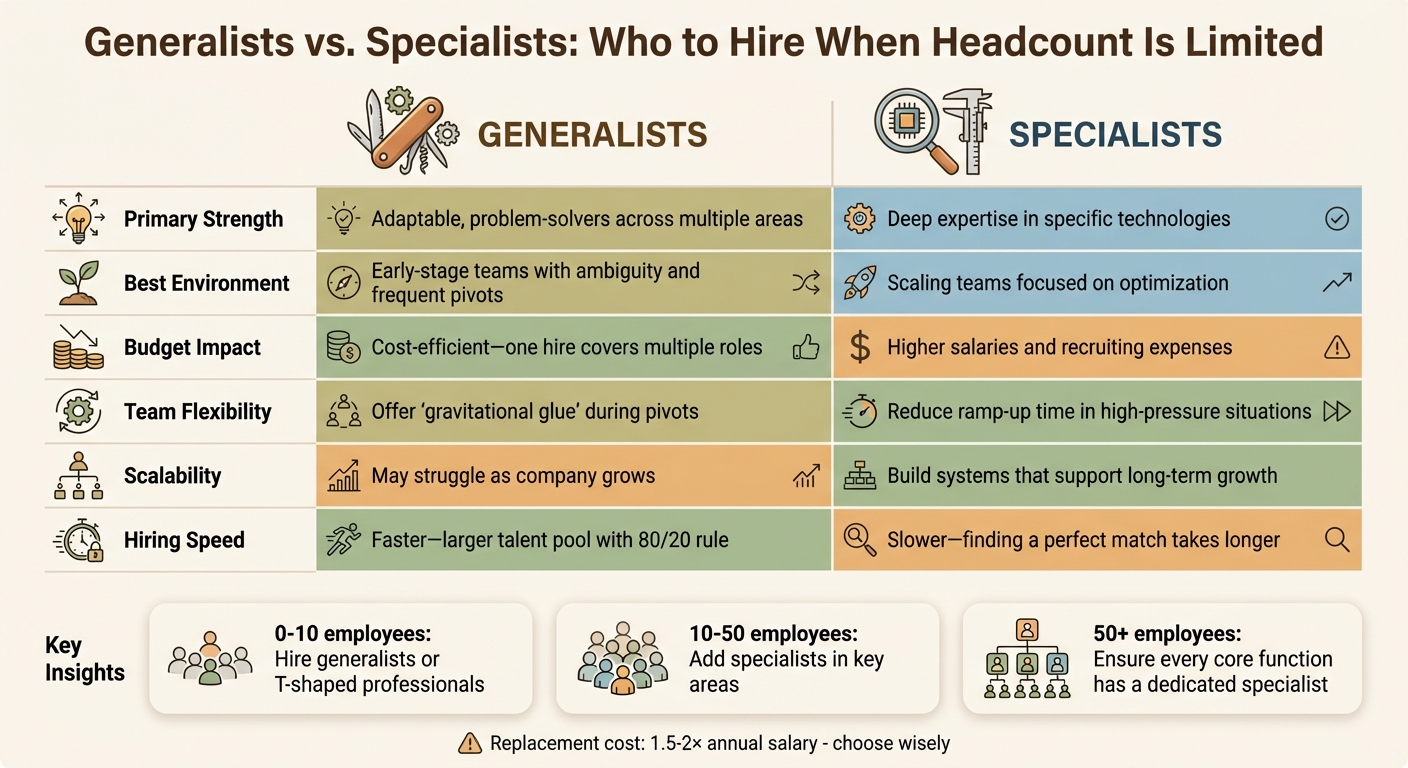
When you're working with a limited headcount, deciding between hiring a generalist or a specialist is a big deal. The wrong choice can either leave your team overburdened or saddle you with costly expertise that doesn't align with your current needs.
Assessing Current Team Needs and Future Plans
Before you even think about posting a job or evaluating developer sourcing tools, take a step back and figure out what your team really needs right now - and where you're headed in the future. Specialists are your go-to for immediate, high-level results in a specific area. In contrast, generalists bring flexibility and adaptability, which can grow along with your company’s needs .
Tyler Fisher from Hawx Smart Pest Control recommends applying the 80/20 rule when evaluating candidates:
"If they meet 100% of the requirements there's no growth for them, and most ambitious professionals want to grow. 80% is a good threshold" .
This approach not only widens your candidate pool through top developer networks but also encourages employee loyalty by offering growth opportunities.
The size and stage of your company also play a major role. For teams with 0–10 employees, generalists or T-shaped professionals (broad skills with one area of deep expertise) are often the best fit. Once you reach 10–50 employees, you’ll likely need specialists in a few key areas to support growth. Beyond 50 employees, it’s time to ensure every core function has a dedicated specialist .
Dao LE from Pepperl+Fuchs Group stresses the importance of finding balance:
"Hiring for mindset and potential is great but sometimes businesses also need people who can deliver results right away. The best approach is to balance both: hire for attitude, train for skills and measure by impact" .
This balanced approach helps you meet immediate needs while setting the stage for long-term success.
Generalists vs. Specialists: A Direct Comparison
Here’s a side-by-side look at how generalists and specialists stack up in terms of cost, flexibility, and scalability:
| Feature | Generalists | Specialists |
|---|---|---|
| Primary Strength | Adaptable, problem-solvers across multiple areas | Deep expertise in specific technologies |
| Best Environment | Early-stage teams with ambiguity and frequent pivots | Scaling teams focused on optimization |
| Budget Impact | Cost-efficient - one hire covers multiple roles | Higher salaries and recruiting expenses |
| Team Flexibility | Offer "gravitational glue" during pivots | Reduce ramp-up time in high-pressure situations |
| Scalability | May struggle as company grows | Build systems that support long-term growth |
| Hiring Speed | Faster - larger talent pool with 80/20 rule | Slower - finding a perfect match takes longer |
As the table shows, both generalists and specialists come with their own set of strengths and challenges. Generalists are cost-effective, versatile, and great for identifying inefficiencies, but they might lack the deep expertise required for solving highly technical issues as your company scales. Specialists, on the other hand, elevate technical standards and create scalable systems, though they come with higher costs and may struggle in less-structured, early-stage environments .
One option to consider is hiring "T-shaped" professionals. These individuals offer a mix of broad skills with deep expertise in one area, giving you flexibility without sacrificing technical depth. This makes them especially valuable for startups or when hiring your first few team members . And remember, replacing an employee can cost 1.5–2× their annual salary , so making the right choice early on can save you a lot of money - and headaches - down the road.
Protecting Your Employer Brand During Layoffs and Hiring Freezes
Economic downturns put your company's reputation to the test. How you handle employees during tough times can shape whether developers want to work with you in the future. A strong employer brand can cut hiring costs by up to 50% , but that advantage can vanish if layoffs are poorly managed or communication dries up during hiring freezes.
Communicating Clearly and Respectfully
In challenging times, transparency matters more than ever. Whether you're navigating layoffs or pausing hiring, owning the narrative with honest and clear communication is essential. As Monika Mester from Assoc. CIPD explains:
"Being open, respectful, and timely with candidates reflects who you are as an employer" .
One mistake to avoid? Ghosting candidates. Ignoring applications or leaving interviews unresolved is damaging, especially in a competitive job market where recruiters may face a surge in applications. Even a short, respectful rejection goes further than silence. Internally, use focused feedback and developer-first hiring platforms to address employee concerns and retain your top talent - losing them can set back your recovery efforts.
This commitment to transparency, both inside and outside the company, builds a foundation for a resilient employer brand.
How Reputation During Downturns Affects Future Hiring
As independent recruiter Ryan Nead points out:
"People judge a company not just by how it celebrates success, but by how it handles adversity and what it does next" .
Your current employees act as ambassadors for your brand. Their reviews on platforms like Glassdoor and LinkedIn shape how future candidates view your company. Mishandling layoffs or fostering a negative work environment can make it harder to attract talent when hiring resumes.
Respectful offboarding also opens the door for "boomerang hires" - former employees who return. These hires save time and money, as they already know your culture and systems. When you're ready to rehire, focus on personalized outreach rather than generic mass emails. Bring enthusiastic team members into the interview process to show that your company is moving forward. However, if morale remains low, no amount of external messaging will convince candidates that your workplace has improved.
Building Your Talent Pipeline for Future Hiring Needs
Creating a strong talent pipeline now can make all the difference when hiring picks up again. Even if you're in the middle of a hiring freeze, maintaining relationships with skilled developers ensures you're not starting from scratch when the market turns around. Recruitment often moves in cycles, and having candidates already familiar with your company can save valuable time later.
Staying Connected with Passive Candidates
Start by identifying evergreen roles - those key positions that are always critical to your business, like backend engineers, DevOps specialists, or frontend developers skilled in specific frameworks. Group potential candidates into pools based on these skill sets, making it easier to reach out when hiring resumes .
Jamie Cross, VP of East Coast at Talentful, emphasizes the importance of a proactive approach:
"Create candidate pools and develop nurture campaigns so that when you're ready to hire again, you have a warm pool of candidates ready to interview who are already interested in your company" .
Take time to audit your ATS (applicant tracking system) and refresh your candidate database. Developers who applied in the past might still be open to opportunities, especially if you’ve stayed in touch. A simple quarterly email sharing company updates or industry insights can keep your brand on their radar without feeling intrusive.
It’s also smart to stay in sync with business leaders to predict future hiring needs and ensure your pipeline is ready when the time comes. Platforms like Layoff.fyi can be a goldmine for finding talented developers who have been recently let go through no fault of their own . These individuals often bring a wealth of experience and are eager for new opportunities.
Pair these strategies with active participation in developer communities to strengthen your talent pipeline even further.
Using Developer Networks to Build Long-Term Pipelines
Once you’ve organized your candidate pools, developer networks can help you maintain these connections over time. Engaging with developer communities allows you to keep candidates interested without the hefty costs of traditional sourcing methods. For example, daily.dev Recruiter connects you with over 1 million developers who use the platform to stay updated on tech news and trends. Instead of relying on cold outreach, you’re meeting developers in a space they already trust and frequent.
The platform’s double opt-in system ensures you’re only engaging with developers genuinely interested in your opportunities, cutting down on wasted effort. This approach shifts recruiting from being reactive to proactive, building genuine relationships that will benefit your efforts when hiring picks up. Plus, its predictable pricing model makes it easier to justify these activities to finance teams, even during tighter budget periods.
How daily.dev Recruiter Reduces Sourcing Costs
When budgets are tight, every dollar spent on recruiting needs to count. daily.dev Recruiter is designed to cut sourcing costs while still connecting you with top-tier developer talent. Say goodbye to unpredictable agency fees and unnecessary tools.
With its double opt-in system, the platform ensures you're only engaging with developers who are genuinely interested in your opportunities. This means fewer ignored cold emails and less time wasted on screening disengaged candidates.
ATS integration takes care of repetitive tasks like data transfers, status updates, and workflow management. By automating these processes, your team can focus on building relationships with candidates. This efficiency not only speeds up hiring but also trims overall recruitment expenses.
What’s more, daily.dev Recruiter features predictable pricing, allowing you to better plan and manage your recruitment budget. For finance teams scrutinizing costs during economic downturns, a consistent cost structure makes it easier to justify ongoing investment in hiring. The platform eliminates the need for multiple tools, job boards, and agency contracts, consolidating everything into one cost-effective solution.
Here’s a closer look at the features that make these savings possible.
Double Opt-In Introductions That Ensure Engagement
Recruiting often wastes time chasing candidates who aren’t interested. daily.dev Recruiter’s double opt-in system changes that. Both the developer and your company must express mutual interest before any interaction begins. Developers receive job briefs tailored to their skills and preferences, and they decide whether to engage - ensuring that you only connect with candidates who are eager to learn more.
This targeted approach replaces mass outreach with meaningful conversations. The result? Higher response rates, fewer wasted interviews, and lower sourcing and screening costs. Your team spends its time connecting with engaged talent rather than playing a numbers game.
Additionally, tailored job briefs replace generic postings that often attract irrelevant applications. By sending concise, customized summaries to pre-qualified developers, you receive more relevant applicants, speeding up the hiring process and cutting costs associated with sorting through unqualified candidates.
Next, let’s explore how access to a thriving developer network makes sourcing even more efficient.
Sourcing Through an Active Developer Network
daily.dev is more than just a job board - it's a bustling professional network where over 1 million developers engage daily with tech news, educational content, and industry updates. This means you’re not just reaching active job seekers but also tapping into passive talent who are deeply invested in their professional growth.
Passive candidates - those not actively job hunting - are often some of the best hires. They’re experienced professionals who might not respond to traditional outreach methods, which often come with high costs and low success rates. With daily.dev Recruiter, you gain direct access to this high-quality talent pool without the hefty price tag.
Because developers use the platform for their own development, they’re more receptive to relevant opportunities when they come across them. Engaging with candidates in a trusted, developer-centric space not only boosts response rates but also strengthens your employer brand - without the need for expensive ads or aggressive outreach. This approach reduces costs while fostering meaningful connections within a trusted community.
Predictable Pricing That Controls Recruitment Budgets
In uncertain economic times, unpredictable recruitment costs can be a major headache. Traditional agencies often charge steep, variable fees, while job boards and sourcing tools require multiple subscriptions that add up quickly. These fluctuating expenses make it tough to build a reliable hiring strategy.
daily.dev Recruiter simplifies this with a straightforward, predictable pricing model. Instead of paying per hire or juggling contracts with multiple vendors, you get a clear, consistent cost that makes budget planning easier. This transparency helps finance teams understand and approve recruitment spending, even during tighter budget cycles.
The platform also encourages you to evaluate your current recruitment tools for redundancies. Many companies pay for overlapping resources like LinkedIn Recruiter, multiple job board subscriptions, ATS platforms, and sourcing databases. With daily.dev Recruiter, you can consolidate these tools into one streamlined solution, reducing vendor clutter while improving your candidate pipeline.
The benefits don’t stop there. Lower cost-per-hire, faster time-to-hire, higher-quality candidates, and better retention all combine to deliver a stronger recruitment ROI. This is especially valuable when you need to defend hiring budgets in a challenging market.
Conclusion
Recruiting technical talent during an economic downturn requires a smarter, more strategic approach. Companies that succeed during uncertain times don’t stop hiring altogether - they focus on precision. As Erica Stacey from Pin.com explains:
"The companies that came out strongest didn't stop hiring. They hired smarter. They invested in tools and processes that let smaller teams produce better results."
The strategies outlined in this guide - such as building strong business cases, leveraging referrals, and maintaining talent pipelines - emphasize targeted investment over sweeping cuts. Companies that balanced cost control with thoughtful talent acquisition outperformed competitors by at least 10% after economic recovery .
Technology is a key enabler in this shift. With 83% of recruiting budgets expected to remain flat or decrease by 2026, organizations are moving resources away from expanding recruiter teams and toward AI-powered tools that amplify individual productivity . Platforms like daily.dev Recruiter, which offer features like double opt-in introductions and access to passive talent pools, demonstrate how technology can make recruiting more efficient and cost-effective, even in challenging times.
Reputation is everything. How you treat developers now can have a lasting impact. Transparency, respect, and a positive candidate experience not only enhance your employer brand but also reduce cost-per-hire by up to 50% . This makes reputation-building one of the smartest investments you can make during lean periods.
Finally, don’t let your talent pipeline go cold. Teams that maintain relationships with passive candidates can fill roles in under two weeks, compared to the 6–8 weeks it takes teams that pause hiring. While the downturn may feel indefinite, it won’t last forever. Strategic investments today will position your company to scale quickly when the market turns around.
FAQs
Which roles should we hire for first in a downturn?
In challenging economic times, it's smart to focus on roles that directly influence your business goals. For instance, developers working on crucial features or maintaining the infrastructure of core products are essential. It's also wise to lean toward hiring flexible generalists - people who can handle multiple responsibilities - so you can make the most of a smaller team.
At the same time, don't lose sight of the bigger picture. Look for candidates who show leadership potential. This way, you're not just addressing today's needs but also building a team that's ready to thrive when things turn around.
How do I prove hiring ROI to finance leaders?
To show the hiring ROI to finance leaders, connect strategic hires directly to measurable results like revenue growth, cost savings, or increased productivity. Make a case for cost efficiency by presenting targeted sourcing strategies that cut expenses while maintaining top-notch quality.
Also, keep an eye on metrics like cost-per-hire and compare these figures to the impact of new hires. For example, point out how they contribute to faster project completions or bring fresh ideas to the table. Don’t forget to underline the long-term advantages of investing in a strong employer brand - it’s not just about immediate returns but building a sustainable edge in attracting top talent.
How can we keep candidates warm during a hiring freeze?
Keeping candidates engaged during a hiring freeze requires consistent and thoughtful communication. Focus on maintaining relationships by staying in touch regularly and utilizing social recruiting platforms. Share updates, industry news, or insights that are genuinely helpful to your candidates. By building this connection now, you'll ensure they stay interested and ready to re-engage when hiring picks back up, saving you both time and effort down the line.
.png)