

Want to fill engineering roles in just 30 days? A technical hiring sprint is a focused, fast-paced recruitment strategy designed to source, screen, and hire top talent efficiently without compromising quality.
Here’s how it works:
- Why use it? Perfect for urgent hiring needs like compliance deadlines, rapid scaling, or critical production gaps.
- How it’s different: Sprint hiring prioritizes reducing time to hire (4–8 weeks) over the longer-term approach of ongoing recruitment (6–18 months).
- Key steps: Define roles, use structured evaluation, train your team, and streamline every stage of hiring.
- Tools and tips: Use applicant tracking systems, automated scheduling tools, and standardized templates to stay organized.
This playbook outlines a week-by-week plan to source candidates, run technical screens, assess team fit, and close offers - all while maintaining high hiring standards. Ready to hire fast? Let’s dive in.
When to Use a Technical Hiring Sprint
Technical hiring sprints are your go-to solution when the stakes are high, and delays could cost you revenue or market opportunities. These sprints are designed to quickly bridge specific talent gaps when time is of the essence .
Common Triggers for Sprint Hiring
There are a few scenarios where sprint hiring becomes essential:
Hard compliance deadlines: If your product needs certifications like FedRAMP, SOC, or ISO within a tight 60–120 day timeframe, a sprint can help you avoid penalties or restricted market access. For instance, in late 2025, a fintech company expanding into two EMEA countries faced a tight regulatory window. They executed a 6-week sprint, hiring three compliance engineers and two SREs, successfully meeting their compliance needs and protecting revenue .
Mass hiring surges: Launching a new platform, integrating an acquisition, or scaling quickly after securing funding often requires hiring at scale - fast. A sprint ensures you can maintain both speed and quality in these situations.
Critical production gaps: If repeated outages threaten revenue or customer commitments, filling stabilizing roles becomes urgent. Sprint hiring can address these gaps before operational issues spiral further out of control .
"Compliance is binary - either you meet the deadline or you lose business." - Recruits.cloud
These examples show why sprints are best used for urgent, high-stakes hiring needs.
Sprint Hiring vs. Ongoing Recruitment
Sprint hiring and ongoing recruitment are fundamentally different approaches, each with its own strengths.
Sprint hiring: Typically lasting 4–8 weeks, this method prioritizes speed. It often involves tactical trade-offs like higher agency costs or streamlined interview processes (e.g., limiting interviews to a technical screen and a deep dive with the hiring manager).
Ongoing recruitment: This takes a longer-term approach, spanning 6–18 months. It focuses on organizational health with comprehensive interviews, a strong emphasis on employer branding, and retention strategies.
To decide which approach fits your situation, use a checklist to score factors like hard deadlines, the need to hire more than 10 people within 90 days, and the potential revenue impact. A score above 8 signals the need for a sprint, while a score of 4 or less suggests sticking with long-term recruitment. Just remember: sprints are a short-term fix, not a permanent solution .
Pre-Sprint Preparation
Undefined roles and mismatched teams are often the root of hiring challenges. To avoid these pitfalls, it's essential to clearly outline each role and ensure the entire team is on the same page before starting the hiring process. Once roles are set, the next step is to establish measurable success metrics.
Define Roles and Success Metrics
Start with a 48-hour gap audit to align your business needs with the required headcount and skills. For each role, lay out specific 30/60/90-day goals - what should a successful hire achieve in their first 30, 60, and 90 days? This clarity ensures everyone understands what success looks like .
Take it a step further by standardizing role families with leveled competency checklists. For instance, clearly differentiate between Platform Engineer I, II, and III by detailing their technical skills, decision-making authority, and scope of impact. These checklists eliminate confusion and set clear expectations .
Pre-approve salary bands and benefits to avoid delays during the sprint. Having financials ready enables quick decisions. For example, when Volta Trucks aimed to hire 50 people in 50 days, pre-approving salary bands helped them cut their average time-to-hire to just 18 days. Mornie Robertson, their Chief People Officer, credited this streamlined approach for achieving their ambitious hiring goals .
Additionally, map out your talent funnel by building a tech talent pipeline by defining targets for outreach, screening, and interviews. This ensures everyone is aligned on calendar commitments from day one .
Build Interview Rubrics and Align Your Hiring Team
Once roles and success metrics are defined, it’s time to standardize the evaluation process. Develop scorecards before the sprint begins so every interviewer assesses candidates using the same criteria, whether it's for technical skills, problem-solving, or teamwork. This consistency improves the reliability of evaluations .
During the initial 48 hours, train recruiters, hiring managers, and interviewers on the hiring process and role expectations. When Volta Trucks partnered with Bond Global for their sprint, this focused training allowed them to eliminate redundant screening steps because hiring managers trusted the initial evaluations .
Decide early on what defines a successful hire - whether it’s the signed offer, the start date, or even a 30-day post-hire check-in . Also, establish whether your priority is speed, quality, or learning. This decision will guide how you handle trade-offs during the sprint .
For high-volume hiring, consider using hiring pods. A typical pod might consist of one sourcer, one recruiter, and two interviewers for every 10 roles. This setup ensures focused efforts and consistent evaluations, even when dealing with a large number of candidates . Proper preparation like this is key to running an efficient and effective engineering hiring sprint.
The 30-Day Sprint: Week-by-Week Guide
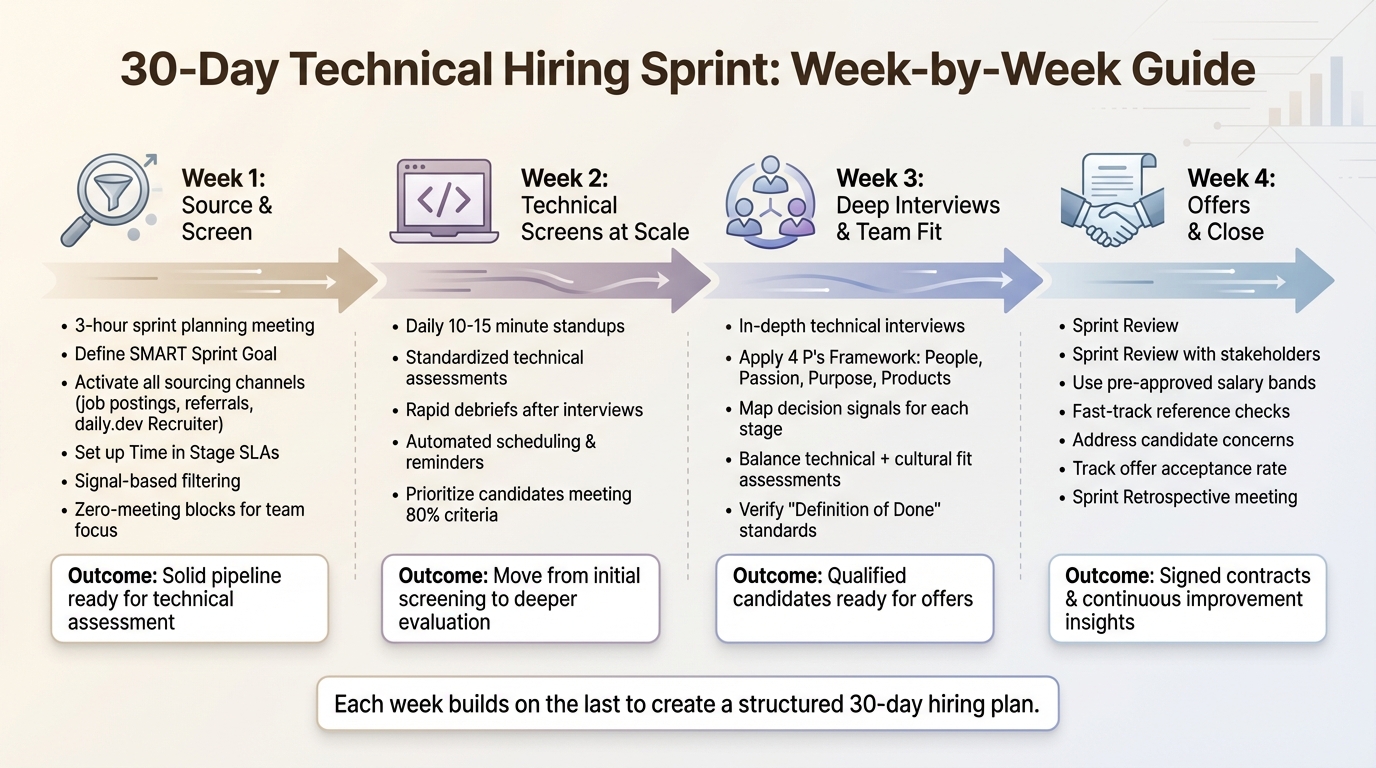
The sprint process is divided into four phases, each with its own focus. Every week builds on the last, creating a structured 30-day plan.
Week 1: Source Candidates and Start Screening
The first week is all about sourcing. Activate every available channel - job postings, networking, referrals, and tools like daily.dev Recruiter's matching features - to quickly fill your pipeline. The goal here is volume, but don't compromise on basic candidate quality.
Kick things off with a 3-hour sprint planning meeting to define a SMART Sprint Goal (Specific, Measurable, Achievable, Relevant, Time-bound) . Refine your candidate backlog and prioritize roles based on their impact on the business.
Set up Time in Stage SLAs to keep things moving. For instance, ensure screening responses and interview invites are handled promptly. Use signal-based filtering, like work sample requests or outcome-based questions, to score candidates quickly without manually reviewing every resume .
To keep your hiring team focused, introduce a "zero-meeting" block during critical execution periods . By the end of Week 1, you should have a solid pipeline of candidates ready for technical assessment.
Once your pipeline is ready, move into Week 2 for rapid technical evaluations.
Week 2: Run Technical Screens at Scale
Week 2 is all about efficient, standardized technical screening. Start with daily standups - quick 10-15 minute meetings - to share updates, plan interviews, and tackle any blockers .
Use standardized technical assessments to ensure fairness and consistency. Schedule rapid debriefs immediately after interviews so decisions can be made while feedback is still fresh. As one expert put it:
"The short time box is a forcing function for teamwork. Communication and efficiency are key when there is such a short time to deliver!" – Motion Consulting Group
Automate as much as possible, from scheduling to reminders and follow-ups, so your team can focus on evaluating technical skills and problem-solving abilities. Prioritize candidates who meet at least 80% of the criteria and show potential for growth .
By the end of Week 2, shift your focus from initial screenings to deeper evaluations in Week 3.
Week 3: Conduct Technical Interviews and Assess Team Fit
This week goes beyond technical skills and dives into team fit. Bring in your technical team for in-depth interviews and ensure there are no scheduling delays. Map out decision signals for each stage so candidates aren't asked the same questions repeatedly.
Use the 4 P's Framework to evaluate team fit: People (are they likable and eager to learn?), Passion (do they have personal drive?), Purpose (do they align with your company's mission?), and Products (are they interested in what your company creates?) . During interviews, ask yourself questions like, "Would I enjoy working with this person?" or "Is this someone I can learn from?"
"If you don't like the people you're interviewing with, or want to 'grow up to be like them', walk away." – Luis Felipe Sanchez, Director, QuickBooks Accountant Marketing at Intuit
Ensure candidates meet your "Definition of Done", the standard they must achieve to move forward. Balance structured technical evaluations with open-ended conversations to get a full picture of both their skills and how they'll fit with the team.
Week 4: Make Offers and Close Candidates
The final week is all about closing. After thorough assessments, move quickly to make offers. Use pre-approved salary bands and offer templates to simplify decision-making.
Hold a Sprint Review to present candidates ready for offers and gather last-minute feedback from stakeholders . Speed up reference checks to avoid delays, and have honest conversations to address any concerns candidates might have.
Track your offer acceptance rate - it’s a key indicator of how effective your closing process is. Keep in mind that 79% of candidates would consider reapplying if they received feedback after an interview, even if they weren’t hired . Wrap up the week with a Sprint Retrospective to evaluate what worked well and what could be improved for the next sprint cycle.
How to Move Fast Without Lowering Standards
Speed doesn't mean sacrificing structure. When timelines shrink, there's a higher risk of unconscious bias and subjective decisions creeping into the process. To avoid this, it's crucial to establish a clear and standardized process before diving into the sprint.
As mentioned in Pre-Sprint Preparation, defining specific outcomes for each role upfront helps avoid vague assessments based on traits like "culture fit" or "leadership potential." Companies that rely on clear frameworks for evaluation not only maintain quality but also identify top talent faster. This is where standardized evaluation methods and blind screening play a crucial role.
Use Standardized Evaluation and Blind Screening
Structured rubrics take the guesswork out of hiring. Using templates with pre-set interview kits ensures every candidate is measured against the same criteria. Melissa Lobel, Senior Talent Planning Operations Manager at Greenhouse, highlights the importance of this approach:
"That structure ensures every leader we hire is evaluated against the same signals, regardless of the team or recruiter running the search" .
Consistent scoring methods, like numerical scales paired with standardized questions, help reveal genuine skills - even when a candidate's resume looks polished . You can also include work-sample requests or outcome-based questions, such as asking for code repositories, to confirm technical abilities early on. This approach not only weeds out low-intent candidates but also provides early proof of their capabilities .
In 2024, 54% of candidates reported encountering discriminatory questions during interviews - a problem that structured question sets can help prevent . Standardization reduces bias, but incorporating diverse perspectives strengthens the process even further.
Include Diverse Interview Panels and Fast Reference Checks
Involving a mix of interviewers from different teams and backgrounds helps uncover blind spots while ensuring both technical skills and team compatibility are evaluated. This approach helps maintain high standards, even when working under tight deadlines.
Reference checks don't have to slow things down. Instead of vetting the entire shortlist, focus on your top candidate. Tools like SkillSurvey can streamline the process by contacting multiple references at once . You can also ask candidates to prepare ahead of time by reaching out to their references to confirm contact details and set expectations .
To keep things efficient, use 5–7 standardized questions with a 1–10 rating scale for quick performance benchmarking . If a reference gives a high score, follow up by asking, "What could they have done to earn a 10 instead of an 8?" This helps uncover constructive feedback without wasting time . With a 2023 ResumeLab survey revealing that over 70% of candidates admit to embellishing their resumes, it's also smart to verify job titles and employment dates before proceeding .
After the Sprint: Onboarding and Pipeline Building
The sprint doesn’t end when the contracts are signed. What happens next - how you onboard your new hires - can either boost your team’s productivity or create unnecessary hurdles. At the same time, the data gathered during the sprint offers valuable insights to improve your long-term hiring strategy.
Create a Structured Onboarding Plan
Onboarding starts the moment an offer is accepted. Begin pre-boarding by sending welcome notes, shipping company gear, and ensuring all hardware and software - like email, VPN, and essential tools - are ready before day one .
Pairing new hires with a technical buddy from their domain can make a world of difference. This peer mentor, rather than a manager, helps guide them through their first tasks and collaborations . Nicole Miller, People Operations Manager at Buffer, highlights the importance of this approach:
"We believe that our current teammates are our greatest asset to help shepherd new folks into the team: they've been a newbie before, they're excited and looking for opportunities to share" .
Data shows that new hires with onboarding buddies become fully productive 25% faster .
To ease the transition, assign simple tasks during the first week - like fixing minor bugs or updating documentation. This builds confidence without overwhelming them . A 30/60/90-day milestone plan is also key. Focus the first 30 days on learning and integration, shift to collaboration and contribution in the next 30 days, and aim for independent execution by the 90-day mark . Regular one-on-one meetings during this period can address challenges and improve the onboarding process. With 34% of software developers citing unclear direction as a workplace issue , structured goals are essential.
A well-thought-out onboarding plan ensures new hires settle in quickly and start contributing effectively.
Leverage Sprint Learnings to Refine Your Hiring Pipeline
The data collected during the sprint isn’t just useful for immediate needs - it’s a goldmine for improving your long-term recruitment efforts. By analyzing the sprint, you can identify which strategies worked best and adjust your hiring pipeline accordingly.
Focus on sourcing channels that deliver quality over quantity . For instance, DoorDash tracked applicant demographics throughout their hiring process and used those insights to boost applications from underrepresented groups by 30% .
Compare interview scores from the sprint with the actual performance of new hires at the 90-day mark. This helps validate your evaluation criteria and refine them for future hires . Document which interview sequences yielded the best results - like whether technical screens before team fit discussions provided more actionable insights .
Pay close attention to early turnover. If multiple hires leave within three months, it might indicate that your "fit" assessments need tweaking . Use one-on-one meetings to gather feedback with specific questions like, "What resources would have been helpful earlier?" This feedback can improve both onboarding and future hiring sprints . As Brett Van Buskirk emphasizes:
"Data-driven recruitment isn't an action or even a strategy, it's a philosophy. By continuously monitoring and analyzing data, recruiting teams can make informed decisions, improve efficiency, and ultimately enhance the hiring outcomes" .
Tools and Templates for Running a Hiring Sprint
The right combination of software and documentation, combined with a modern talent acquisition framework, can transform a chaotic hiring process into a smooth and efficient sprint. These tools are essential for managing a fast-paced engineering hiring sprint while maintaining quality. You’ll need solutions that centralize candidate data, automate repetitive tasks, and keep your team on the same page - all without compromising on speed or effectiveness.
Software Categories for Sprint Hiring
Applicant Tracking Systems (ATS) serve as the foundation of any hiring sprint. These systems organize candidate data, streamline application filtering, and handle large volumes of resumes efficiently . Workday is the top choice for Fortune 500 companies, but tools like Greenhouse, Lever, and JazzHR are excellent options for smaller teams, offering robust workflow automation .
Sourcing platforms are critical for accessing talent pools. Indeed, with over 250 million monthly visitors, is a popular choice, while LinkedIn Recruiter specializes in connecting with passive candidates . For technical roles, daily.dev Recruiter simplifies the process by offering pre-qualified developer introductions through a warm, double opt-in system - eliminating the need for cold outreach.
Sprint management tools such as Jira, Zenhub, and Linear allow you to break the hiring process into manageable steps. Using Kanban boards, these tools track candidates through stages like "To Do", "In Progress", and "Done", providing real-time updates for your team . Costs range from free for smaller teams to $8–$18 per user per month for premium plans .
"Sprint planning is an important tool to ensure that teams can focus on the right work at the right time without being bogged down by out-of-scope activities" . - Chaissan Ashcroft
Automated scheduling tools like Sprintful and Calendly save hours by letting candidates choose their own interview slots, avoiding endless email exchanges . Additionally, AI-powered job description tools like Textio and Ongig refine language for inclusivity and SEO, helping you attract top-tier technical talent . For quick, asynchronous updates, tools like Loom allow you to share video messages without scheduling more meetings .
Once these tools are in place, standardized templates help ensure consistency and efficiency throughout the sprint.
Templates for Job Descriptions, Rubrics, and Team Communication
Templates are key to keeping your hiring sprint organized and consistent. Start with a checklist to ensure job descriptions use clear, inclusive language while outlining short-term goals, growth opportunities, and transparent compensation . Tools like daily.dev's job description generator can help you quickly create detailed, outcome-focused descriptions.
Standardized interview kits are vital for evaluating candidates fairly. These kits should include structured questions, scoring rubrics, and attribute mapping tailored to each role .
Filtering question templates are another time-saver, helping you narrow down applicants early in the process. Ask for work samples, examples of past outcomes, or specific tool expertise to identify serious candidates before scheduling interviews . With the rise of AI-generated applications, these filters are more critical than ever .
Finally, use centralized platforms like Confluence or Notion to store communication and offer templates. This ensures consistency across follow-ups and candidate offers, helping you maintain speed and professionalism .
Conclusion
As highlighted in the sprint strategy, preparation is the foundation for achieving both speed and quality in technical hiring. A well-executed sprint thrives on this balance, achieved through careful planning. Setting clear 30/60/90-day goals before posting a job, creating standardized interview kits with anchored scoring systems, and ensuring your hiring team is aligned on essential qualifications all contribute to a process that consistently identifies top-tier talent .
The data backs up this method. Streamlined recruiting funnels can cut engineering time spent on hiring by up to 60% and reduce overall hiring costs by 60% to 80%. Meanwhile, structured evaluation processes help manage the 239% surge in AI-driven applications, ensuring the best candidates stand out .
Leverage automation for tasks like scheduling, keyword filtering, and reminders, while reserving human expertise for in-depth technical assessments and final decisions. By setting 48-hour decision SLAs at each stage and using pre-designed offer templates, you can act quickly and boost offer acceptance rates .
FAQs
How many roles can I fill in a 30-day hiring sprint?
Filling multiple roles in just 30 days is achievable if you use effective strategies to simplify the hiring process. The total number of hires will depend on how complex the roles are and your team's ability to manage the workload. To make this happen, start by clearly defining each role and ensuring your hiring processes are well-organized and aligned. This preparation can help you meet even the most aggressive hiring targets efficiently.
What interview stages are the minimum to keep quality high?
To maintain high-quality hiring, a few essential interview stages are typically required. These include screening and first-round interviews, which serve as an initial filter, followed by technical deep-dives and team fit discussions. This approach ensures that candidates are assessed for their technical expertise as well as their compatibility with the team, even when hiring needs to move quickly.
What should I do if my offer acceptance rate is low?
If you're struggling with a low offer acceptance rate, it's time to take a closer look at your hiring process. Start by making sure job roles are clearly defined - candidates need to know exactly what they're signing up for. Next, prioritize creating a positive candidate experience. This includes everything from timely updates to respectful interactions throughout the process.
Also, check if your offers are competitive by comparing them to current market standards. Compensation, benefits, and growth opportunities all play a role in making your offer attractive. Lastly, speed and transparency are key. A hiring process that’s quick, open, and respectful helps build trust, which can significantly boost the chances of candidates saying "yes" to your offer.
.png)


