

Recruiting software and developer sourcing tools serve different purposes in the hiring process:
- Recruiting software helps manage the hiring process, from tracking applicants to coordinating interviews and ensuring compliance. It’s ideal for handling large applicant pools and streamlining workflows.
- Developer sourcing tools focus on finding technical talent, especially passive candidates, by analyzing coding activity on platforms like GitHub and Stack Overflow. They excel at identifying niche skills and specialized expertise.
Quick Comparison
| Feature | Recruiting Software | Developer Sourcing Tools |
|---|---|---|
| Purpose | Managing hiring workflows | Finding technical talent |
| Focus | Inbound applicants | Passive candidates |
| Data Used | Resumes, applications | Coding activity, profiles |
| Best For | High-volume hiring | Niche technical roles |
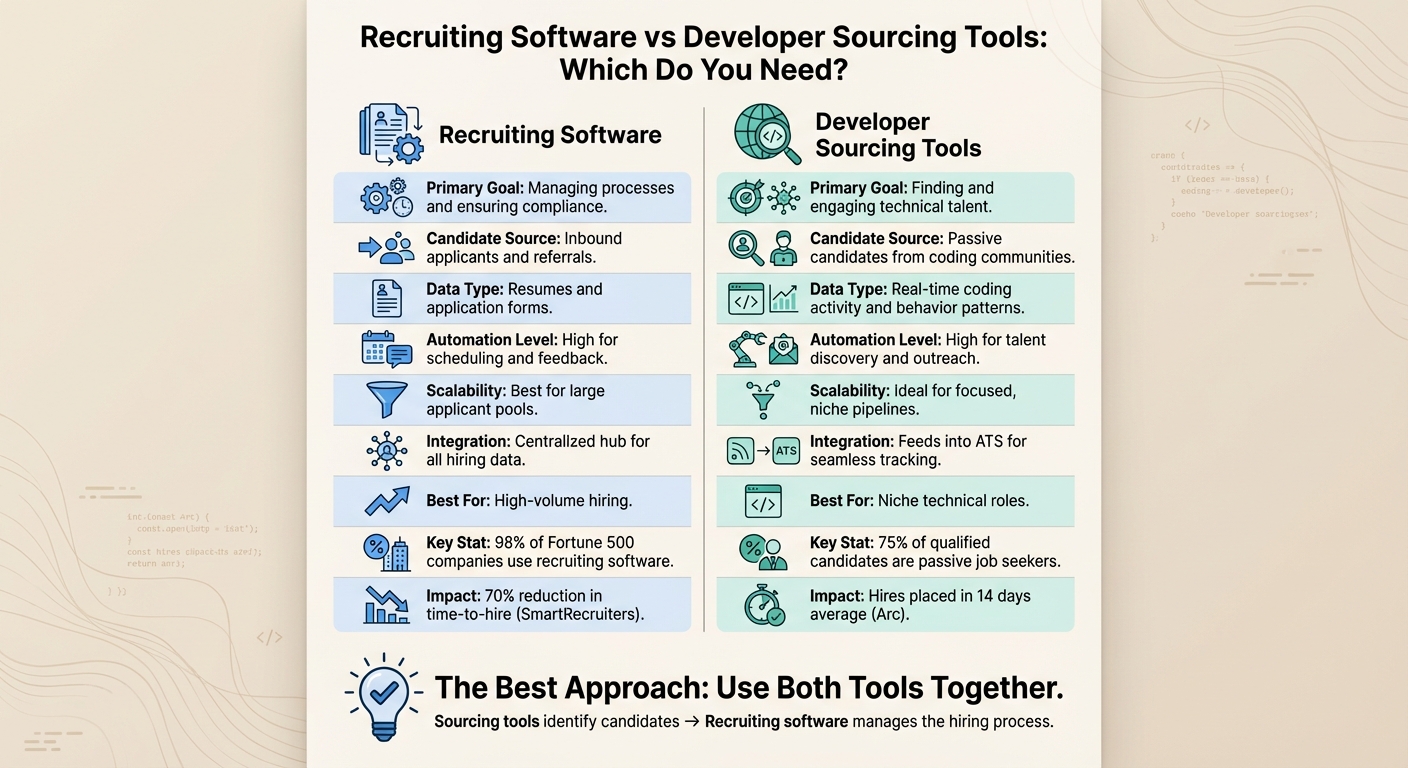
The best approach? Use both tools together. Sourcing tools identify candidates, while recruiting software organizes and manages the hiring process for engineering teams.
What Is Recruiting Software?
Recruiting software acts as a central hub for managing the entire employee lifecycle - from sourcing candidates to onboarding them seamlessly . It brings all candidate interactions, feedback, and compliance records into one unified system, making the hiring process more efficient and organized.
It’s no surprise that over 98% of Fortune 500 companies rely on recruiting software . Modern platforms combine applicant tracking systems (ATS) with customer relationship management (CRM) tools, email automation, interview coordination, and real-time analytics. Together, these features provide hiring teams with a single, reliable source of information for decision-making.
The benefits are clear: 94% of recruiters say recruiting software positively impacts their work . By automating tasks like managing spreadsheets and email threads, recruiters can focus more on strategic hiring efforts .
Core Functions and Capabilities
Recruiting software oversees every stage of the hiring process - from the initial intake to the final offer acceptance . Its ATS ensures compliance with legal standards by acting as a centralized record-keeping system , while its CRM helps build proactive talent pipelines. This is especially important since 75% of candidates are passive job seekers .
Advanced platforms also provide analytics on metrics like time-to-hire, source-of-hire, and diversity benchmarks . Automation simplifies tasks such as scheduling interviews, sending follow-ups, and recording notes. By reducing system inefficiencies, these tools can significantly cut the average time-to-fill of 36 days . These features make recruiting software a powerful tool, especially when compared to developer sourcing tools.
When to Use Recruiting Software
Recruiting software is ideal for situations like high-volume hiring or managing complex pipelines. If you’re juggling multiple candidate interviews, collecting feedback, and ensuring compliance, these tools can streamline the process. Features like standardized scorecards also help ensure fair and informed hiring decisions .
Building long-term talent pools is another key advantage. Poor communication during recruitment can lead to 63% of candidates rejecting offers , making effective communication tools critical.
Take Ramp, for example. By consolidating fragmented tools into one platform, the company reduced its time-to-hire by 60% in just three months . Up next, we’ll dive into how developer sourcing tools differ from and complement recruiting software.
What Are Developer Sourcing Tools?
Developer sourcing tools are platforms designed to help recruiters find and connect with technical talent in their preferred online spaces. Unlike traditional recruiting software, which focuses on managing the hiring process, these tools are all about identifying developers who aren't actively job hunting but might be open to the right opportunity. They prioritize proactive outreach over waiting for applications to roll in.
These platforms gather data from popular technical hubs like GitHub, Stack Overflow, and Kaggle . Using artificial intelligence, they analyze coding activity, project contributions, and technical skills - details that often go beyond what's listed on a typical resume. Some tools even compile this data to provide a deeper understanding of a developer's abilities .
Key Features and Advantages
One standout feature of developer sourcing tools is their ability to use AI for matching and profile aggregation. By scanning specialized developer communities, they identify candidates based on actual coding skills rather than just job titles or keyword matches .
Additionally, many of these tools offer capabilities like contact discovery and automated outreach. For example, recruiters can find potential hires on platforms like GitHub and then launch personalized email campaigns with ease. Some even come with Chrome extensions that allow recruiters to capture candidate profiles directly from key websites .
These tools shine when you're looking for expertise in a specific programming language or framework. Unlike traditional job boards, they focus on real-world coding contributions and engagement in developer communities, giving you a clearer picture of a candidate's technical abilities.
When to Use Developer Sourcing Tools
Developer sourcing tools are especially useful when you're hiring for niche technical roles or need to reach passive candidates quickly. If you're searching for someone with specialized skills in a particular language or emerging technology, these tools can help you find candidates that might not appear through conventional recruiting methods.
They also save time by streamlining the process of identifying and contacting qualified developers - a critical edge in the fast-paced tech industry. These tools are ideal for building a pipeline of talent for hard-to-fill positions, especially when many top-tier developers aren't actively seeking new roles.
Up next, we'll compare these tools with traditional recruiting software to help you decide which option aligns best with your hiring goals.
Recruiting Software vs Developer Sourcing Tools: Side-by-Side Comparison
Now that we’ve covered the basics of these tools, let’s dive into how they compare. Your choice depends on your hiring goals - whether it’s managing a large pool of applicants or finding active vs passive developers.
Feature Comparison Table
The major difference lies in their core purpose and where they fit in the hiring process. Recruiting software focuses on managing candidates after they’ve been identified, while developer sourcing tools are designed to locate talent earlier.
| Feature | Recruiting Software (ATS) | Developer Sourcing Tools |
|---|---|---|
| Primary Goal | Managing processes and ensuring compliance | Finding and engaging technical talent |
| Candidate Source | Inbound applicants and referrals | Passive candidates from coding communities |
| Data Type | Resumes and application forms | Real-time coding activity and behavior patterns |
| Automation Level | High for tasks like scheduling and feedback | High for talent discovery and outreach |
| Scalability | Best for handling large applicant pools | Ideal for building focused, niche pipelines |
| Integration | Centralized hub for all hiring data | Feeds into ATS for seamless tracking |
For example, SmartRecruiters, a widely-used recruiting software, reported cutting time-to-hire by 70% and reducing scheduling tasks by 97% through automation . On the other hand, Arc, a developer sourcing platform, places contractors in under 72 hours and full-time hires in 14 days on average, thanks to its pre-vetting process . These stats show how each tool excels: recruiting software streamlines administrative tasks, while sourcing tools speed up finding the right talent.
Knowing these distinctions can help you align your tools with your hiring strategy.
Matching Tools to Your Hiring Goals
If you’re handling high-volume hiring or need to ensure compliance, recruiting software is your go-to. It’s built to manage large applicant pools, automate interview scheduling, and maintain detailed records. It’s also invaluable for teams of recruiters collaborating on candidate feedback and managing multiple roles.
On the other hand, developer sourcing tools are perfect for finding specialized technical talent. Say you’re looking for expertise in a specific programming language or a cutting-edge framework - these tools allow you to evaluate candidates based on their actual coding contributions rather than just resume keywords.
The bottom line? These tools address different stages of the hiring process. Sourcing tools help you find the right people, while recruiting software ensures you can engage and hire them efficiently. Often, the best results come from using both, creating a seamless flow from discovery to hire .
Using Recruiting Software and Developer Sourcing Tools Together
Pairing recruiting software with developer sourcing tools can transform your hiring process into a more efficient and cohesive system. By combining their strengths, you can create a workflow that flows seamlessly from talent discovery to formal evaluation, with each tool excelling at its specific role.
Integration and Workflow Setup
The foundation of this approach lies in setting up continuous sourcing cycles that integrate directly with your recruiting software. Instead of relying on massive candidate lists, adopt a more agile process: source candidates daily, conduct quick screenings, and feed top prospects into your recruiting software for a more structured evaluation .
For example, SmartRecruiters showcases this method by blending AI-powered matching with add-ons like Mokka for quality screening. This setup reportedly reduced time-to-hire by 70% and boosted hiring speed by 50% through automation and connected workflows . In this system, the recruiting software handles logistics like scheduling, compliance, and team collaboration, while sourcing tools provide real-time insights into candidates' coding abilities, helping to assess their quality.
To make this work, coordination between sourcing and recruiting teams is essential. Start by defining clear handoff protocols: specify what data needs to be shared, how candidates should be tagged, and how feedback loops can refine sourcing criteria. Using dynamic scheduling platforms can streamline scheduling tasks, cutting the time spent on this by 97%, allowing recruiters to focus on evaluating candidates .
This integration lays the groundwork for a more layered and effective recruitment strategy.
Building a Layered Recruitment Approach
With integrated workflows in place, you can build a layered recruitment strategy that maximizes both discovery and evaluation. Think of recruiting software as the backbone of your process, while sourcing tools act as the engine for discovering talent. The recruiting software manages structured workflows - like interview kits, offer management, and compliance tracking - while sourcing tools identify passive candidates who might not engage through traditional job postings.
Here’s how it works in practice: sourcers use developer platforms to find candidates based on actual coding contributions rather than just scanning resumes for keywords. After identifying potential candidates, they conduct quick screenings - either through automated assessments or short conversations - before passing qualified leads to recruiters for formal evaluation. This ensures that only pre-vetted candidates move into the structured recruiting process .
Ongoing collaboration between sourcing and recruiting teams is vital. Regular alignment meetings to discuss job requirements, shared objectives, and feedback on candidate quality can help refine the sourcing strategy over time. This teamwork not only reduces time-to-hire but also improves candidate quality, as sourcers gain a clearer understanding of what recruiters need while recruiters stay informed about the realities of the talent pool .
Choosing the Right Tool for Your Hiring Needs
When it comes to streamlining your hiring process, the right tool should address your specific challenges. Recruiting software is perfect for handling inbound applicants, maintaining compliance, and managing the entire hiring journey. On the other hand, developer sourcing tools shine when it comes to reaching the 75% of qualified candidates who aren't actively job hunting but could be open to the right opportunity .
Your company’s growth stage plays a big role in determining what you need. Startups making their first 1–50 hires often rely on proactive outreach to secure top talent before they hit the open market. For companies scaling beyond 50 employees, minimizing inefficiencies - like manual data transfers that can push average hiring times to 36 days - becomes critical . This is why tools that not only fill gaps but also grow with your team are essential.
"A fragmented stack forces your team to operate with one hand tied behind their back. Every hour spent on manual data transfer is an hour not spent building relationships with top-tier candidates."
– Vicky Liu, Juicebox
One key area to evaluate is how much time and efficiency you lose due to manual data transfers between systems. Pinpointing whether your tools work seamlessly together - or slow you down - can make a huge difference.
Given these challenges, many tech recruiters find that success isn’t about choosing one tool over another but combining their strengths. For example, daily.dev Recruiter offers a standout solution by connecting you with pre-qualified developers who are already engaged and open to opportunities. With warm, double opt-in introductions, it eliminates the need for cold emails vs. warm introductions, bridging the gap between traditional sourcing and recruiting workflows.
FAQs
Do I need both tools or just one?
When deciding whether to use both recruiting software and developer sourcing tools, it comes down to what your hiring process looks like and what you're aiming to achieve. Recruiting software is great for organizing applicants and simplifying your workflows, while sourcing tools shine when it comes to locating and connecting with passive candidates who might not be actively job hunting.
Combining these two tools can be a game-changer. Sourcing tools help you discover top talent, and recruiting software ensures you can effectively manage their journey through the hiring process. In fast-paced tech industries, integrating both can give you an edge in finding and securing the right candidates.
When should I add an ATS to my hiring stack?
When the task is to manage candidates efficiently, streamline workflows, or handle tasks like resume parsing and interview scheduling, adding an Applicant Tracking System (ATS) is a smart move. An ATS is perfect for keeping applicant data organized and tracking their progress through the hiring process. However, it’s not the best tool for sourcing passive talent.
If your goal is to find and engage developers, consider pairing your ATS with tools like daily.dev Recruiter. While the ATS excels at managing the candidate pipeline, tools like these can help you connect with hard-to-reach talent, ensuring a more comprehensive recruitment strategy.
How do I connect sourcing data to my recruiting workflow?
To seamlessly link sourcing data with your recruiting workflow, make sure your sourcing tools are integrated with your Applicant Tracking System (ATS). Prioritize tools that handle tasks like automating data transfers, syncing candidate updates, and minimizing manual data entry. Set up APIs, define relevant data fields, and establish automation rules to simplify your processes. Evaluate the success of your integration by monitoring key metrics such as time-to-hire and data accuracy. This will help confirm that the integration is boosting efficiency and aligning with your hiring objectives.
.png)


