Hiring developers for small teams is tough. You're competing with bigger companies, limited resources, and tight timelines. The best candidates? They're already employed and off the market within 10 days. Dragging out your hiring process could cost you top talent, making it essential to reduce your time to hire without losing quality.
Here’s the solution: small teams can hire faster by creating a clear, fast, and efficient recruitment process. This guide breaks it down into 4 steps:
- Define Roles Clearly: Focus on outcomes, not generic tasks. Build developer personas to target the right talent.
- Source Passive Talent: Use tools like daily.dev Recruiter for warm leads and build a steady talent pipeline.
- Simplify Screening: Structured interviews and rubrics ensure fair, quick evaluations.
- Craft Offers & Onboard Fast: Competitive offers with equity, clear growth paths, and hands-on onboarding to boost retention.
Key stats to know:
- 75% faster hiring is possible with automation.
- Structured interviews predict job performance twice as well as unstructured ones.
- Strong onboarding can improve retention by 82%.
Speed and structure are your biggest advantages. Let’s dive into how to make it work.
::: @figure 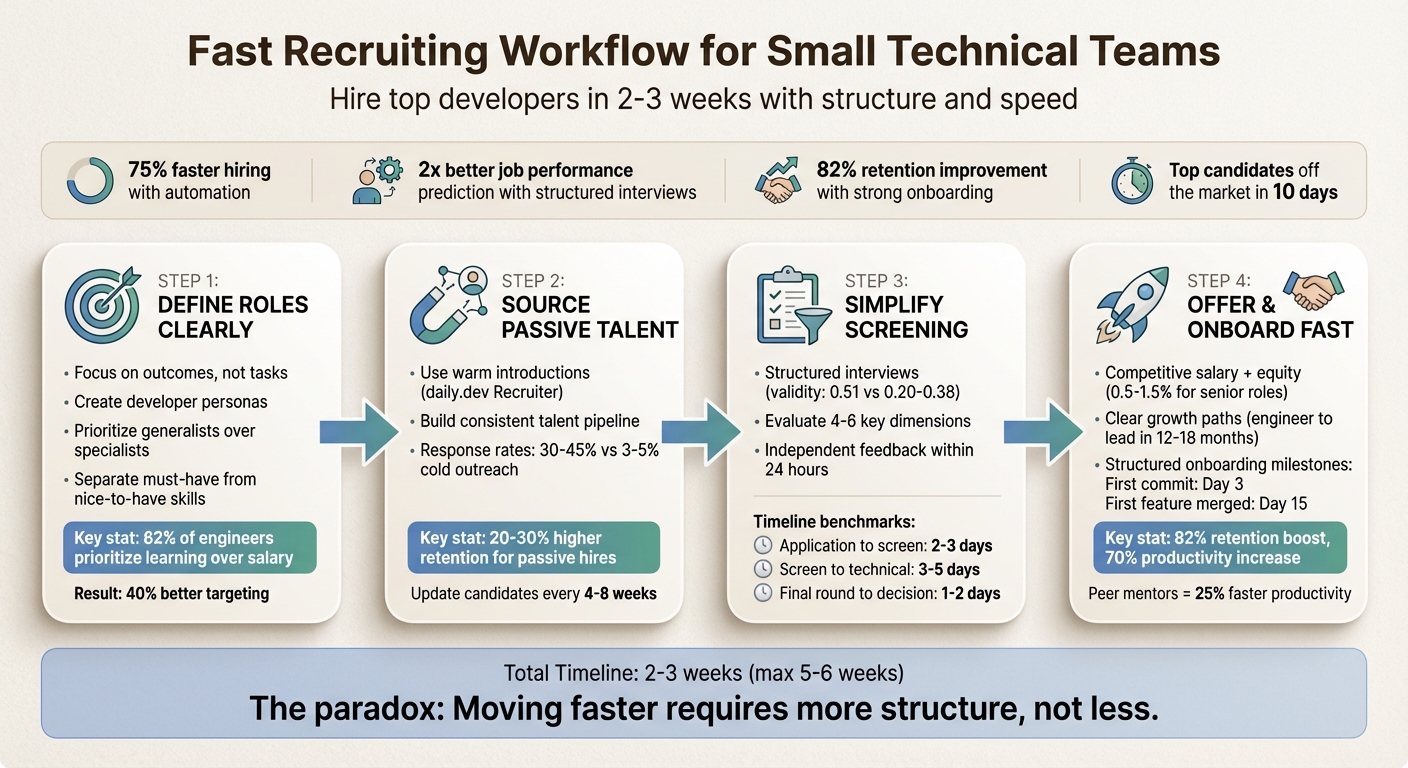 {4-Step Recruiting Workflow for Small Technical Teams}
Step 1: Define Role Requirements and Candidate Profiles
Before drafting a job description, focus on defining the role's success metrics as part of a modern talent acquisition framework. Instead of listing generic tasks like "write code" or "attend meetings", zero in on outcome-driven goals such as "rewrite feed service to handle 100 million users" . This approach forces you to consider the real impact you need rather than just checking off activities. It also sets the stage for creating clear and effective developer personas.
For small teams, generalists often outperform specialists. You need developers who thrive in ambiguity, adapt quickly, and are open to working with various technologies . Dharmesh Shah, Founder and CTO of HubSpot, sums it up perfectly:
"The best people are problem solvers and like to build elegant solutions and are not hung up on specific languages or technologies" .
This adaptability is especially critical when resources are tight, and priorities shift frequently.
Create Developer Personas for Better Targeting
Once you've defined success metrics, use them to shape developer personas. These personas help your team visualize the ideal candidate by detailing technical skills, career goals, motivations, and deal-breakers. For instance, a persona might outline where the candidate works now, what excites them about technology, and what might cause them to decline your offer .
Here’s a key insight: 62% of engineers prioritize learning opportunities over salary once their basic financial needs are met . Use this to your advantage. If you're hiring a senior backend engineer, for example, your persona could highlight that they likely value autonomy, cutting-edge tech stacks, and the chance to make a meaningful product impact. On the flip side, they might avoid rigid processes or outdated codebases . Documenting these traits can increase your chances of finding the right hire by up to 40% .
Separate Must-Have Skills from Nice-to-Have Qualities
Keep job descriptions focused by avoiding unnecessary requirements. Instead of looking for someone who checks every box in your tech stack, prioritize solving your immediate challenges. Identify one core technical area where expertise is non-negotiable, and then look for candidates with a broad range of complementary skills . This "T-shaped" approach balances depth with versatility.
Also, consider candidates eager to grow into the role. Mark Suster, Managing Partner at Upfront Ventures, shares this perspective:
"I believe that you should always hire people who are looking to 'punch above their weight class,' which means to hire people who want to be one league above where they are today" .
These individuals bring energy, ambition, and a willingness to grow - qualities that can make them long-term assets to your team. Unlike someone who has already mastered the role, they’re more likely to stay engaged and evolve alongside your company.
Hiring engineers?
Connect with developers where they actually hang out. No cold outreach, just real conversations.
Step 2: Source Passive Talent with Minimal Effort
Most developers are open to new opportunities but aren’t actively searching, making mass cold outreach a low-return strategy with response rates hovering around 3–5% . To stand out, you need smarter, relationship-driven tactics that build trust and pre-qualify interest before initiating conversations.
Use daily.dev Recruiter for Warm Introductions
daily.dev Recruiter offers a fresh approach to solving the cold outreach problem. Instead of relying on scraped databases or generic LinkedIn searches, this platform connects you with developers through double opt-in introductions. The result? Response rates of 30–45% - nearly ten times higher than traditional cold outreach .
Here’s how it works: Developers on daily.dev are already engaged, consuming technical content regularly. When you post a role, it’s privately pitched to candidates who match your criteria - whether it’s timezone, location, tech stack, or seniority . Only those who opt in to connect will move forward, ensuring you’re engaging with genuinely interested individuals. Plus, the platform handles the pre-qualification process based on your requirements, saving you from endless resume reviews and initial interviews . This efficient workflow is a game-changer, especially for small teams working under tight timelines.
Build a Consistent Talent Pipeline
To keep your hiring efforts steady, focus on creating a reliable talent pipeline. Recruitment software can help you automate and track employee referrals while managing rewards, such as $1,000 bonuses for successful hires . Promote these programs through internal tools like Slack or email templates, tapping into trusted networks for quality leads.
Stay connected with passive candidates by sharing brief updates every 4–8 weeks. This keeps your company on their radar and leverages the fact that passive hires tend to have 20–30% higher retention rates because their job changes are typically well-considered . By nurturing these relationships, you’ll always have a pool of pre-qualified candidates ready when opportunities arise.
Step 3: Streamline Screening and Interviews
When working with a small team, you can't afford to let the interview process drag on for weeks. The trick is to build a structured system that gathers the evidence you need quickly and effectively. By evaluating every candidate against the same set of criteria, you can cut through the noise and make decisions with confidence. With clearly defined role requirements and a strong talent pool, an efficient screening process becomes the backbone of fast, informed hiring.
Apply Structured Evaluation Criteria
Did you know that structured interviews are roughly twice as effective at predicting job performance compared to unstructured ones? They boast a validity coefficient of 0.51, while unstructured methods hover between 0.20 and 0.38 . The secret? Consistency. A standardized approach ensures every candidate is evaluated on the same playing field, making comparisons straightforward and fair.
Before diving into interviews, identify 4–6 key dimensions to evaluate, such as technical expertise, system design skills, collaboration style, communication clarity, and debugging ability . Then, create detailed rubrics for each dimension. For example, instead of a vague "strong technical skills" rating, a rubric might describe: "Candidate identified the problem as graph traversal, explained why BFS was the best choice, and implemented a working solution that accounted for edge cases."
To reduce bias in technical hiring, require interviewers to submit their feedback independently within 24 hours of an interview, before group discussions begin . This ensures that feedback is based on direct observations rather than being influenced by others' opinions. Once all individual evaluations are in, the team can come together to discuss and refine their insights.
Enable Team Collaboration with Simple Tools
After gathering individual assessments, streamline team collaboration using a centralized digital tool that organizes all candidate feedback. For interviews involving case studies or work product reviews, which are effective ways to assess technical skills without coding tests, ask candidates to provide artifacts like sketches or notes so there’s a clear documentation trail for debriefing . Additionally, a follow-up conversation between the hiring manager and the candidate after technical rounds can help resolve any conflicting feedback and confirm the process went smoothly .
This streamlined, collaborative approach keeps your hiring process aligned with the agility and speed that small teams need to thrive.
Step 4: Create Developer-Friendly Offers and Onboarding
Once you've identified your top candidates, the next step is to seal the deal with an offer that stands out and an onboarding process that sets them up for success. For small teams, this means balancing competitive pay with perks like fast career growth and meaningful equity.
Structure Offers That Appeal to Developers
Developers joining small teams often look beyond just the base salary. They care about factors like career growth, equity ownership, and making a direct impact. In 2026, base salaries for senior engineers at early-stage startups typically fall between $120,000 and $180,000, while those at scale-ups range from $160,000 to $220,000. While these numbers may not match the cash compensation at larger companies, offering substantial equity can make a big difference.
For senior roles at early-stage companies, equity offers should range from 0.5% to 1.5% ownership. Don’t just share a percentage - explain its potential value. For example: “1% equity at a $10M valuation equals $100,000; if the company grows to a $1B valuation, that same 1% becomes $10M”. This clarity helps candidates understand the long-term potential of their equity.
Be upfront about trade-offs. Acknowledge that while large companies may offer higher salaries, small teams provide unique opportunities, like shipping features more frequently and having an immediate impact on the product. Additionally, developers in small teams often experience faster career growth, with the possibility of moving from engineer to lead in just 12 to 18 months.
Finally, make sure your onboarding process is streamlined and designed to enable new hires to contribute quickly. This ensures your offer is backed by a strong experience from day one.
Design Onboarding for Quick Productivity
In small teams, every hire counts, and getting them up to speed quickly is critical. A onboarding checklist for new technical hires helps new developers start contributing right away, which is essential for both productivity and retention.
Research shows that strong onboarding can boost retention by 82% and productivity by 70%. For small teams, speed is key. Set clear milestones like achieving a "First Commit" by Day 3 and a "First Feature Merged" by Day 15. Since developers retain 75% of what they practice compared to just 10% of what they read, focus on hands-on tasks rather than overwhelming them with documentation.
Start with pre-boarding to minimize delays. Have hardware, software access, and essential accounts (like GitHub, Jira, AWS, and Slack) ready 3 to 7 days before their start date. This preparation can reduce friction during the first week by up to 80%.
Assigning a peer mentor instead of a manager can also make a big difference. Peer mentors help new hires become productive 25% faster and improve long-term satisfaction. Developers who meet with their mentor at least eight times in their first 90 days report a 97% increase in productivity.
To build early momentum, assign simple starter tasks like fixing minor bugs or updating documentation. Pair programming sessions - two hours daily for the first 10 days - can help transfer knowledge effectively. Additionally, daily 15-minute check-ins during the first week can address blockers and keep things on track. With this structured approach, new developers can start making meaningful contributions within just two weeks.
Track Metrics to Improve Your Recruiting Workflow
Keeping tabs on important metrics is the best way to spot weaknesses in your hiring process and improve your results. For small technical teams, it’s smart to focus on just a few key numbers that show where things are running smoothly - and where they’re not.
Monitor Key Recruitment Metrics
One of the most telling metrics to track is time-to-hire. Ideally, your entire hiring process - from application to offer acceptance - should take 2 to 3 weeks, with an upper limit of 5 to 6 weeks before you risk losing top candidates. Breaking it down further, aim for these benchmarks:
- Application to recruiter screen: 2 to 3 days
- Recruiter screen to technical screen: 3 to 5 days
- Final round to decision: 1 to 2 days
If you notice delays, especially between technical screens and final rounds, it could point to scheduling bottlenecks or hesitation in decision-making. To keep things moving, schedule decision meetings immediately after final interviews. This urgency helps secure top talent before they move on to other offers.
Another metric to keep an eye on is conversion rates. If you see high drop-offs after technical screens or frequent declines of your offers, it’s a sign that something isn’t clicking. This could be an issue with your evaluation process, how clearly you’re communicating expectations, or even the competitiveness of your offers. Research shows that companies who analyze recruitment data can improve both efficiency and cost-effectiveness, sometimes by 2–3 times. While numbers are critical, don’t overlook the value of qualitative insights for fine-tuning your approach.
Use Feedback Loops for Ongoing Improvement
Feedback is your secret weapon for improving your hiring process. Collect input from both interviewers and candidates to pinpoint what’s working and what’s not. For example, ask interviewers if the technical assessments are effective predictors of job performance or if there are too many interview rounds. On the candidate side, find out what might have discouraged them.
Pay special attention to feedback from candidates who declined your offer or dropped out mid-process. A simple follow-up email asking why they made their decision can uncover issues like slow timelines, unclear communication, or an unappealing offer structure. When you notice recurring feedback - especially from rejected candidates - it’s a clear signal that something needs fixing. These insights allow you to tweak your process, making each hiring cycle more efficient and better aligned with attracting top talent.
Conclusion
This guide has covered the essentials of defining roles, sourcing candidates, refining screening processes, and crafting offers that appeal to developers. Successful recruiting doesn't require endless resources - it just needs a clear structure, focused efforts, and an approach that aligns with your team's goals. Small technical teams, in particular, can act quickly, make swift decisions, and provide developers with meaningful work from day one. The key is designing a process that respects your team's limited time while meeting the expectations of top technical talent.
Start by clearly outlining role requirements and building developer personas. Leverage tools like daily.dev Recruiter for warm introductions, and implement structured screening methods. When it comes to offers, focus on competitive compensation, clear growth opportunities, and engaging technical challenges. When done right, these steps ensure that new hires are not only skilled but also a strong cultural fit.
The secret to long-term hiring success lies in treating recruitment like an agile process. A systematic, automated approach can reduce hiring timelines to as little as 2–4 weeks and significantly streamline onboarding. As daily.dev Hiring Academy wisely explains:
"The paradox: moving faster requires more structure, not less. Process enables speed at scale."
Relying on ad-hoc methods might work for a handful of early hires, but avoiding common hiring mistakes is essential as your team grows. To scale effectively, it's crucial to establish a structured process - complete with standardized stages, clear evaluation criteria, and trained interviewers.
Continuously refine your workflow, gather feedback, and adapt with each new hire. By building a thoughtful and scalable recruiting process, your team will be well-positioned to attract and retain the technical talent that fuels long-term success.
FAQs
What’s the minimum number of interview stages we need to hire well?
The number of interview stages can vary, but a streamlined process often involves 2–3 key steps: an initial screening, a technical assessment, and a final interview. This approach strikes a balance between thorough evaluation and efficiency, especially for smaller teams.
How do we create a developer persona without overthinking it?
Defining a developer persona doesn’t have to be complicated. Start by outlining practical profiles that highlight essential skills and motivations. Focus on the roles you’re hiring for and build profiles around workflows, tools, and problem-solving capabilities. To keep things focused, emphasize actionable traits such as technical expertise, preferred technologies, and work habits - these are the attributes that will directly influence your hiring outcomes.
Which hiring metrics should we track first to speed up decisions?
Tracking time-to-hire and offer acceptance rate is a great starting point. These metrics shed light on where delays might be occurring in your hiring process and reveal areas that could use some fine-tuning. By focusing on these, you can simplify workflows and make quicker, more informed decisions.
.png)