Static resumes no longer cut it for hiring developers. They focus on past jobs but fail to show current skills or growth potential. Today, recruiters want proof of ability - not just claims. Here’s what works better:
- Portfolios: Showcase 3–5 working projects with clear documentation and live demos.
- GitHub Profiles: Highlight commit frequency, code quality, and teamwork through pull requests and stars.
- Coding Assessments: Test real-world skills with job-specific challenges.
- Developer Activity Platforms: Platforms like daily.dev reveal ongoing learning and engagement.
Why it matters: Portfolios and GitHub provide verifiable proof, while coding tests and activity platforms show current capabilities. This approach ensures hiring decisions are based on skills, not just resumes.
Quick Comparison
| Method | Shows Past Work | Verifies Skills | Highlights Growth | Collaboration Insight |
|---|---|---|---|---|
| Resume | Yes | No | No | No |
| Portfolio | Yes | Yes | Limited | No |
| GitHub Profile | Yes | Yes | Yes | Yes |
| Coding Assessments | No | Yes | Limited | Limited |
| Developer Activity | No | Limited | Yes | Yes |
Resumes are not enough anymore. Use tools like portfolios and GitHub to stand out.
::: @figure 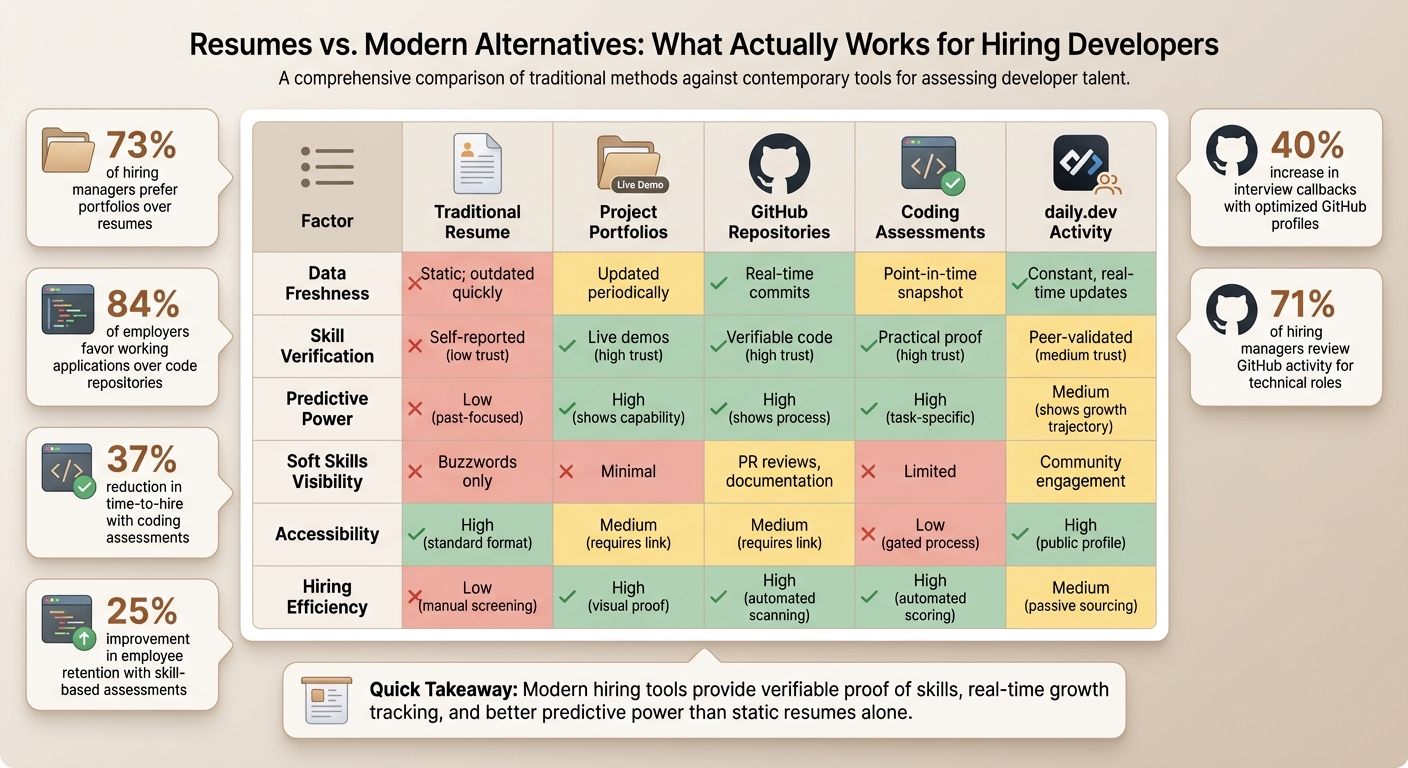 {Resume vs Modern Developer Hiring Tools Comparison Chart}
Project Portfolios: Show What You Can Build
Project portfolios are a powerful way to highlight a developer's abilities. Instead of just listing skills, they showcase real, functional applications that address specific problems. This approach aligns with how modern employers evaluate talent - placing more importance on proven skills than just previous job titles. In fact, research shows that 73% of hiring managers and 84% of employers prefer seeing working applications over simple code repositories . Let’s dive into what makes a portfolio stand out.
What Makes a Good Project Portfolio
An effective portfolio doesn’t overwhelm with quantity - it focuses on 3–5 original projects that demonstrate depth and problem-solving skills . Each project should tell a story, covering the problem you tackled, your specific contributions, the technical process (like wireframes or architecture diagrams), and the final solution, ideally with a live demo link . Including a comprehensive README file for each project is essential. This file should provide:
- An overview of the project
- The tech stack used
- Installation instructions
- Architecture diagrams
"A great project with no documentation is a bad portfolio. A good project with great documentation is a winning portfolio."
- Skill Upgrade Hub
Documentation is just as important as the code itself. Highlight original projects that solve real-world problems over generic tutorial-based examples . For instance, in 2024, Sarah Chen secured a Frontend Developer position at Spotify by showcasing a music streaming app with custom audio visualizations and a guitar tuner built using the Web Audio API. Her portfolio demonstrated not only technical expertise with React but also domain-specific knowledge .
Why Portfolios Beat Resumes
Portfolios go beyond the static claims of a resume by providing a glimpse into a developer’s thought process and adaptability. When hiring managers see a working app hosted on platforms like Netlify or Vercel, they know the developer is capable of delivering functional, deployable code - not just describing it . Portfolios reveal how developers approach problems, make decisions, and navigate technical trade-offs while completing a project from start to finish .
Unlike resumes, which can now be generated by AI tools, portfolios are much harder to fake. They demand functional code and well-documented logic . Clear README files, consistent commit histories, and developer-friendly documentation also highlight soft skills like communication and collaboration.
The impact of a well-maintained portfolio is significant - it can boost interview callback rates by 40% compared to relying solely on a resume .
GitHub Repositories: A Live Record of Your Work
GitHub acts as a dynamic portfolio, showcasing your coding skills, collaboration, and problem-solving abilities in real time - far surpassing the limitations of static resumes. Unlike traditional resumes, which rely on self-reported claims, GitHub provides verifiable proof of your technical expertise and ongoing growth. A Stack Overflow survey found that 71% of hiring managers actively review a candidate's GitHub activity when assessing technical roles . This shift highlights a growing preference for tangible evidence of work over unverifiable assertions. Let’s explore the key metrics recruiters focus on when evaluating GitHub profiles.
What to Look for in GitHub Activity
A strong GitHub profile isn’t just about having repositories - it’s about what those repositories say about your skills and habits. For instance, commit frequency is a clear indicator of consistency and dedication. Developers who contribute regularly demonstrate not only their work ethic but also their passion for coding.
Even more critical is code quality. Recruiters look for modular designs, consistent formatting, and clear naming conventions - hallmarks of maintainable, professional-grade code.
Documentation is another essential factor. Each repository should include a well-crafted README.md file, outlining the project’s purpose, setup instructions, and the technologies used. Beyond technical skill, this reflects a developer’s ability to communicate effectively.
Community engagement also matters. Metrics like stars and forks highlight the impact and relevance of your work. If others find your code useful enough to build upon, it speaks volumes about its value. Lastly, recent activity is crucial. Long gaps or outdated projects may raise concerns, whereas consistent contributions signal a developer who is actively growing and staying current.
| GitHub Indicator | What It Reveals to Recruiters |
|---|---|
| Commit Frequency | Dedication, consistency, and engagement with coding |
| Code Quality | Maintainability, readability, and adherence to best practices |
| Documentation | Communication skills and ability to make code accessible |
| Stars and Forks | Community recognition and the relevance of your work |
| Pull Request Comments | Teamwork, feedback skills, and communication style |
These metrics don’t just verify technical skills - they also provide insights into collaboration, problem-solving, and continuous learning, which are explored further below.
What GitHub Reveals About a Developer
GitHub offers a deeper, more authentic glimpse into a developer’s abilities than any resume ever could. Instead of simply stating "proficient in Python", a well-maintained GitHub profile shows how someone structures APIs, handles edge cases, and writes tests. The presence of unit or integration tests, for example, reflects a commitment to building reliable, maintainable software.
Collaboration is another key area GitHub brings to light. Pull requests, code reviews, and issue discussions reveal how a developer works within a team, showcasing soft skills that are difficult to assess through a resume alone.
"We look at GitHub before anything else. It tells us whether someone contributes to real projects, works well in a team, and writes maintainable code."
- Mike Sokirka, CEO, Index.dev
GitHub also tracks a developer’s growth over time. Repositories that show progression - such as updates that refine earlier projects or incorporate new technologies - highlight a commitment to learning and adapting. Research indicates that 86.7% of developers have taught themselves a framework, language, or tool outside of formal education . Profiles with polished READMEs and consistent commit activity tend to stand out, attracting 3x more profile visits and boosting interview callbacks by 40% .
Coding Assessments: Test Skills in Action
Coding assessments have become an essential tool in modern hiring, focusing on what candidates can do now rather than what they've done in the past. While resumes provide a snapshot of previous roles, these assessments dive deeper by evaluating real-time abilities like code structure, error handling, and problem-solving. For instance, in July 2025, Red Hat's project-based assessments disqualified 63% of phase-one candidates, streamlining the hiring process significantly . This shift from listing achievements to demonstrating skills offers a clearer picture of a candidate's technical capabilities.
Why Use Coding Assessments
Resumes are inherently retrospective, filled with job titles and self-reported skills that are often hard to verify. Coding assessments flip this script, offering a forward-looking evaluation of a candidate's current technical abilities. Instead of taking someone's word that they "managed API development", you can watch them build an API endpoint, handle authentication, and write tests in real time.
Interestingly, 66% of developers say they prefer practical challenges that reflect their actual work over abstract algorithm puzzles . Modern coding assessments cater to this preference by evaluating multiple aspects of a candidate's performance. They don’t just check if the code runs but also assess elements like code structure, documentation, and debugging strategies. These tests even measure how candidates interact with AI tools - a skill that’s becoming increasingly relevant as 90% of engineers are expected to use AI code assistants by 2028 .
"The disconnect between traditional coding interviews and actual developer work has reached a tipping point." - HackerRank 2025 Developer Skills Report
Another major advantage is reducing bias. Standardized challenges and scoring rubrics focus on skills rather than resume buzzwords or educational background. This approach often uncovers "hidden gems" - talented developers who might otherwise be overlooked by automated resume filters. In fact, 75% of hiring managers say they've hired exceptional candidates who lacked standout resumes .
The stakes are high: a bad technical hire costs companies an average of $33,251 . By implementing objective, skill-based assessments, businesses have reported a 37% reduction in time-to-hire and a 25% improvement in employee retention .
How to Use Coding Assessments Effectively
To maximize the benefits of coding assessments, thoughtful implementation is key. The most effective assessments are aligned with the actual job requirements. For example, if the role involves building REST APIs and debugging legacy code, don’t test abstract computer science puzzles. Instead, design challenges that mirror real-world tasks. If you're hiring for a financial institution, create a financial data project rather than a generic weather app .
Time is a critical factor. Keep assessments short and respectful of candidates' schedules. Take-home projects should take no more than 2–4 hours, while live coding sessions should last between 60–90 minutes . Overly long assessments can deter top candidates who are juggling multiple opportunities.
Before rolling out an assessment, calibrate it internally by having about 20 current employees at similar seniority levels complete the test. This ensures the challenge is appropriately difficult and clearly worded . A poorly designed test - whether too easy, too hard, or confusing - can undermine the entire process.
Consistency is crucial, so use a standardized scoring rubric. Clearly define what scores like 1, 3, and 5 mean for categories such as correctness, code quality, testing, and problem-solving . This eliminates the subjectivity that often creeps into hiring decisions.
"A well-designed developer skills assessment is more than just a test; it's a preview of the collaborative and problem-solving environment a candidate can expect if they join your team." - Isabelle Fahey, Head of Growth, CloudDevs
Finally, don’t overlook documentation. Pay attention to README files and code comments alongside the working code. Developers who document their work effectively tend to be better collaborators, making this an important factor in your evaluation.
Hiring engineers?
Connect with developers where they actually hang out. No cold outreach, just real conversations.
daily.dev Activity: See Who's Learning and Growing
Resumes tell you where someone has been, but a developer's activity shows you where they're headed. When developers dive into new technical content, actively participate in discussions, or share their insights on platforms like daily.dev, they're building a living record of their growth .
As hiring practices shift toward evidence-based approaches, recruiters are increasingly looking for proof of a candidate's contributions - whether they've "shipped something, contributed to something, or written something worth reading" . Traditional hiring methods often fail to capture the full potential of developers, leaving 74% of them underserved. Meanwhile, referrals and professional networks account for 30%–50% of hires . This trend highlights the importance of platforms that showcase real-time developer activity and growth.
How daily.dev Recruiter Connects You with Active Developers
daily.dev Recruiter reimagines the hiring process by meeting developers where they already spend their time - engaging with technical content and learning every day. Unlike cold outreach, this platform ensures warm, double opt-in introductions, meaning both the recruiter and the developer express genuine interest before a conversation begins.
This approach leads to higher response rates because developers aren't bombarded with irrelevant messages. Instead, they're matched with roles that align with their skills and interests. With targeted job visibility, your openings reach developers who are actively learning in areas relevant to your needs. Custom screening criteria refine the process further, helping you zero in on candidates who meet specific technical qualifications. Unlike outdated profiles or scraped databases, daily.dev connects you with developers who are active, engaged, and genuinely open to new opportunities. These connections provide a clearer picture of a candidate's ongoing growth and potential.
Why Developer Activity Matters
A developer's activity speaks volumes beyond the bullet points on their resume. Regularly exploring new frameworks, languages, or architectural concepts signals not just expertise but a commitment to growth. When developers contribute to discussions or share their perspectives, it also showcases their communication skills and ability to collaborate .
"When it comes to hiring, I'll take a GitHub commit log over a resume any day." - John Resig, Creator of jQuery
The range of topics a developer engages with can reveal their passion and drive. For example, someone experimenting with multiple programming languages, joining technical communities, or writing about system design trade-offs demonstrates curiosity and flexibility - qualities that make for standout hires. With 79% of developers favoring remote or hybrid work models , these digital "proof-of-work" signals have become vital for assessing talent you'll likely interact with virtually.
Resumes vs. Modern Alternatives: A Direct Comparison
Traditional resumes, while familiar and widely used, often fall short in showcasing a developer's evolving skills and capabilities. When compared with modern alternatives like GitHub profiles or live project portfolios, the difference is striking. Resumes are essentially static snapshots - a frozen moment in time - whereas modern platforms provide a dynamic, ongoing record of a developer's work and growth .
The statistics back this up. For instance, 73% of hiring managers prioritize a strong portfolio over a polished resume when hiring developers. Optimizing a GitHub profile can boost interview callbacks by 40%, and 84% of employers prefer seeing working applications over standalone code repositories . These trends reflect a clear shift in how technical talent is evaluated.
"If I'm seeking someone in a role, I have 5 questions in mind. Answering those questions tells me much more than any resume ever could."
- Mike Sokirka, CEO, Index.dev
Another key issue is the verification gap. With enterprise AI adoption projected to hit 78% globally by 2026, resumes are becoming easier to embellish using tools like ChatGPT . On the other hand, platforms like GitHub offer verifiable proof through commit histories and live demos, showcasing not just what was done but how problems were solved. This ability to validate skills and contributions underscores the growing importance of real-time, dynamic data in hiring decisions.
Side-by-Side Comparison Table
| Factor | Traditional Resume | Project Portfolios | GitHub Repositories | Coding Assessments | daily.dev Activity |
|---|---|---|---|---|---|
| Data Freshness | Static; outdated quickly | Updated periodically | Real-time commits | Point-in-time snapshot | Constant, real-time updates |
| Skill Verification | Self-reported (low trust) | Live demos (high trust) | Verifiable code (high trust) | Practical proof (high trust) | Peer-validated (medium trust) |
| Predictive Power | Low (past-focused) | High (shows capability) | High (shows process) | High (task-specific) | Medium (shows growth trajectory) |
| Soft Skills Visibility | Buzzwords only | Minimal | PR reviews, documentation | Limited | Community engagement |
| Accessibility | High (standard format) | Medium (requires link) | Medium (requires link) | Low (gated process) | High (public profile) |
| Hiring Efficiency | Low (manual screening) | High (visual proof) | High (automated scanning) | High (automated scoring) | Medium (passive sourcing) |
This comparison highlights why modern tools like GitHub, project portfolios, and even platforms like daily.dev are reshaping how developers showcase their capabilities and how employers evaluate them. Static resumes, while still useful in some contexts, are increasingly being supplemented - or even replaced - by these dynamic, real-time alternatives.
Conclusion: Better Tools for Better Hiring
Resumes might tell you where someone has been, but they rarely show where they’re headed - or what they’re truly capable of. Did you know that optimizing a GitHub profile can increase interview callbacks by 40%? This isn’t just a passing trend; it’s a shift toward hiring practices grounded in real evidence.
Modern tools are stepping up to fill the gaps left by traditional resumes. Platforms like GitHub, project portfolios, coding challenges, and developer activity hubs such as daily.dev offer something resumes can’t: proof of skills in action. These resources highlight problem-solving abilities, collaboration, and technical expertise, giving a glimpse into the process behind the work - not just a list of job titles.
John Resig, the creator of jQuery, puts it perfectly: “Live commit histories reveal far more about a developer’s capabilities than any static document ever could”.
For recruiters, these tools streamline decision-making, uncover talent from unconventional backgrounds, and even help tackle the rise of AI-generated resumes. For developers, they’re an opportunity to showcase growth and potential - no longer held back by outdated screening systems. With 84% of employers favoring live demos over static code repositories, one thing is clear: showing what you can build matters far more than simply listing what you’ve done.
The takeaway? The tools are here, the data backs them up, and those willing to embrace this approach are poised for better hiring outcomes.
FAQs
Why are portfolios and GitHub profiles better than resumes for evaluating developers?
Portfolios and GitHub profiles provide a dynamic snapshot of a developer's skills and capabilities, offering a refreshing contrast to traditional resumes that mainly highlight past roles and static achievements. While resumes often lean on buzzwords and job titles, portfolios and GitHub profiles bring skills to life through real projects, live demos, and tangible coding contributions, making a developer’s abilities much more transparent.
A portfolio allows recruiters to explore completed projects, understand the thought process behind them, and even interact with functional applications. On the other hand, a GitHub profile showcases the quality, consistency, and impact of a developer’s code contributions. It gives recruiters a real-time view of their current expertise and problem-solving methods. This forward-looking approach equips hiring teams with better tools to assess a candidate’s potential, far surpassing the static nature of a traditional resume.
How can developers make their GitHub profiles stand out to recruiters?
To make your GitHub profile shine, focus on creating a polished and professional first impression. Start by writing a short, engaging bio under your avatar, adding a professional profile picture, and linking to your personal website or portfolio. You can also include a profile README that goes into more detail about your skills, highlights standout projects, and shares links to live demos.
Take time to organize your repositories thoughtfully. Pin 3–5 standout projects that best demonstrate your expertise and the impact of your work. For each pinned repository, ensure the README is clear and informative, the documentation is thorough, and the code is clean and well-structured. If possible, include automated tests or CI badges to showcase your focus on quality and reliability.
Lastly, keep your activity graph vibrant by making consistent contributions. Regular commits, involvement in open-source projects, and engagement with issues or pull requests not only reflect your dedication but also highlight your collaborative spirit and eagerness to grow - qualities that recruiters pay close attention to.
What are the advantages of using coding assessments during the hiring process?
Coding assessments provide a hands-on, unbiased method to gauge a developer's capabilities, giving you insight beyond the surface of a résumé. They help you evaluate essential skills like problem-solving, coding expertise, and how candidates tackle real-world scenarios.
With these assessments, you can pinpoint the best talent more accurately, ensuring candidates align with the technical demands of the role. This leads to smarter hiring choices and ultimately builds a more capable and effective team.
.png)