When hiring developers, the flood of inbound applications can feel promising but often leads to disappointment. Resumes might showcase impressive credentials, but many candidates fail to meet basic technical expectations during evaluations. This mismatch stems from:
- Volume vs. Quality: Inbound applications have skyrocketed (175 median applicants per job in 2023 vs. 44 in 2021), but fewer than 2% of candidates are truly qualified.
- AI-Generated Resumes: 89% of candidates use AI tools to craft polished applications, making it harder to assess real skills.
- Job Misalignment: Many candidates apply based only on job titles, ignoring qualifications or role specifics.
Recruiters often review just 10% of applications, increasing the risk of overlooking top talent. To improve hiring outcomes, focus on smarter filters, role-specific screening, and targeting pre-qualified candidates over sheer volume. Tools like daily.dev Recruiter, which connect you with developers already aligned with your role, can save time and improve results.
Why Inbound Developer Applications Look Better Than They Are
Inbound applications often seem more promising than they actually are, creating a frustrating gap between expectations and reality for recruiters. This disconnect stems from three main issues: mismatched skills, polished but misleading resumes, and a poor understanding of the role. Let’s break down each of these factors.
Mismatched Skills and Irrelevant Experience
Recruiters often lean on surface-level indicators like prestigious universities, years of experience, or big-name companies when evaluating candidates. However, these markers don’t necessarily reflect a developer’s ability to solve real-world challenges. In fact, only 15% of developers believe recruiters understand the technical demands of their roles, and 57% rate this understanding at a dismal 0–2 out of 5 .
Candidates often load their resumes with buzzwords to beat applicant tracking systems (ATS), even when they lack real experience. Take the case of Marcus, a software engineer in 2025. He applied to 43 jobs, stuffing his resume with "machine learning" 17 times despite having no expertise in the field. Unsurprisingly, he received zero callbacks. But when he rewrote his resume using the "ATS Context Formula" - phrasing like "Implemented machine learning algorithms to improve user recommendation accuracy by 34%" - he landed five interviews out of his next 12 applications .
"AI recruitment tools are great at patterns, terrible at potential. We're looking for developers who know how to write code and understand why it works the way it does."
– Ira Prokopiv, Former Vetting Lead, Lemon.io
Inflated Resumes and AI-Generated Applications
AI tools have added another layer of complexity, making it harder to gauge a candidate’s true skills. A staggering 89% of tech candidates now use AI at some stage of their application process . In early 2025, a study analyzing 1,240 interviews and 275 placements found that nearly 9 out of 10 applicants relied on AI. By introducing live-validation interviews and recorded sessions, recruiters cut false-positive hires by 37% compared to resume-only screening .
However, this shift means recruiters now spend 23% more time verifying skills when they encounter AI-generated phrasing in resumes . Some candidates even use real-time AI during remote interviews, crafting scripted answers on the fly. This has forced hiring managers to look for red flags like response delays or overly robotic delivery .
"The resume illusion - a growing disconnect between what's written and what's real. And it's leading to lost time, strained resources, and interviews with candidates who aren't the right fit."
– Rob Hosking, Executive Director, Robert Half
Ironically, stuffing resumes with keywords often backfires. Modern ATS platforms analyze context, not just frequency, and keyword stuffing fails 73% of the time .
Poor Job Alignment
Another major issue is the lack of alignment between candidates and job requirements. Many applicants focus solely on job titles, skipping over the actual qualifications. In a 2025 study of 15,000 applications across 200 companies, researchers found that 94% of applications never even reach a human recruiter due to ATS filters .
Even minor formatting errors can lead to rejection. For instance, candidates who list 20+ skills without weaving them into their work experience face a 67% rejection rate, compared to 34% for those who provide context . Misalignment becomes glaring when candidates claim expertise in tools like Kubernetes but can’t explain basic concepts like an ingress controller - or when they apply for senior roles without production-level debugging experience.
"A senior developer isn't just someone who makes things work. They need to understand why things work the way they do, and what might break when conditions change."
– Ira Prokopiv, Former Vetting Lead, Lemon.io
These trends highlight why traditional screening methods often fall short, underscoring the need for better strategies to identify truly qualified candidates.
Hiring engineers?
Connect with developers where they actually hang out. No cold outreach, just real conversations.
The Cost of Low-Quality Inbound Applications
::: @figure 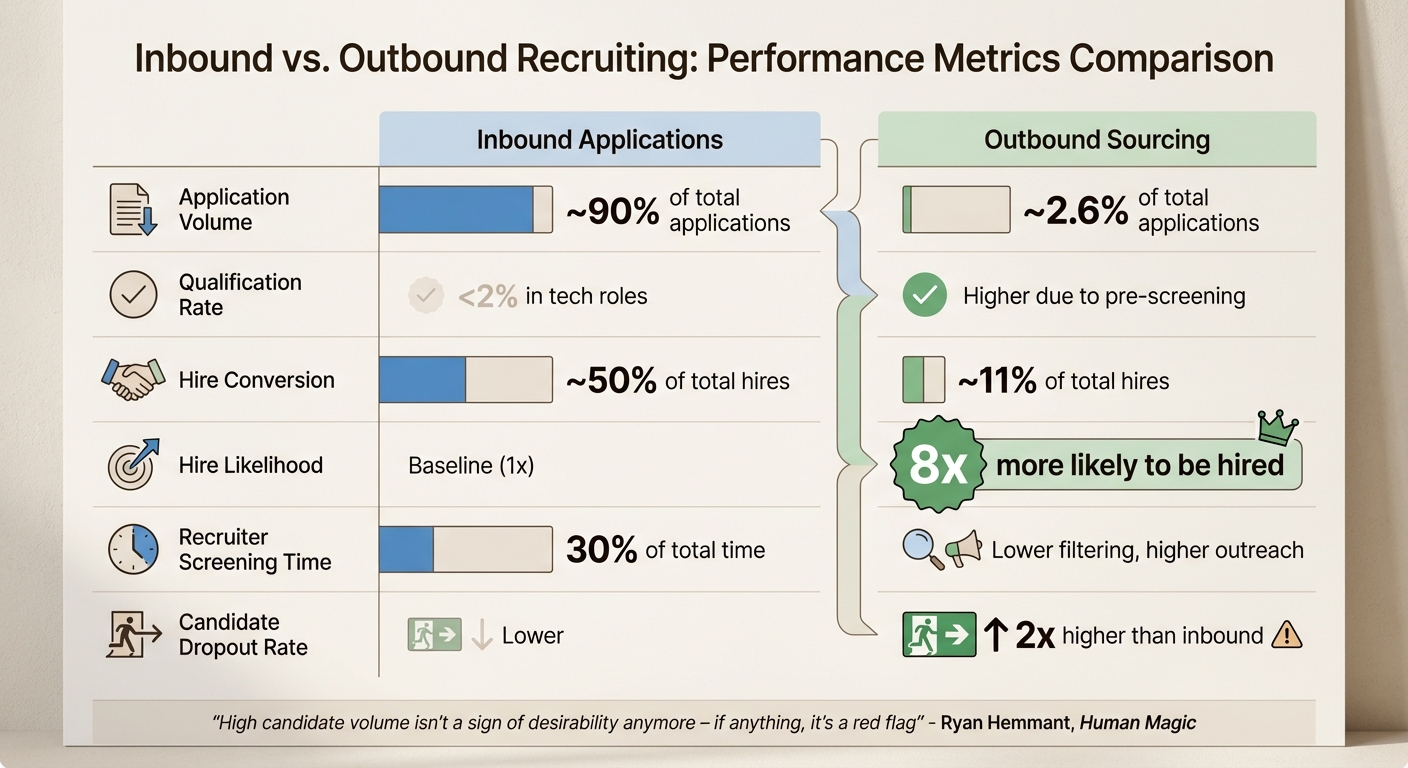 {Inbound vs Outbound Recruiting: Performance Metrics Comparison}
Recruiter Overload and Screening Inefficiencies
Recruiters are drowning in applications, and it's taking a toll on productivity. Today, recruiters spend up to 30% of their time sifting through unqualified applications . That’s valuable time that could be better spent engaging with top candidates or conducting interviews. The workload has skyrocketed - recruiters now handle 93% more applications in 2026 compared to 2021 . At the same time, recruiting teams have shrunk, operating with 14% fewer staff than they did in 2021 .
AI-powered application tools, while intended to streamline the process, have only added to the chaos. These tools allow candidates to mass-apply with tailored resumes in minutes, flooding recruiters with spam and bot-generated applications. Stephanie Manzelli, CHRO at Employ, shares: "Recruiters are getting more applicants, but the increase often, especially nowadays, is spam or bots or unqualified submissions, because people are spraying out applications" . The numbers back this up: between 2021 and late 2024, applications per hire shot up by 182%, while recruiters had to interview 40% more candidates per hire just to find suitable talent .
Low Qualification Rates and Missed Opportunities
The majority of inbound applications don’t make the cut. In high-volume tech roles, less than 2% of inbound applications come from qualified candidates . Even fewer make it past initial screenings - just 8% of applicants advance to the next stage . Ultimately, only 0.5% of applicants receive offers, which translates to one hire for every 200 applications .
This overwhelming volume leads to a troubling "10% rule." When recruiters are buried under hundreds of applications, they often review only the first 10% before moving forward. Jim Miller, VP of People and Talent Acquisition at Ashby, explains: "The noise of all the superfluous applications will cloud the talent pool and make it very difficult to hire the best candidate for the role" . Statistically, this approach means there’s just a 1 in 10 chance that the best candidate in a pool of 100 is even reviewed . For underrepresented groups, who make up a smaller portion of the applicant pool (4%), there’s only a 34% chance that one member will be included in the first 10% reviewed .
The candidate experience for technical roles also suffers. Long, drawn-out hiring processes frustrate applicants - 57% of candidates lose interest in a role if the process drags on , and 42% withdraw because it’s too lengthy or complicated . In July 2025, Mike Conley, a software engineering manager, withdrew from a hiring process that had ballooned to nine interview rounds. His LinkedIn post about the ordeal garnered over 2.6 million views, showcasing how inefficient processes can harm a company’s reputation and scare off top talent .
Comparing Inbound vs. Outbound Metrics
The inefficiencies of inbound applications stand in stark contrast to the performance of outbound sourcing. While inbound efforts generate high volume, they often fail to deliver quality. Outbound sourcing, on the other hand, focuses on targeted efforts, leading to better results:
| Metric | Inbound Applications | Outbound Sourcing |
|---|---|---|
| Application Volume | ~90% of total applications | ~2.6% of total applications |
| Qualification Rate | Often <2% in tech roles | Higher due to pre-screening |
| Hire Conversion | ~50% of total hires | ~11% of total hires |
| Hire Likelihood | Baseline | 8x more likely to be hired |
| Recruiter Screening Time | 30% of total time | Lower filtering, higher outreach |
| Candidate Dropout Rate | Lower | 2x higher than inbound |
"High candidate volume isn't a sign of desirability anymore – if anything, it's a red flag"
– Ryan Hemmant, Human Magic
This shift is prompting talent teams to rethink their priorities. Instead of focusing on application volume as a success metric, they’re turning their attention to the quality of hires and the efficiency of sourcing methods .
How to Filter and Improve Inbound Applications
Recruiters face a tough balancing act: sorting through a flood of applications while ensuring only the best candidates make it through. The goal is to filter out unqualified applicants early, saving time and energy for evaluating the ones who truly fit the role. By setting clear boundaries and using smarter filters, you can streamline the process and focus on quality over quantity.
Setting Application Limits and Auto-Reject Rules
The first step is to block irrelevant applications right at the start. Many modern applicant tracking systems (ATS) can automatically flag duplicate submissions and stop additional applications once a certain volume is reached . This helps prevent your pipeline from becoming overwhelming. For instance, remote jobs attract 51% of all applications on LinkedIn, even though they make up only 14% of job listings . If you're hiring for an on-site role, make that crystal clear upfront and use knockout questions to filter out candidates who are only interested in remote work.
Automation can also handle deal-breakers like visa requirements, salary expectations, or location constraints. Let the system handle these yes/no filters so you can focus on the candidates who meet your baseline criteria. Additionally, track where your best applicants are coming from. Focus on developer sourcing channels that deliver high application-to-offer ratios, not just high volume . If a particular platform repeatedly sends unqualified candidates, it might be time to adjust your posting strategy - or stop using that channel altogether.
Once you've managed the application flow, you can refine the process further with tailored screening methods.
Using Role-Specific Screening Questions
Generic applications are a common headache for recruiters. One way to weed them out is by using open-ended, role-specific questions that force candidates to demonstrate their expertise. The numbers tell the story: 66% of applicants apply after only reading the job title, and just 33% read the minimum qualifications . Screening questions act as a gatekeeper, filtering out those who are just clicking "apply" without understanding the role.
For example, instead of relying on resumes, ask evidence-based questions like: "Describe a time you optimized database query performance. What was the problem, your approach, and the measurable outcome?" This approach pushes candidates to showcase their real skills, not just buzzwords. As Hirium highlights:
"A focused job description filters better than any AI tool. It's your first screening layer; use it well" .
You can also combine multiple-choice knockout questions with free-text responses for a more layered filtering process . Adding a short intro video before the screening questions can help candidates self-select out if the role isn’t a good fit, saving everyone time .
After implementing these filters, it’s important to continuously monitor and fine-tune your process using data.
Tracking and Analyzing Application Quality
To improve your hiring process, you need to measure how well it’s working. Use analytics dashboards to track the quality of your inbound applications over time . For example, monitor pass-through rates (PTR) for each sourcing channel. If one platform requires 200 applications to make a single hire, while another only needs 50, it’s clear where you should focus your efforts.
Hootan Altafi, Head of Talent Operations at Dandy, shares how AI tools can help streamline the process:
"The AI-Assisted Application Review feature from Ashby has been valuable in helping us efficiently sort through this influx. It allows us to quickly flag candidates who meet our key skill requirements while still maintaining a human-centered approach to final evaluations" .
Leverage historical data to create reports on application-to-hire ratios for each channel . While automation is excellent for tasks like flagging duplicates or providing status updates, human judgment remains essential. It’s the human touch that can spot behavioral red flags, overly polished AI-generated resumes, and gaps in real-world experience . Jim Miller, VP of People and Talent Acquisition at Ashby, emphasizes:
"Only screening 10% of your pipeline does not optimize this situation! It might seem efficient, but instead, you'll either make a lower-quality hire, revisit a stale pool of applicants, or ultimately source more" .
Improving Results with daily.dev Recruiter
When it comes to dealing with the flood of job applications, many recruiters face the same challenge: too many applicants, too little quality. Developers often mass-apply without paying attention to job requirements, leaving recruiters to sift through countless unqualified resumes. daily.dev Recruiter flips the script by introducing you to passive, pre-qualified developers who’ve already shown genuine interest in your role. This approach not only saves time but also ensures better candidate matches.
Warm, Double Opt-In Introductions to Pre-Qualified Talent
daily.dev Recruiter uses a double opt-in system to ensure both parties are genuinely interested before connecting. Developers get full visibility into job details - like tech stack, salary range, and work model - and must agree to an introduction. This eliminates the uncertainty and ghosting that often come with traditional recruiting methods. The platform leverages real-time developer activity from its network of over 1,000,000 developers , creating matches based on actual interests rather than outdated resumes.
"Resumes lie. Behavior doesn't. Our AI matches based on what developers are actually learning and building right now."
This system delivers a 100% trust score for warm introductions, compared to less than 1% for cold emails and 5% for LinkedIn InMail . Additionally, candidates hired through this intent-driven approach have 20-30% higher retention rates compared to active vs passive developer recruitment . You can also add up to three custom screening questions to confirm technical fit before moving forward, ensuring only the most qualified candidates enter your pipeline.
By confirming mutual interest and presenting clear, developer-focused job details, daily.dev Recruiter ensures every connection is meaningful.
Developer-Friendly Job Briefs to Attract the Right Talent
Generic job descriptions often miss the mark, attracting candidates who don’t align with the role. daily.dev Recruiter transforms these into developer-centric briefs that focus on the essentials: tech stack, salary range, and work model. Job posts with transparent salary details attract 75% more clicks than those without , giving developers the clarity they need to self-qualify before applying.
The platform’s "Smart Career Match" feature identifies developers whose recent learning activities - like diving into GenAI or React performance optimization - align with your open roles. This approach taps into the 70% of developers who are passive, meaning they’re not actively job hunting but are open to the right opportunity . By connecting with developers where they already spend time learning and engaging, you attract candidates who are genuinely interested in your role, not just clicking "apply" out of habit.
Integration with ATS for Easier Screening
daily.dev Recruiter integrates directly with popular ATS platforms like Greenhouse, Lever, Ashby, Loxo, Zoho Recruit, and Recruit CRM. Its two-way sync automatically transfers pre-screened candidates into your existing workflow, eliminating the need for manual data entry and keeping your pipeline organized. Unlike traditional ATS systems that rely on static resumes and keyword searches, daily.dev provides verified developer data - including tech stack usage, seniority, and location - based on community activity rather than self-reported information .
This integration works seamlessly with your current compliance and management processes while adding the benefit of daily.dev’s real-time behavioral insights. With the optional ATS sync, pre-qualified candidates move directly into your interview pipeline, and you can use custom screening questions to validate their qualifications upfront. Plus, the platform operates on a pay-for-results model, meaning you only pay for successful connections - not for seats or subscriptions.
Conclusion: Focus on Quality Over Quantity
Inbound applications can create the impression of an overflowing talent pool, but they often hide a critical issue: a lack of quality. When recruiters are flooded with hundreds of applications, they typically sift through only the first 10%. This approach not only wastes time but also risks missing out on exceptional candidates buried deeper in the pile.
"Only in one in ten roles at your company will the best applicant even be considered if you only screen the first 10% of your pipeline." – Jim Miller, VP of People and Talent Acquisition, Ashby
This highlights a glaring inefficiency in traditional recruiting methods. A smarter, more effective strategy starts with prioritizing quality over sheer numbers. This can be achieved by implementing better filtering techniques, such as limiting the number of applications, using role-specific screening questions, and tracking metrics that focus on candidate quality. Beyond filtering, targeting pre-qualified candidates - those who have already demonstrated genuine interest - yields better outcomes. Instead of passively waiting for a flood of applications, actively engage with skilled professionals who align with the role.
Tools like daily.dev Recruiter streamline this process by focusing on real-time developer activity rather than outdated resumes or keyword-heavy profiles. With features like warm, double opt-in introductions and transparent job descriptions, you can sidestep the 67% of developers who feel their time is undervalued by recruiters . This ensures you're connecting with candidates who are genuinely interested and aligned with your needs.
FAQs
How can I quickly spot AI-generated or inflated resumes?
When reviewing resumes, certain red flags can suggest the use of AI tools or exaggerated claims. Be cautious of resumes that:
- Use overly polished or generic language without any personal touch.
- Overload on keywords but lack meaningful context.
- Highlight achievements without providing clear metrics or supporting details.
During interviews, inconsistencies can also reveal inflated resumes. For instance, watch for candidates describing projects with unrealistic timelines or vague explanations. To dig deeper, ask for specific examples or situations where they applied their skills. Verifying accomplishments through follow-up questions or references can also help confirm their experience. These steps make it easier to identify resumes that may not accurately reflect a candidate's true background.
What screening questions work best for developer roles?
When screening candidates for developer roles, your questions should dig into three key areas: technical skills, problem-solving abilities, and intent. Here's how you can approach this:
Practical Coding Challenges: Test candidates with real-world coding tasks. These might include debugging exercises, algorithm challenges, or building small features. The goal is to see how they think and code under realistic conditions.
System Design Tasks: For more advanced roles, ask about system architecture or scalability solutions. This helps gauge their ability to design efficient and maintainable systems.
Behavioral Questions: Learn about their communication and teamwork skills. Ask about past experiences where collaboration was critical or how they handled conflicts within a team.
You can also dive into motivation and alignment by asking about their involvement in open-source projects or how they see their skills contributing to your specific projects. This gives insight into their passion and how well they understand your company's goals.
By blending technical assessments, intent-driven questions, and behavioral insights, you can build a comprehensive evaluation process. This approach not only identifies candidates with the right technical expertise but also those who are a good match for your team's dynamics.
How do I measure which inbound channels bring real hires?
To figure out which inbound channels are leading to actual hires, it's essential to track and analyze where applicants are coming from. Tools like inbound source reports can make this process easier. Pay close attention to metrics like the application-to-hire conversion rates and source-specific breakdowns (e.g., paid job boards or niche platforms). By keeping an eye on these pipelines, you can identify the channels that work best and fine-tune your recruiting strategy for better results.
.png)