The hiring process is your company’s first impression, and for developers, it speaks volumes about your workplace culture. A poorly structured process can drive top talent away, while a smooth, transparent journey can win their trust. Here’s what you need to know:
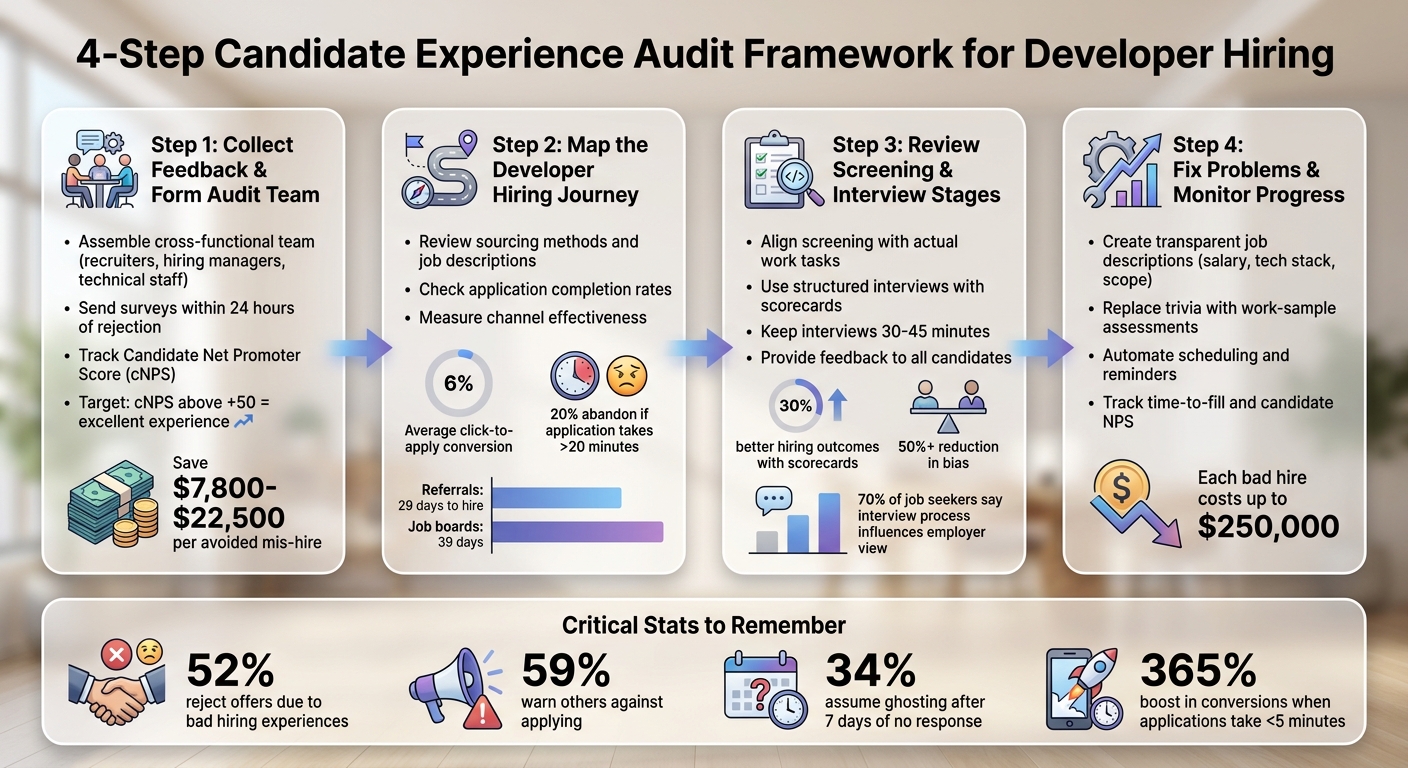
- Why it matters: 52% of candidates reject offers due to bad hiring experiences, and 59% actively warn others against applying to companies with poor processes.
- What developers care about: Transparency, efficiency, and relevance. They judge your hiring process as a reflection of your company’s organization and culture.
- Key steps to improve: Gather candidate feedback, map the hiring journey, refine job descriptions, and align interview tasks with real-world work.
Actionable insights:
- Keep applications under 5 minutes to boost conversions by 365%.
- Avoid vague roles that mix unrelated tasks (e.g., DBA + DevOps).
- Use structured interviews and scorecards to reduce bias and improve outcomes.
- Communicate clearly and promptly - 34% of candidates assume they’ve been ghosted if there’s no response within 7 days.
Takeaway: A candidate-focused hiring process isn’t just about filling roles - it’s about building trust and attracting the right talent. Fixing missteps can save time, money, and your reputation.
Step 1: Collect Feedback and Form Your Audit Team
Assemble a Cross-Functional Team
To get started, put together an audit team with members from different areas of expertise. This diversity helps uncover issues that might otherwise go unnoticed. Include recruiters, hiring managers, and technical staff to ensure that assessments reflect actual job responsibilities . Nimrod Kramer, CEO of daily.dev, highlights the risks of misalignment:
"Mismatch inside the company is killing momentum... When hiring managers, interviewers, and recruiting aren't aligned on the real work, the loop degenerates into trivia, vibes, and stall-outs" .
Kick things off with an alignment meeting involving department leaders, recruiters, and hiring managers. Use this time to establish priorities and agree on success criteria . A Hiring Manager Intake Form can help everyone get on the same page about job requirements early on. This simple alignment step could save anywhere from $7,800 to $22,500 per mis-hire for a $60,000 salary role . Additionally, consider assigning someone to act as a "mystery shopper" by going through your application process to pinpoint areas of friction . Then, gather direct feedback from candidates to validate the team's observations.
Gather Feedback from Developer Candidates
Rejected candidates can offer some of the most honest and unbiased feedback. Send out surveys within 24 hours of rejection, while the experience is still fresh in their minds . For successful hires, wait until after their first week on the job to ask if the interview process aligned with the actual role .
Ask specific questions to uncover recurring issues. For example, check whether interview tasks reflected real work, if the job description clearly communicated the tech stack and salary, and whether candidates received clear reasons for rejection. A study into common problems in developer hiring revealed 66 detailed comments about issues like pedigree bias, unclear compensation, and "ghost jobs" . It's also worth noting that 34% of candidates assume they've been ghosted if they don’t hear back within seven days .
Build a Feedback Scorecard
Develop a standardized scorecard that uses a 1–5 scale across all feedback forms to identify patterns . Key areas to evaluate include:
- Application friction (ease of completion, clarity of job descriptions)
- Recruiter quality (technical knowledge, clarity on next steps)
- Interview relevance (how well tasks mirror day-to-day responsibilities)
- Respect for candidates' time (total process duration)
- Communication (timeliness of rejection notices)
Make sure to include an open-ended question asking for one specific improvement suggestion . To measure overall candidate experience, track the Candidate Net Promoter Score (cNPS). Ask candidates if they’d recommend applying and calculate the score by subtracting the percentage of detractors (0–6 ratings) from promoters (9–10 ratings). A cNPS above +50 indicates an excellent candidate experience . Using structured scorecards can also make a big impact - companies that adopt them report 30% better hiring outcomes and reduce bias by over 50% .
Step 2: Map and Review the Developer Hiring Journey
Once you've gathered insights from candidates, it's time to step into their shoes and analyze your hiring process. Map out every interaction a developer has with your company, starting from the job posting all the way to the final interview. This detailed overview will help you identify where candidates might face challenges or lose interest. Use the feedback collected in Step 1 to zero in on the exact stages that need improvement.
Review Your Sourcing Methods
Begin by crafting job descriptions that leave no room for confusion. Missing key details like salary, tech stack, or work-life balance often causes candidates to lose interest . Developer Maksym summed it up perfectly:
"I have no idea why I'd want to work for you. You haven't announced a salary or described the tasks" .
Make sure your job descriptions clearly outline compensation, daily technologies, and realistic expectations. Vague or overly generic listings lead to higher bounce rates and wasted effort for both you and the candidates.
Next, assess where and how you're promoting these improved job descriptions. If you're using tools like daily.dev Recruiter, check whether your postings align with what developers actually care about - transparency, honest limitations, and a clear scope of work. Cold outreach that feels impersonal or overly sales-driven is often ignored, while personalized, opt-in introductions tend to engage passive candidates more effectively.
Examine How Developers Find Your Roles
Understand which channels are driving qualified applicants. With an average click-to-apply conversion rate of 6% in 2024 , your job posts need to make an immediate impact. Strong employer branding and well-crafted briefs that provide enough context can help developers quickly determine if the role is a good fit.
Consider the application experience itself. One in five developers will abandon an application if it takes more than 20 minutes , and 60% will drop out if the process feels overly complicated or slow . Check your application page's load times and remove redundant fields - there's no need to ask candidates to re-enter details already on their resumes.
Measure Sourcing Performance
Use data to evaluate the effectiveness of your sourcing efforts. Monitor your application completion rate to spot potential bottlenecks , and measure the quality of your sources by comparing hires to the total number of candidates from each channel .
Pay close attention to your applicant-to-interview ratio. If only 3% of applicants make it to the interview stage, it could mean your sourcing methods are attracting unqualified candidates or that job descriptions aren't accurately reflecting the role . Additionally, track your cost per hire by dividing total recruiting expenses by the number of hires. Keep in mind that referrals typically result in faster hires (29 days on average) compared to job boards (39 days) or career sites (55 days) . These metrics can help you refine your approach and focus on what works best.
Step 3: Review Screening and Interview Stages
Once you've mapped out your hiring process, it's time to fine-tune the screening and interview phases. With 90% of recruiters predicting a candidate-driven labor market by 2026 , nailing these steps is essential. These stages connect the initial touchpoints with in-depth evaluations of technical fit. Use your mapping insights and candidate feedback to shape a process that aligns with developers' expectations.
Check Your Screening Criteria
Take a hard look at your screening criteria. Are they truly aligned with the work developers will be doing? A common misstep is relying on surface-level metrics like years of experience or past employers instead of focusing on what actually matters. Nimrod Kramer, CEO of daily.dev, puts it perfectly:
"The signal is can this person solve our kind of problems, with our kind of constraints, with curiosity and care? Right now, we screen for what's easy to count - logos, years, acronyms - and miss what actually matters."
Move beyond these "countable" metrics. Instead, incorporate work-sample assessments that reflect real tasks, such as debugging APIs, editing SQL queries, or resolving tickets . Ensure that hiring managers, recruiters, and engineers are all on the same page about the technical requirements and the level of seniority needed.
Transparency is key. Let candidates know upfront which technologies will be tested, the format of the questions, and how their performance will be evaluated . If you're using take-home projects, keep them short - 1 to 3 hours max - or consider compensating candidates for their time . Software Engineer Ricardo Tovar emphasizes the importance of clarity:
"Developers really appreciate getting an overview of the whole interview process, from the get go. I like to be aware of how many rounds there's going to be, and a rough timeline."
Evaluate Interview Format and Communication
With your screening criteria in place, it's time to revisit your interview structure. Make sure it reflects the same standards while keeping candidates comfortable. Shift away from abstract algorithm challenges and focus on tasks that mimic real work, like debugging, refactoring, or reviewing pull requests . Keep interviews concise - 30 to 45 minutes - and use environments like IDEs instead of whiteboards to create a more realistic and less stressful experience .
Aim for interviews that feel like a collaborative peer discussion rather than an interrogation . For practical tasks, consider shorter "watch-them-work" assessments (30–60 minutes) instead of lengthy multi-day assignments, which often discourage top candidates from continuing .
To reduce bias, use structured evaluations with scorecards and predefined rubrics, especially during technical assessments . Leading tech companies often evaluate candidates on four main pillars: Communication, Problem Solving, Technical Competency, and Testing (handling edge cases) . Consistency is critical - ask all candidates for a specific role the same core questions to ensure fairness .
Finally, always provide feedback, even to candidates who don't make it through. As Nimrod Kramer points out:
"If your process feels like hazing, great people will self-select out. Not because they can't do it. Because they won't."
Track Screening and Interview Data
Keep an eye on key metrics to spot issues in your screening and interview stages. For example, monitor the screening completion rate. If it's under 50%, your process may be too cumbersome or demanding . Traditional phone screens typically see completion rates of 30–50%, but asynchronous methods can boost this to 70% .
Track your time-to-screen, which measures how long it takes for a candidate to complete their evaluation after entering the pipeline. Aim for less than 48 hours for high-volume roles and under five business days for specialized positions . Delays here could mean losing top talent to competitors. Structured AI interviews can significantly cut this timeline - from eight days to just 2.75 days, a 66% decrease .
After screening, send candidates a quick three-question survey while their experience is still fresh. This will help you gather candidate feedback scores on fairness and clarity . Why does this matter? Because 70% of job seekers say the interview process directly influences how they view an employer . Lastly, measure predictive validity by tracking how well screening results align with success in later interview stages. Structured interviews can make a big difference - candidates who pass these are 54% more likely to succeed in final interviews, compared to just 34% for those selected through traditional resume screening .
Step 4: Fix Common Problems and Make Improvements
Take advantage of candidate feedback and hiring journey mapping to uncover and address flaws in your hiring process. The data you’ve collected can highlight recurring issues like unclear job descriptions, gaps in communication, or technical assessments that don’t align with actual job requirements. Fixing these areas can transform your hiring process into a competitive edge.
Common Mistakes in Developer Hiring
Feedback and journey mapping can help you identify specific missteps that hurt candidate engagement. For instance, vague job descriptions often leave out key details like salary, tech stacks, or realistic experience requirements. On the other hand, trivia-heavy interviews focus on rote memorization rather than actual problem-solving skills. Pablo Portillo, a Google Cloud Specialist at Telus, shares:
"I've seen these 'all-in-one' roles that combine skills for DBA, full-stack, network, DevOps… all in one single profile, and that for me is a red flag."
Communication breakdowns also take a toll on the candidate experience. Long, drawn-out processes or unclear updates can cause developers to lose interest. Additionally, misalignment between recruiters and hiring managers - whether it’s about role expectations, budget, or seniority - leads to wasted time and frustration for everyone involved.
Use Tools to Improve Your Process
Start by creating clear and transparent job descriptions. Include essential details like salary ranges, specific tech stacks, remote work policies, and a realistic scope of responsibilities. This level of clarity builds trust and saves time right from the start.
Replace generic coding tests with work-sample assessments that reflect the actual tasks candidates would handle on the job. For example, you could ask candidates to debug an API, refactor outdated code, or review a pull request using your company’s tech stack. Keep these tasks short, or compensate candidates if a more extensive evaluation is needed .
Leverage ATS integrations to automate repetitive tasks like scheduling, sending reminders, and data entry. This allows your team to focus on meaningful interactions. Nimrod Kramer emphasizes the importance of this approach:
"Use AI to free up humans, not replace them. Automate reminders, scheduling, parsing. Keep the conversation human."
For sourcing, consider platforms with double opt-in systems, like daily.dev Recruiter. These tools ensure mutual interest before outreach, reducing spam and encouraging more genuine connections.
Once these tools are in place, shift your attention to tracking measurable outcomes.
Monitor Your Progress
Track key metrics to gauge the success of your improvements. Use candidate feedback to analyze metrics like application abandonment rates and time-to-fill. For example, if 20% of candidates abandon an application that takes over 20 minutes to complete, it’s a sign your process might be too time-consuming . Similarly, monitor your time-to-fill to avoid losing top talent, as delays can be costly - vacant tech roles cost an average of $500 per day .
Evaluate your hiring sources and assess new hires’ technical skills, team compatibility, and ramp-up time. To measure candidate satisfaction, use the Net Promoter Score (NPS) to see if candidates would recommend your company, regardless of the outcome . Finally, compare your interviews-per-hire ratio before and after implementing changes to determine if your screening process has become more efficient.
Conclusion: Create a Developer-Focused Hiring Process
Main Lessons from the Audit
Your audit findings highlight several key points to refine your hiring process. Clarity matters - developers want upfront details like salary ranges, specific tech stacks, and clear job expectations from the very first interaction . Structured interviews help minimize bias and improve decision-making, while realistic assessments give candidates a sense of the actual work they’d be doing . Isaac Lyman, a writer at Stack Overflow, captures this perfectly:
"Unscripted conversations aren't interviewing; they're speed dating. Yet employers stubbornly believe they're the most effective way to select high-performing candidates."
The stakes are high - each bad hire could cost your company up to $250,000 . This underscores why respecting candidates' time and providing timely feedback isn’t just polite; it’s a business imperative. Nimrod Kramer, CEO of daily.dev, puts it succinctly:
"Trust is the only edge that lasts."
These lessons pave the way for a hiring strategy that evolves with the needs of developers and the demands of the industry.
Keep Your Hiring Strategy Current
Developer expectations don’t stand still, and neither should your hiring process. A single audit won’t cut it. Regularly revisiting your strategy - whether quarterly for fast-growing teams or annually for stable ones - helps you stay ahead of shifting trends. This proactive approach allows you to spot bottlenecks before they cost you top-tier talent .
To make these changes easier, consider using a developer hiring checklist and tools that align with candidate preferences. Platforms with double opt-in models reduce spam and show respect for developers’ time, creating a better candidate experience. Remember, your hiring process should evolve as quickly as the technology your team works with. Falling behind risks leaving you stuck with outdated methods in a fast-moving market. Regular updates ensure your approach remains as agile as the developers you’re looking to bring on board.
FAQs
What should I track to know if our candidate experience is improving?
Tracking progress in improving the candidate experience requires monitoring a few key metrics. Focus on candidate feedback, which provides direct insights into their experience. Pay attention to response rates to your outreach efforts and assess how clear your communication is throughout the process. Finally, measure overall candidate satisfaction to pinpoint areas that need attention and to see how things evolve over time. These metrics can serve as a guide for refining your approach.
How do I replace algorithm-style interviews with real-world assessments?
To step away from traditional algorithm-heavy interviews, consider using assessments that mirror actual job tasks. Begin by pinpointing the key responsibilities and challenges candidates will encounter in the role. From there, design scenario-based exercises - like coding challenges or real-world problem-solving tasks - that test their ability to handle those situations. Incorporating these practical assessments early in the hiring process provides a clearer picture of a candidate's skills and ensures they're better suited to the job's demands.
How often should we run a developer hiring process audit?
Running a developer hiring process audit on a regular basis is a smart move. How often you should do this depends on a few factors, such as the size of your company, the number of developers you hire, and how successful your current process is. These reviews help you adapt to evolving developer expectations and ensure your hiring approach stays efficient and appealing.
.png)