Hiring Developer Advocates and DevRel Engineers is more challenging than ever in 2026. These roles require a rare mix of technical expertise, communication skills, and community engagement. As the developer tools market grows to $15 billion, companies are prioritizing DevRel to build trust with developers who avoid traditional marketing.
Key Insights:
- Role Clarity: Understand the differences between Developer Advocates, DevRel Engineers, and Community Managers. Each has distinct responsibilities, from creating SDKs to managing developer communities.
- Hiring Challenges: Only 500 professionals in DevRel exist in cities like San Francisco compared to 100,000 software engineers. Finding candidates with the right balance of skills is tough.
- Sourcing Talent: Look beyond job boards to places like GitHub, Dev.to, conference speaker lists, and internal teams.
- Interview Process: Focus on practical tasks like portfolio reviews, live exercises, and paid trial projects.
- Compensation: Salaries average $160,000, with senior roles reaching $200,000–$280,000.
To succeed, align DevRel hires with your company’s growth stage and ensure leadership understands their long-term impact. DevRel isn’t about sales quotas - it’s about building developer trust and influencing product success.
What Developer Advocates and DevRel Engineers Actually Do
Before starting your developer sourcing process, it’s crucial to understand the different functions within Developer Relations (DevRel). While every DevRel professional has the same overarching goal - helping developers succeed with a particular technology - how they achieve this varies based on their role. So, before drafting a job description, take a step back to figure out exactly what you need. After all, "DevRel" isn’t a one-size-fits-all job.
The DevRel Role Spectrum: Community, Content, and Product
DevRel roles generally fall into three main categories: content, community, and code. Most positions lean heavily on one of these areas, but the strongest candidates often have skills that cross into multiple categories.
| Role | Primary Focus | Key Deliverables |
|---|---|---|
| Developer Advocate | Bridge/Liaison | Tutorials, demos, feedback loops, workshops |
| Developer Evangelist | Awareness & Promotion | Keynote talks, blog posts, webinars |
| DevRel / DX Engineer | Technical Tools | SDKs, API wrappers, sample code, documentation |
| Community Manager | Community Health | Discord/Slack moderation, event logistics, AMAs |
Among these, the Developer Advocate is often the most common hire. They typically divide their time between creating technical content like blog posts, tutorials, and demo videos (30–40%), engaging with developer communities on platforms such as Discord, GitHub, and Stack Overflow (25–30%), and working internally to share developer feedback with product teams and influence the roadmap.
On the other hand, a DevRel Engineer (sometimes called a Developer Experience Engineer) takes on a more technical role. Their focus is on creating the tools and resources that developers rely on - SDKs, API libraries, quickstart templates, and documentation tools. Unlike community-focused roles, they operate more like software engineers.
"Our role is to act as the bridge between internal engineering teams and our developer community. We also advocate for developers internally." - Wassim Chegham, Senior Developer Advocate, Microsoft
Understanding this spectrum helps dispel common misunderstandings about DevRel roles.
Common Misconceptions About DevRel Roles
One big mistake hiring managers make is treating DevRel as an extension of marketing. While marketing teams often focus on metrics like sales quotas or MQLs, DevRel is built on relationships and trust. Developers can quickly see through efforts that feel like pure sales pitches, and this can damage credibility .
Another misconception is viewing DevRel as a form of free customer support. While DevRel professionals do interact with developers, their role isn’t to cover up deeper product or organizational issues. If a Developer Advocate only engages externally without bringing developers’ challenges back to the product team, they become less of a strategic partner and more of a marketer .
"A DA who only talks to developers externally is a marketer. A DA who also changes the roadmap is a growth lever." - Marcus Rivera, Tech Journalist
These distinctions are essential when crafting job descriptions for DevRel roles. To find the right fit, you can also leverage developer networks that track real-world learning behaviors.
Sample DevRel Job Descriptions
Here are examples of well-defined DevRel job descriptions:
Developer Advocate (Series A–B SaaS)
- Create technical tutorials, integration guides, and "Getting Started" content
- Represent the product at developer conferences and community events
- Moderate and grow the company’s Discord and GitHub Discussions communities
- Gather and synthesize developer feedback into structured product reports
- Build demo apps and sample projects to shorten developer onboarding time
- Required: 3+ years of software engineering experience; strong written and verbal communication skills; active presence in developer communities
DevRel Engineer / Developer Experience Engineer (Series B+)
- Build and maintain SDK libraries, API wrappers, and CLI tools
- Manage developer documentation infrastructure and contribute to technical writing
- Beta test new product features and file detailed improvement tickets
- Develop quickstart templates and integration samples for key use cases
- Required: 5+ years of software engineering experience; expertise in developer-facing tools; familiarity with API design principles
Both roles are grounded in the "3 Cs" framework - Coding, Community, and Content - though the focus shifts depending on the specific position. Clear role definitions not only simplify hiring but also ensure you’re building a DevRel team that meets your organization’s needs.
Why Hiring DevRel Roles Is Uniquely Difficult
The Multi-Disciplinary Nature of DevRel
Hiring for most technical roles is fairly straightforward: engineers tackle coding challenges, and marketers showcase their campaign strategies. But when it comes to Developer Relations (DevRel), the game changes. DevRel professionals need both technical expertise and a knack for building and nurturing communities - a combination that’s not easy to find.
Take San Francisco as an example. While the city boasts around 100,000 software engineers, only about 500 professionals work in DevRel . This stark difference highlights how challenging it is to find the right candidates for these roles. Posting a job ad isn’t enough; sourcing DevRel talent demands a more tailored approach.
Traditional hiring methods often fall short. Recruiters with an engineering focus may overemphasize technical skills, while those from marketing might prioritize metrics like lead generation. This can lead to mismatches because DevRel sits at the intersection of these disciplines, requiring a balance of both .
"Technical skill can be learned quickly on the job, but empathy has got to be there from day one." - Sam Julien, Developer Relations Leader
Another challenge? Many potential candidates - like experienced engineers or open-source contributors - don’t even see DevRel as a career option . This lack of visibility makes finding the right fit even harder. Given these hurdles, companies should first assess whether they’re truly ready to bring a DevRel professional on board.
Is Your Organization Ready to Hire DevRel?
One mistake companies often make is hiring a DevRel too early. For a DevRel hire to succeed, the organization needs to have certain foundations in place: a solid product, an active developer audience, and processes that ensure community feedback reaches the right teams. Without these, even the most talented DevRel professional may struggle to deliver results.
"Your first DevRel should scale what's already working, not completely start from scratch." - Josh Dzielak, Co-Founder and CTO, Orbit
Before diving into the hiring process, consider this readiness checklist:
- Clear Goals: Define measurable objectives, like improving activation rates or reducing time-to-value, instead of vague targets like "increasing brand awareness."
- Internal Influence: Set up a system to route community feedback directly to product and engineering teams.
- Technical Resources: Ensure there’s adequate documentation, SDKs, or sample code for the new hire to work with.
- Executive Buy-In: Make sure leadership understands that DevRel results often take 6 to 12 months to materialize.
Avoid assigning DevRel hires to a mix of unrelated tasks. Instead, decide upfront whether their role will focus on driving growth (e.g., attracting new users) or enhancing success (e.g., helping existing users get more value). This clarity will shape everything from the job description to the interview process.
How DevRel Differs from Adjacent Roles
To hire effectively, it’s important to distinguish DevRel roles from similar positions like Solutions Engineers, Product Marketers, and Community Managers. While these roles share some overlap in technical communication and external engagement, their core responsibilities and success metrics are quite different:
| Role | Primary Responsibility | Key Skills | Success Metrics |
|---|---|---|---|
| Developer Advocate | Connects external developers with internal teams | Coding, content creation, community building, empathy | Community engagement and product feedback |
| Solutions Engineer | Provides technical sales support | Delivering technical demos, customer communication | Sales performance and technical wins |
| Product Marketer | Crafts messaging and go-to-market strategies | Copywriting, market analysis | Lead generation and brand influence |
| Community Manager | Manages platform moderation and engagement | People skills, community platform management | Engagement rates, community growth |
What sets Developer Advocates apart is their role as a bridge between developers and the company. They bring valuable developer insights back to the team, influencing the product roadmap in meaningful ways. Unlike Solutions Engineers, who focus on closing deals, or Product Marketers, who aim to generate leads, Developer Advocates combine technical knowledge with communication and community-building skills. Understanding these distinctions can help you fine-tune your hiring strategy and set clear expectations for the role.
Where to Find and Attract DevRel Candidates
Top Sourcing Channels for DevRel Talent
Great DevRel candidates are often already immersed in the community. Instead of applying through standard job postings, they’re likely already doing the work - just without the title.
Take conference speaker lists, for example. Presenters at events like KubeCon or DevCon have already demonstrated their ability to break down complex technical topics for live audiences - a key skill for any DevRel role. Similarly, GitHub open source maintainers showcase their technical expertise and patience by writing clear issue responses and maintaining detailed documentation.
Other excellent sources include platforms like Dev.to, Hashnode, and YouTube. These spaces act as public portfolios, where you can see how candidates explain ideas, interact with their audience, and maintain consistency. Don’t overlook community moderators managing Discord servers or Slack groups. Their experience in handling large-scale public interactions makes them a natural fit for community-focused DevRel positions.
Lastly, consider looking internally. Promoting a senior engineer or solutions architect who already enjoys discussing the product can be one of the quickest ways to secure a strong DevRel hire .
| Sourcing Channel | Best For | Key Signal |
|---|---|---|
| Conference Speaker Lists | Senior Advocates | Public speaking and technical expertise |
| GitHub Maintainers | DevRel Engineers | Code quality and community engagement |
| Technical Bloggers | Content Specialists | Simplifying complex ideas |
| Community Moderators | Community-Focused Roles | Proven public engagement skills |
| Internal Engineers | First DevRel Hire | Deep product knowledge and team trust |
Once you’ve identified the right channels, focus on crafting outreach strategies that turn interest into meaningful conversations.
How to Reach Out to DevRel Candidates
Generic cold outreach doesn’t work with DevRel candidates. These individuals are highly specialized and likely accustomed to receiving impersonal messages. To stand out, your approach needs to be both personalized and transparent.
Reference something specific - like a blog post, GitHub pull request, or conference talk - that grabbed your attention. This shows you’ve done your homework and aren’t just sending out a mass email. Transparency is equally important: share details upfront about salary, travel expectations (e.g., how many conferences they’ll need to attend per year), and their influence on the product roadmap. Serious candidates will ask these questions anyway, so addressing them early builds trust .
"Treating an advocate as a quota-carrying salesperson is the fastest way to destroy their credibility and your program's effectiveness." - Matt Pru, Stackmatix
Another practical option? Offer a paid trial project to finalists. Whether it’s writing a short tutorial or running a mock office hour, this allows both parties to get a clearer sense of fit before making a full commitment .
How daily.dev Recruiter Helps with DevRel Hiring
After identifying where top candidates are active, daily.dev Recruiter can help you connect with them efficiently. The toughest part of hiring for DevRel is that the best candidates aren’t actively job hunting - they’re busy creating tutorials, answering community questions, and engaging with developer news. That’s exactly where daily.dev Recruiter steps in.
Because developers rely on daily.dev to read, learn, and interact with technical content, the platform naturally highlights candidates who are already exhibiting key DevRel behaviors. Instead of sorting through outdated resumes or sending cold emails that often go ignored, recruiters can connect with developers who are actively contributing to technical communities - a strong indicator of their potential for DevRel roles.
What makes this approach even more effective is its warm, double opt-in introductions. Candidates have already expressed interest in hearing about opportunities, ensuring that your outreach is welcome. This is especially critical in DevRel hiring, where a poorly timed or impersonal message can harm your reputation within a candidate’s network. With daily.dev Recruiter, the process prioritizes trust over volume - an approach that resonates deeply with DevRel professionals.
How to Assess and Interview DevRel Candidates
Skills to Evaluate: Technical, Communication, and Community
Hiring for a DevRel role is unlike hiring a software engineer or a marketing expert. The ideal candidate needs to not only write functional code but also explain it in a way that resonates with a room full of developers - a combination that's not easy to find.
Start by evaluating technical skills. A strong DevRel professional should be proficient in at least one relevant programming language, such as JavaScript, Python, Go, or Rust. They should also understand API design, SDKs, and tools like GitHub, CI/CD pipelines, and Postman . Developers often have the authority to approve or reject tools outright , so a DevRel candidate who can't hold their own in technical discussions risks losing credibility.
Next, examine their communication abilities. It's not just about explaining concepts to experts; the real challenge lies in breaking down complex ideas for beginners without being condescending. Review their content for clarity, tone, and audience alignment. Do they define terms when necessary? Avoid jargon? Get to the point without unnecessary fluff? These are all critical indicators of effective communication .
Lastly, consider their community involvement. Check for active participation on platforms like GitHub Discussions, Stack Overflow, Discord, or Slack. Ask them to walk you through a piece of content they’ve created. What problem did it address? Who was the target audience? What was the outcome? If they can't articulate their process or the impact of their work, it’s a warning sign, regardless of how many followers they have .
Designing a DevRel Interview Process
Once you’ve identified the key skills, design a developer hiring checklist and interview process that mirrors the real-world challenges of DevRel. Traditional technical screens, like LeetCode-style exercises, are a poor fit for this role. They suggest a lack of understanding about the position and can quickly turn off top candidates .
Instead, structure the interview around practical tasks. A four-step approach works well:
- Portfolio review: Start by examining their public work - blog posts, GitHub contributions, conference talks, or tutorials. This is a quick and effective way to gauge their capabilities .
- Live exercise: Ask the candidate to explain a technical concept first to developers and then to nontechnical stakeholders. This tests both their technical depth and their ability to communicate with empathy .
- Scenario-based exercise: Present a realistic situation, like handling public criticism of your product’s documentation in a community forum. This reveals how they navigate communication and community management challenges .
- Paid trial project: For finalists, assign a short paid task, such as drafting a tutorial or creating community guidelines. This gives you a glimpse of how they work and deliver results .
You might also consider asking them to critique your current "Getting Started" guide. A strong candidate will quickly identify unclear instructions, missing details, or confusing error messages - because they’ve been in the shoes of a developer trying to learn something new .
Scoring Rubrics for DevRel Candidates
To avoid subjective judgments, use a structured scoring rubric. This ensures consistent evaluations across interviewers and prevents one strong skill, like public speaking, from overshadowing weaker areas like technical expertise.
| Competency | What to Look For | Rating (1–5) |
|---|---|---|
| Technical Depth | Can write and explain working code; familiar with tools and APIs | - |
| Storytelling | Adjusts tone and depth for different audiences; avoids jargon | - |
| Community Instinct | Active in developer spaces; shows empathy and responsiveness | - |
| Content Quality | Portfolio demonstrates practical, audience-focused work | - |
| Business Awareness | Links work to outcomes like adoption, retention, or NRR | - |
Rate each area on a 1–5 scale, and require interviewers to provide notes. This prevents biases, like favoring polished presenters over candidates with deeper technical knowledge. For instance, someone scoring a 5 in storytelling but a 1 in technical depth might be better suited for marketing than DevRel .
Keep an eye out for red flags during the process. Candidates who overemphasize their social media following instead of content quality, use marketing-heavy language that developers dislike, or frame success solely in terms of leads and conversions are unlikely to thrive in a DevRel role . Building authentic developer relationships requires a very different mindset from hitting sales quotas.
DevRel Titles, Compensation, and Team Building
DevRel Titles and What Each Role Covers
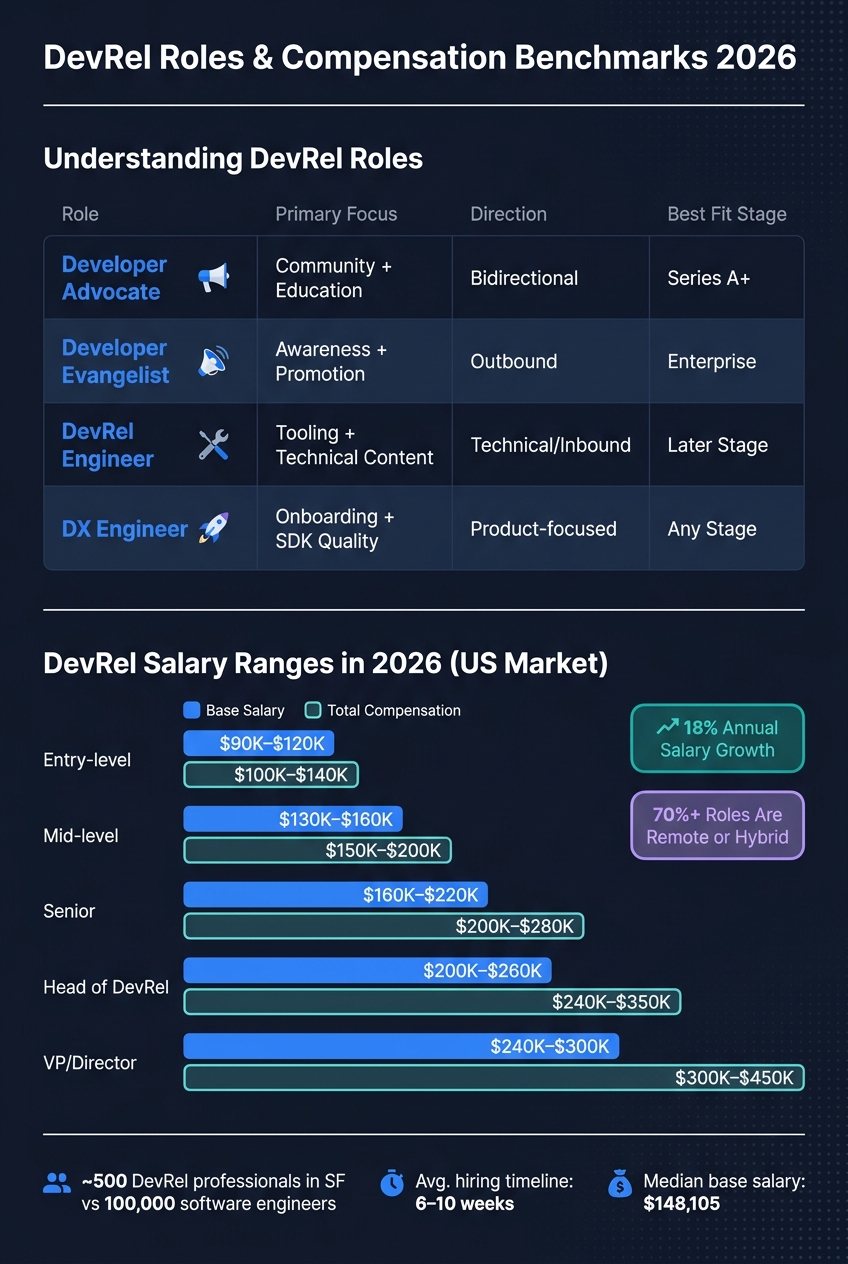
The world of DevRel titles can be a bit confusing. Terms like "Developer Advocate", "Developer Evangelist", "DevRel Engineer", and "Developer Experience Engineer" are often tossed around as if they mean the same thing. But each role has its own focus and responsibilities.
| Role | Primary Focus | Direction | Best Fit |
|---|---|---|---|
| Developer Advocate | Community + Education | Bidirectional | Series A+ |
| Developer Evangelist | Awareness + Promotion | Outbound | Enterprise |
| DevRel Engineer | Tooling + Technical Content | Technical/Inbound | Later Stage |
| DX Engineer | Onboarding + SDK Quality | Product-focused | Any Stage |
A Developer Advocate acts as a two-way bridge. They educate the developer community while also bringing valuable feedback to the product team. On the other hand, a Developer Evangelist is outward-facing, focusing on building excitement and raising awareness, often within enterprise settings . As Iris, former COO of AFFiNE, explains:
"A DA who only talks to developers externally is a marketer. A DA who also changes the roadmap is a growth lever." - Iris, Ex-CoFounder & COO, AFFiNE
Meanwhile, DevRel Engineers dive into the technical side, creating SDKs, sample applications, and integrations . DX Engineers focus on improving the developer's first experience, such as refining onboarding processes, clarifying documentation, and shortening the time it takes for users to achieve a working result .
The right title depends heavily on your company’s market approach. Product-Led Growth companies often need advocates who can drive user activation, while Sales-Led companies benefit from advocates who can build credibility with enterprise clients. For hybrid models, starting with a strong Technical Content Writer can be a smart move . Recruiters can use these distinctions to craft job postings that attract candidates with the right mix of skills.
DevRel Compensation Benchmarks for 2026
Now that the roles are clear, let’s talk numbers. By 2026, DevRel salaries averaged $160,000, reflecting an 18% annual increase . In the U.S., Developer Advocates earned a median base salary of $148,105 .
| Level | Base Salary | Total Compensation |
|---|---|---|
| Entry-level | $90K – $120K | $100K – $140K |
| Mid-level | $130K – $160K | $150K – $200K |
| Senior | $160K – $220K | $200K – $280K |
| Head of DevRel | $200K – $260K | $240K – $350K |
| VP/Director | $240K – $300K | $300K – $450K |
Compensation packages often include equity, travel budgets, and remote work flexibility. In fact, over 70% of DevRel roles are now fully remote or hybrid . However, mismatched travel expectations remain a major cause of burnout and early turnover in this field . Including salary ranges in job postings not only builds trust but also speeds up the hiring process .
Building a DevRel Team: First Hires and Growth
Once you’ve defined roles and set competitive salaries, the next step is structuring your team. Aligning your DevRel hires with your company’s growth stage is crucial for success. As Josh Dzielak, Co-Founder and CTO of Orbit, advises:
"Your first DevRel should scale what's already working, not completely start from scratch." - Josh Dzielak, Co-Founder and CTO, Orbit
For companies with $0–$1M ARR, hiring a generalist is the way to go. This person can manage developer forums, respond on platforms like Reddit and Hacker News, and ensure technical accuracy. As revenue grows to $1M–$5M ARR, you can add a strategic lead and a couple of specialists, such as a content manager or community manager. By the time you hit $10M–$20M ARR, your team might expand to 10+ members, including directors for content, product marketing, and demand generation .
The reporting structure also plays a big role in DevRel's success. Reporting to Marketing can provide resources but might make the team feel overly promotional. Reporting to Engineering offers technical depth but may limit outreach. Product-led reporting often creates the strongest feedback loop for improving the developer experience . For companies beyond $10M ARR, a standalone DevRel team with its own budget is often the most effective setup .
As your team grows, think about how each new hire adds to your capabilities. Whether it’s technical expertise, community engagement, or content production, avoid simply duplicating the generalist role that worked in the early stages. Each new addition should bring something fresh to the table.
Key Takeaways for Hiring DevRel Talent in 2026
Finding the right DevRel talent is no small feat. On average, hiring for these roles takes around 6–10 weeks . In tech hubs like San Francisco, the numbers speak volumes - there are roughly 500 DevRel professionals compared to a staggering 100,000 software engineers . With such limited availability, every step in your hiring process carries weight.
Start by clearly defining the role before you even post the job. This definition will influence everything - from where you source candidates to how you design interviews and measure success. Align the role with your company’s go-to-market strategy. For instance, sales-led companies often need professionals who can build technical credibility, while product-led companies benefit more from generalists focused on user activation. Getting this clarity upfront is crucial for sourcing the right candidates.
When it comes to sourcing, skip traditional résumé screenings. The best DevRel candidates are already making an impact - you’ll find them writing technical tutorials, managing open-source projects, speaking at conferences, or moderating developer communities. Focus on candidates with visible contributions. As Tushar Soni, Founder of Built for Devs, puts it:
"If you can't draw a line from your work to business outcomes, you don't have a function - you have a hobby."
Don’t get distracted by surface-level credentials. Instead, assess candidates through practical exercises that showcase their skills. Whether it’s a live demo, a writing sample, or a paid "SuperDay" where they tackle real-world tasks, these methods provide a clearer picture of their technical expertise, communication abilities, and community engagement .
Finally, set realistic expectations within your team. DevRel’s impact often takes 6–12 months to show measurable results in terms of signups and retention . Treating DevRel like a sales role with quotas - or measuring success by GitHub stars or badge scans - can drive away top talent. Instead, create an environment where they can genuinely connect with the developer community. When done right, the business outcomes will naturally follow.
FAQs
When should a startup hire its first Developer Advocate?
Startups should wait to hire their first Developer Advocate until the founders or executives have personally explored the role. Jumping the gun can lead to attracting candidates who shy away from companies lacking a solid strategy or visible community presence. Instead, focus on bringing someone in to scale what’s already working - not to build everything from the ground up.
It’s crucial to clearly outline the role’s responsibilities and ensure the organization genuinely supports community engagement. This connection is key, as the advocate’s reputation will often depend on how authentic and meaningful that engagement feels.
What should I include in a Developer Advocate job description?
When drafting a Developer Advocate job description for 2026, focus on these crucial elements to attract the right talent:
Content creation: Develop technical tutorials, guides, and documentation tailored for large language models (LLMs). Clear, accessible content is key to connecting with developers effectively.
Community engagement: Actively participate in and nurture developer communities on platforms like GitHub, Discord, and forums. Building trust and fostering collaboration within these ecosystems is essential.
Technical contributions: Contribute directly by creating tools like SDKs, API wrappers, or demo applications that showcase the product's capabilities in a practical way.
Internal feedback: Act as the bridge between developers and the product team by bringing real-world developer challenges to the table, ensuring the product evolves to meet their needs.
Make sure to require candidates to present a portfolio that highlights their coding expertise, strong communication abilities, and prior experience working with developer-focused projects.
How can I test DevRel skills without LeetCode interviews?
Evaluating Developer Relations skills doesn't have to rely on LeetCode-style challenges. Instead, focus on tasks that mirror the actual work they’ll be doing:
- Live demo presentations: These can reveal how well a candidate explains complex topics and engages an audience, a key part of DevRel work.
- Writing samples: Request tutorials, blog posts, or documentation examples to assess their ability to communicate clearly and effectively in writing.
- Community engagement scenarios: Simulate real-world interactions to see how they handle problem-solving and collaboration within a community.
- Pair-programming sessions: This helps you observe their technical skills and how they work alongside others in real-time.
- Paid trials or project-based tasks: Assigning a small project gives you a chance to see their approach, execution, and ability to deliver results.
These methods provide a more comprehensive view of their strengths and alignment with the role.
.png)