Most engineering hiring problems come from one gap: people use the same title to mean different things.
I’d sum up the fix like this: define levels, match them to plain titles, and tie each one to a pay band. When I do that, intake calls, screening, interviews, and offers stop drifting.
Here’s the whole article in one view:
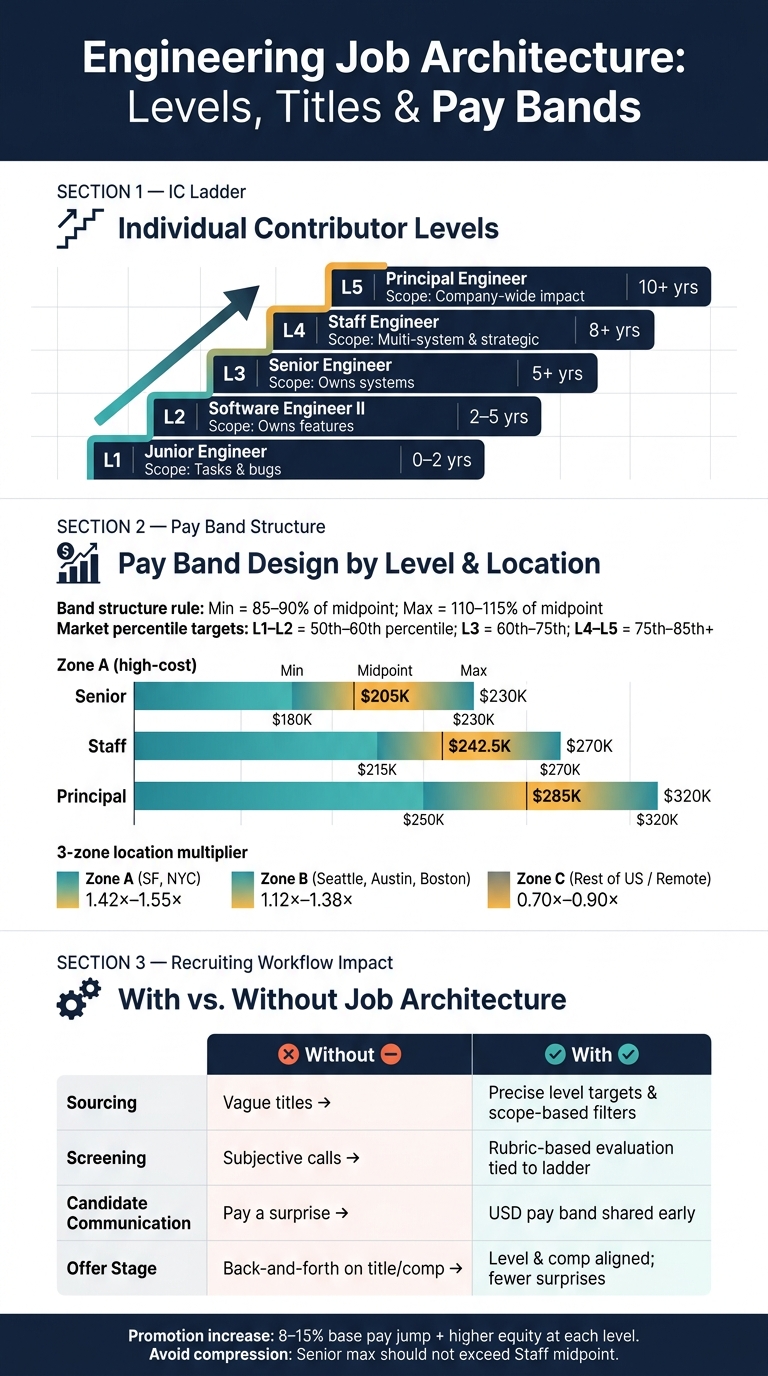
- Levels should be based on scope, autonomy, and impact - not just years worked.
- A simple IC ladder often runs from Junior to Principal.
- Management and IC tracks should stay separate, so strong engineers do not need to become managers to move up.
- Titles should be easy for candidates to recognize, while internal level codes keep hiring teams aligned.
- Pay bands should include a minimum, midpoint, and maximum for each level.
- Many companies price engineering pay around the 50th–85th+ percentile, depending on seniority.
- A common band design places minimum pay at about 85%–90% of midpoint and maximum pay at about 110%–115%.
- Location often shifts pay too. A simple U.S. model uses:
- Zone A: high-cost markets at about 1.42x–1.55x
- Zone B: major hubs at about 1.12x–1.38x
- Zone C: most other U.S. markets at about 0.70x–0.90x
- To avoid pay compression, the top of one band should stay below, or near the lower half of, the next band.
- Promotion increases for engineers often need a visible base-pay change, often around 8%–15%, plus more equity at higher levels.
A simple setup is often enough: 4–6 levels, a short title map, and U.S. dollar pay bands by location. That alone can cut confusion, keep offers in line, and make pay easier to explain.
If I were building this from scratch, I’d start there.
Define engineering levels from Junior to Principal
A clear level ladder keeps recruiter and hiring-manager calls lined up from intake to offer. It gives recruiters one shared rubric for screening, interviews, and offers. Once the ladder is set, map each level to a title and pay band.
A standard IC ladder with scope and autonomy
The core dimensions that define a level are scope, decision-making, and impact. Senior doesn't mean time served by itself. It means a person has shown broader scope and more autonomy.
| Level Code | Common Title | Typical Scope | Decision-Making | Impact | Typical Experience |
|---|---|---|---|---|---|
| L1 | Junior Engineer | Tasks and bugs | Works under close supervision and follows documented processes | Learning codebase and tools | 0–2 years |
| L2 | Software Engineer II | Owns features | Independent on known systems | Mentors interns and juniors | 2–5 years |
| L3 | Senior Engineer | Owns systems | Sets technical direction | Influences adjacent teams | 5+ years |
| L4 | Staff Engineer | Multi-system and strategic | Solves ambiguous problems | Cross-team technical strategy | 8+ years |
| L5 | Principal Engineer | Company-wide impact | Full autonomy on tech stack | Company-wide technical direction | 10+ years |
How to separate IC and management tracks
Keep management on a parallel track so candidates aren't pushed into people leadership just to move up. That's a common mistake, and it muddies the path for strong individual contributors.
On the IC side, Staff+ roles are marked by solving organizational ambiguity, shaping cross-team strategy, and increasing team output . That split makes growth paths easier to read and stops management titles from turning into the default promotion path.
How to write level criteria recruiters can use
Write level criteria in terms recruiters and interviewers can actually spot: ownership, decision-making, and collaboration behaviors. If a level guide sounds good on paper but can't show up in intake notes or scorecards, it won't help much.
Use the same level language across scorecards, debriefs, and offer calibration. Junior owns tasks. Mid-level owns features. Senior owns systems. Staff or Principal owns multi-team strategy and ambiguity .
With levels fixed, the next step is standardizing titles.
Standardize titles so candidates and recruiters are aligned
Engineering titles vary a lot from one company to another. That mismatch can lead to poor screening calls and shaky offer calibration. Once your levels are set, tie each one to a title candidates will recognize. A title only works when it connects to a clear level and a clear scope. The easiest way to handle this is with a title-to-level map.
Choose a simple title framework for internal and external use
For candidate-facing use, keep titles plain and familiar:
- Junior Software Engineer
- Software Engineer
- Senior Software Engineer
- Staff Engineer
- Principal Engineer
For internal calibration, use level codes like L1 through L5. That gives recruiters and hiring managers a shared way to line up scope and compensation.
Build a title-mapping table for inconsistent external resumes
Title norms change from company to company, so recruiters need a way to normalize resumes during screening. A simple mapping table does the job.
| Internal Level | Common External Titles | Scope and Autonomy |
|---|---|---|
| L1 (Junior) | Junior Software Engineer, Associate Engineer | Execution of well-defined tasks |
| L2 (Mid) | Software Engineer, Software Engineer II | Independent feature delivery |
| L3 (Senior) | Senior Software Engineer | Leads complex projects; defines technical patterns |
| L4 (Staff) | Staff Engineer, Lead Engineer | Cross-team impact; architectural strategy |
| L5 (Principal) | Principal Engineer, Distinguished Engineer | Company-wide technical impact |
If a candidate’s last title sounds higher than your target level, explain the gap in terms of scope, autonomy, and team impact. That keeps the conversation grounded in the work itself, not just the label.
Once titles line up, pay bands can follow the same level structure.
Design pay bands for fair and scalable engineering hiring
Once levels and titles are set, pay bands make the system usable in hiring. A pay band only works if it follows the level framework, not the last deal someone signed. Each level should have a minimum, a midpoint, and a maximum. The midpoint should be tied to market data, because that's the number recruiters and hiring managers use as the main reference point when building offers.
Set band structure by level, market percentile, and location
Start with the midpoint. That's the pricing anchor for the band. It reflects what a fully effective engineer at that level should earn in a given market. Many U.S. tech companies set midpoints to a target market percentile - often around the 50th–60th percentile for entry-level and early-career roles, 60th–75th percentile for mid-level and Senior roles, and 75th–85th+ for Staff and Principal roles.
From there, companies usually place the minimum at about 85–90% of midpoint and the maximum at about 110–115%. That range gives recruiters room to place candidates based on experience without pushing routine offers outside the band.
Location adds one more variable. Instead of changing level definitions city by city, keep the level criteria the same across the company and adjust pay bands by geography. A simple three-zone model works well:
- Zone A: high-cost markets like San Francisco and New York, roughly 1.42x–1.55x of the national median
- Zone B: major tech hubs like Seattle, Austin, and Boston, around 1.12x–1.38x
- Zone C: the rest of the U.S., including most remote roles, roughly 0.70x–0.90x
The key point is simple: keep level criteria fixed and change only the pay range by zone.
That setup also gives recruiters a much easier way to explain why two people at the same level may see different pay ranges in different cities or remote markets.
A sample pay-band table recruiters can explain to candidates
Example Zone A bands: Use this format to explain base pay and equity in one conversation.
| Level | Annual Base Salary Range (USD) | Midpoint (USD) | Target Market Percentile | Typical Equity Guidance |
|---|---|---|---|---|
| Senior | $180,000 – $230,000 | $205,000 | 75th | Lower equity than Staff; refreshes tied to performance. |
| Staff | $215,000 – $270,000 | $242,500 | 75th–80th | Higher equity; larger refreshes and special grants. |
| Principal | $250,000 – $320,000 | $285,000 | 80th–85th | Top equity tier; larger grants and refresh policy. |
Equity increases with seniority for a reason. According to Levels.fyi's 2024 data, Principal Engineer (V) is usually a 15+ year role, makes up less than 3% of employees, and is expected to operate fully autonomously. Recruiters can use a table like this to show how base pay and equity connect to level, without suggesting that these exact numbers apply everywhere.
Prevent compression, overlap, and offer-stage surprises
The most common pay-band issue is compression. That's when a Senior Engineer's pay gets too close to - or even passes - what a Staff Engineer makes. SHRM points to a useful warning sign: when direct reports earn more than 95% of supervisors' salaries, compression is likely.
To avoid that, set a firm rule: the maximum of a lower band should not go past the midpoint - or at most the lower half - of the next band. In the table above, the Senior max is $230,000 and the Staff midpoint is $242,500. The gap is tight, but it's there on purpose. If someone moves from Senior to Staff, the promotion should come with a visible jump of 8–15% in base salary, plus a higher equity target. Otherwise, the new title can feel like window dressing.
It also helps to separate level decisions from pay exceptions. If a company makes an above-band offer, document it clearly. And keep the title tied to scope of work, not cash.
Once the bands are in place, recruiters can use them across intake, sourcing, interviews, and offers.
Put job architecture into your recruiting workflow
Use architecture in intake, sourcing, interviews, and offers
Once levels, titles, and bands are set, the next move is simple: use them in hiring. That means bringing job architecture into a modern framework for hiring engineers that covers intake, sourcing, interviews, and offers.
At intake, get aligned on level, scope, title, and pay band in a single role brief. If that doesn’t happen, sourcing begins on guesswork.
In sourcing, level definitions replace fuzzy requests like "experienced backend engineer" with scope-based filters such as ownership, stack fit, and cross-team influence. That change cuts false positives and improves shortlist quality. In screening, a short rubric tied to the target level - checking scope of past work, decision-making autonomy, and compensation alignment - helps keep evaluations consistent across candidates. In interviews, each stage should test one area, like system design, collaboration, or technical leadership, with scorecards mapped straight to ladder criteria.
At the offer stage, the architecture does its most visible job. When level, title, and pay band are set early, the offer confirms what candidates already understand. Low acceptance rates usually point to title or compensation expectations that were off earlier in the process.
Apply the framework with daily.dev Recruiter
A workflow only works if the system recruiters use keeps the same level, title, and pay decisions in place. Tools matter most when those decisions stay intact from intake through offer.
daily.dev Recruiter is built so recruiters can reach developers in a developer-first environment. Recruiters can turn level definitions into short, engineer-friendly job briefs. Warm, double opt-in introductions mean candidates who reply are already open to the conversation, so the first discussion can go straight to level fit and compensation range. Custom targeting criteria let recruiters filter by the signals that matter - stack, scope, and seniority - so the pipeline reflects the architecture, not just keyword matches. And because the platform integrates with ATS workflows, the level and title decisions made at intake stay consistent through screening, interviews, and offer.
Conclusion: the minimum viable architecture to start with
A team starting from scratch doesn’t need a 40-page framework. It needs four to six defined levels, a small set of consistent external titles, and a USD pay band for each level by location. Once those are in place, they should show up in intake forms, sourcing filters, interview scorecards, and offer templates - so the framework changes day-to-day behavior instead of sitting in a doc no one uses.
When the framework is used in intake, sourcing, interviews, and offers, hiring gets faster and much easier to explain. Here’s what that looks like in practice:
| Recruiting Stage | Without Defined Architecture | With Defined Architecture |
|---|---|---|
| Sourcing Clarity | Vague titles; requirements shift role to role | Precise level targets and scope-based search filters |
| Screening Consistency | Subjective seniority calls; no shared standard | Rubric-based evaluation tied to ladder criteria |
| Candidate Communication | Pay discussed late; range often a surprise | USD pay band shared early; placement criteria explained |
| Offer Confidence | Back-and-forth on title and comp; high drop-off risk | Level and compensation aligned before the offer; fewer surprises |
The goal is consistency: one vocabulary for recruiters, hiring managers, and candidates so every stage of hiring moves faster, with fewer surprises and more trust.
FAQs
How often should engineering levels and pay bands be updated?
Review engineering levels and pay bands quarterly so compensation stays in line with the market as salary data shifts.
Then, between those broader reviews, meet with engineering leadership every two to four weeks to look at hiring metrics and make smaller updates to the process or the data when needed. That steady benchmarking helps keep pay fair and in step with what tech candidates expect.
What should hiring teams do when a candidate’s title doesn’t match their actual scope?
Focus on what the candidate has actually done day to day, not just the title on their résumé. Define the role by the work it requires, then use that lens to judge depth and fit instead of leaning on titles or years of experience.
Look at how the person stacks up against the role’s main challenges, like system design and technical problem-solving. That gives you a much clearer read on whether their skills line up with what your business needs.
How can companies explain location-based pay differences without creating trust issues?
Companies can keep trust intact with a clear, written pay framework that shows how salaries are decided. If the model is location-independent, location-adjusted, or hybrid, share the policy and the salary range upfront in job postings.
Be clear about why pay changes from one role or location to another, whether that comes from cost-of-living adjustments or market-based premiums. Before you publish ranges, audit internal pay for equity. Then be upfront about your compensation approach so there’s less friction and more trust.
.png)