If I hire only a few developers each year, an agency often costs less. If I hire around 4+ engineers a year, an in-house recruiter can cost less.
Here’s the short version:
- I’m comparing three hiring models: recruitment agency, in-house recruiter, and RPO
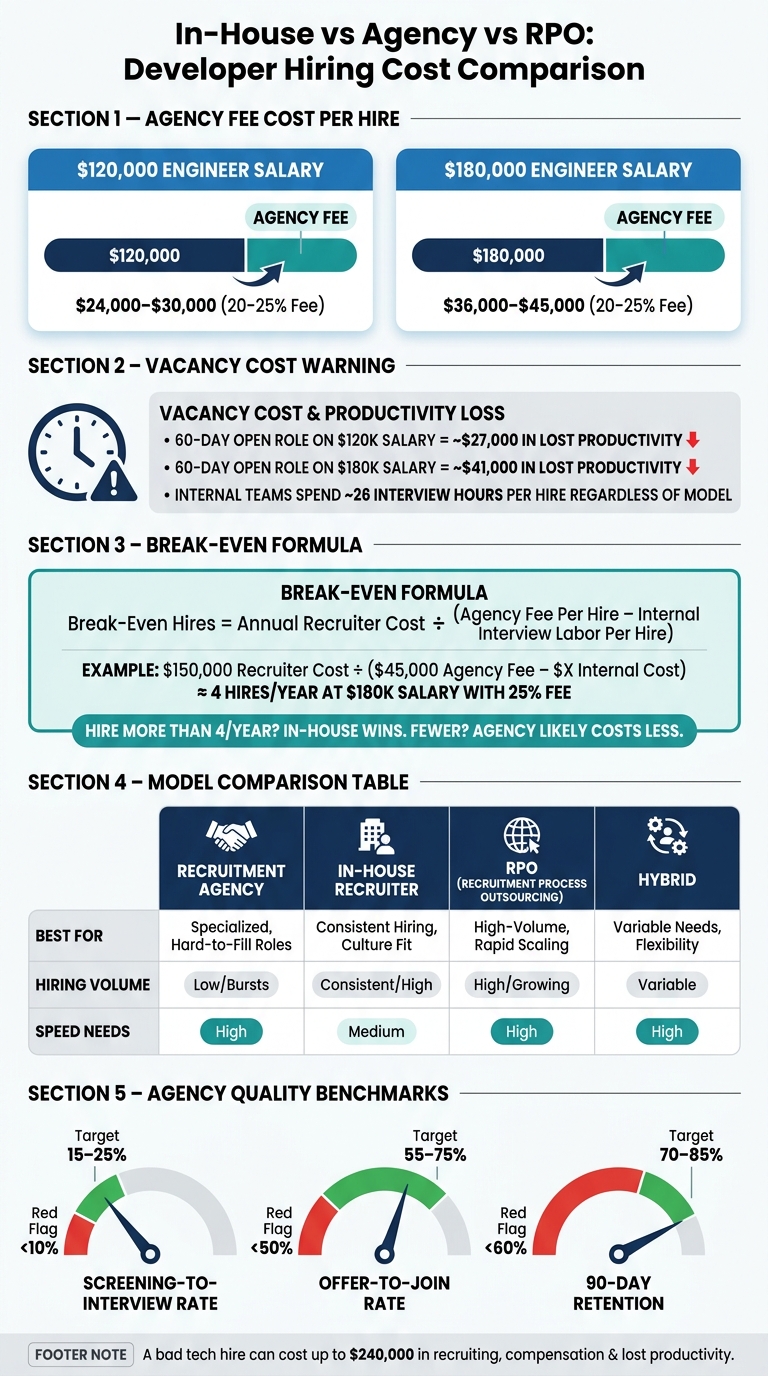
- Agency pricing is often 15%–25% of first-year salary
- For a $120,000 engineer, that means about $24,000–$30,000 per hire
- For a $180,000 engineer, that means about $36,000–$45,000 per hire
- A 60-day vacancy can cost about $27,000 for a $120,000 role and $41,000 for a $180,000 role
- Internal teams still spend about 26 interview hours per hire , making it critical to identify qualified technical candidates quickly to reduce labor costs
- A simple break-even check is: annual recruiter cost ÷ (agency fee per hire − internal interview labor per hire)
- In one example, with a $150,000 loaded recruiter cost and a 25% fee on a $180,000 salary, break-even is about 4 hires per year
So the choice is not just about filling roles fast, but following technical hiring best practices to ensure quality. I need to look at fee per hire, recruiter overhead, vacancy cost, interview time, role difficulty, and hiring volume.
Quick Comparison
| Model | Best fit | Main cost shape | Best when |
|---|---|---|---|
| Recruitment Agency | Hard roles, low volume, hiring spikes | Per-hire fee | I make only a few hires or need outside help now |
| In-House Recruiter | Steady hiring | Fixed yearly cost | I hire often enough to spread recruiter cost across hires |
| RPO | Growth-stage teams | Retainer or per-role fee | I need more hiring support without building a full internal team |
| Hybrid | Mixed hiring needs | Fixed + variable | I want internal ownership plus outside help for hard searches |
I also need to judge quality, not just price. That means watching screening-to-interview rate, offer-to-join rate, and 90-day retention. If agency results stay weak, the math may point to building more of the pipeline in-house.
Below, I break down the cost logic, where each model fits, and how to tell when agency spend is too high.
True Cost Comparison: Agency Fees vs In-House Recruiting
Agency fees are easy to spot: 15%–25% of first-year base salary. In-house recruiting is different. The cost sits in recruiter pay, benefits, software, interview time, and the price of leaving a role open.
So the side-by-side comparison shouldn't stop at fee rate alone. It starts with direct fees, recruiter overhead, and interview time.
Cost scenarios using $120,000 and $180,000 engineer salaries
Let’s use two U.S. salary examples: $120,000 and $180,000.
With a 20% agency fee, each hire costs:
- $24,000 for a $120,000 engineer
- $36,000 for a $180,000 engineer
At 25%, that jumps to:
- $30,000 per $120,000 hire
- $45,000 per $180,000 hire
And that’s per hire, every time.
In-house recruiting works more like fixed overhead. You’re paying for recruiter salary, about 30% in benefits, plus tools.
Vacancy cost also hits harder than many teams expect. A 60-day open role tied to a $120,000 salary can cost about $27,000 in lost productivity. At $180,000, that number climbs to about $41,000. On top of that, internal teams still spend about 26 hours interviewing per hire.
| Cost Category | Recruitment Agency | In-House Recruiter |
|---|---|---|
| Direct cost ($120k hire) | $24,000–$30,000 per hire | Recruiter salary + ~30% benefits + tools |
| Direct cost ($180k hire) | $36,000–$45,000 per hire | Same fixed overhead |
| Sourcing tools | Included in agency fee | $15,000–$150,000/year (ATS and developer sourcing tools) |
| Interview time | 26 hours of internal team time | 26 hours of internal team time |
| Replacement risk | Often includes a 90-day guarantee | Full cost of turnover |
| Pricing model | Contingency or retained | Fixed overhead (salary + software) |
| Break-even logic | Better for fewer than 5 hires/year | Better for higher volume or scaling teams |
Use those inputs to work out your own break-even point.
A spreadsheet-ready framework to calculate cost per hire
You can build a simple model in a spreadsheet and see where the math flips in your favor.
Use these variables:
- A = Annual fully loaded recruiter cost
- B = Internal interview labor per hire
- C = Agency fee per hire
Break-even formula: Break-even hires = A ÷ (C − B)
Put simply, divide your annual recruiter cost by the gap between the agency fee and your internal interview labor per hire.
With $180,000 salaries, a 25% agency fee, and a $150,000 fully loaded recruiter cost, break-even lands at about four hires per year. If you hire more than that, in-house is cheaper. If you hire fewer, the agency route will likely cost less.
Once you know that number, the next step is figuring out when agency speed matters more than in-house capacity.
When Agencies Win, When In-House Wins, and Where RPO Fits
Cost is only one part of the decision. It helps to use that starting point alongside speed, role difficulty, and the amount of time your internal team can give to hiring.
When a recruitment agency is worth the fee
A recruitment agency tends to make sense when hiring volume is low, demand spikes hit, or the role is hard to fill. If your company suddenly needs to hire fast, your internal team may simply not have enough hours to keep up.
That also applies to niche roles. An agency can tap into an existing network much faster than most companies can build one from scratch. In many cases, that helps you avoid the cost of leaving a role open for too long, especially when using a developer hiring timeline planner to map out the search. Early-stage companies also lean on agencies when they don’t yet have recruiting capacity in place. In that setup, the agency can take on sourcing, screening, and interview coordination, which you can factor into your hiring budget calculator.
When in-house technical recruiting lowers cost and builds trust
Once hiring becomes steady, an in-house team usually starts to pay off. An internal recruiter gets close to engineering leadership, learns what the team wants, and builds a pipeline that carries from one search to the next.
That continuity matters. Direct outreach often gets better response rates and less candidate drop-off, which can shorten time-to-fill. If you want to see the operating model behind that kind of pipeline, check the developer recruitment strategies guide for 2026.
Hybrid models and RPO for growth-stage teams
Most scaling teams land somewhere in the middle. They don’t fit neatly into an agency-only or in-house-only model.
A hybrid model keeps core hiring in-house, like senior engineers, team leads, and roles tied closely to team fit, while sending hard-to-fill searches or overflow work to an agency. That gives you the cost upside of in-house recruiting without letting tough roles sit open for months.
RPO (Recruitment Process Outsourcing) works a bit differently. It plugs into your hiring process, often through a monthly retainer or per-role fee, and takes care of sourcing, screening, and coordination. For growth-stage companies that need to scale hiring fast but aren’t ready to build a mature internal recruiting team, RPO can act as a budget bridge. It adds structure without locking you into long-term overhead.
Use this matrix to line up your hiring conditions with the best-fit model.
| Model | Best For | Hiring Volume | Speed Needs | Team Capacity |
|---|---|---|---|---|
| Recruitment Agency | Niche roles, spikes, early-stage | Low / Bursts | High | Limited / None |
| In-House Team | Consistent hiring, culture-heavy roles | Consistent / High | Medium | Fully Built |
| RPO | Scaling teams, standardized roles | High / Growing | High | Growth-stage |
| Hybrid | Mixed role difficulty, variable volume | Variable | High | Augmented |
How to Evaluate Agency Quality and Build the Case for In-House Hiring
Once you hire an agency, judge it by output, not sales talk.
Metrics that matter when working with developer hiring partners
One of the clearest numbers to watch is your screening-to-interview rate. A good agency screens hard before it sends people over, so about 15%–25% of submitted candidates should make it to an interview. If that rate falls below 10%, you're likely getting too many low-fit resumes.
Then look at your offer-to-join rate. A healthy range is 55%–75%. Add 90-day retention on top of that, with a target of 70%–85%, and you start to see the full picture: are these people a match for the role, or just the ones who happened to be on the market?
Numbers matter, but so does interview quality. In technical interviews, strong candidates should be able to talk through architectural trade-offs, not just rattle off tools listed on a resume. That's often where the gap shows up.
| Metric | Strong Performance Signal | Red Flag |
|---|---|---|
| Screening-to-Interview Rate | 15–25% (high-quality filtering) | <10% (high-volume, low-fit submissions) |
| Offer-to-Join Rate | 55–75% (strong candidate alignment) | <50% (misalignment on salary or culture) |
| 90-Day Retention | 70–85% (good technical/culture fit) | <60% (role was mis-sold) |
| Technical preparation | Candidates explain architectural trade-offs | Candidates struggle with basic stack questions |
| Process quality | Structured feedback, warm double opt-in introductions, 48-hour replacement with context handover | Silent rejections, recycled resumes from public job boards, no replacement policy |
If these numbers are weak, the damage usually shows up before the invoice does.
Poor agency performance isn't just a vendor problem. It's often a sign that in-house recruiting may cost less and work better.
Red flags to watch for and how to make the break-even case for an internal recruiter
When these warning signs keep showing up, this stops being just a quality issue and turns into a business case. A bad tech hire can cost as much as $240,000 in recruiting spend, compensation, and lost productivity .
At that point, run a break-even check. Take the full cost of an internal recruiter, including base salary, benefits, taxes, equipment, and software. Those extras can add 40% to 150% on top of base salary . Then compare that total with the agency fees you'd avoid during the same time period.
If the fees you can cut are higher than one recruiter's loaded cost, the case for hiring internally gets pretty plain. Engineering and finance leaders can dig into a more detailed version of this model at /solutions/leadership.
Open roles slow delivery, and that cost often hits harder than the money saved on fees.
If the issue is weak sourcing depth, not just hiring volume, the next move is to evaluate active vs passive developer recruitment and cut back your dependence on agencies.
Reducing Agency Dependence with daily.dev Recruiter
How daily.dev Recruiter supports passive developer sourcing
Once agency fees start costing more than owned sourcing, the next step is pretty clear: build a pipeline you control.
daily.dev Recruiter helps teams reach passive, pre-qualified developers in a place they already use to learn and stay plugged in. Every intro is warm and double opt-in, so recruiters talk only with developers who are interested. That means more top-of-funnel reach without adding headcount. Companies also report a 60–80% drop in cost per hire compared with agency placements, and one hire will often cover the annual platform cost .
For hybrid teams, that matters. It keeps hard-to-fill roles inside an owned pipeline instead of pushing them back to recurring agency fees. You also get custom screening and ATS sync included.
At that point, the choice becomes less about vendor pricing and more about how much hiring capacity your team wants to control.
Conclusion: Use volume, speed, and role difficulty to pick the right model
The right hiring model depends on volume, urgency, and role difficulty. Vacancy cost connects all of it. Each week an engineering role stays open has a real price, from slower product delivery to extra strain on the team, so it should sit right next to recruiter fees in the decision.
Use vacancy cost, hiring volume, and role difficulty to figure out which model saves the most. Agencies make sense for hiring spikes and rare roles. In-house works well for steady hiring. daily.dev Recruiter helps build an owned pipeline that lowers agency spend over time.
FAQs
How do I calculate my hiring break-even point?
Calculate the point when a new hire starts paying back your total hiring and onboarding cost. That means looking past salary alone and adding the full price of bringing someone in and getting them up to speed.
Include:
- Salary and benefits
- Equipment and software
- Recruitment fees
- Vacancy costs
- Ramp-up time
- Management overhead
Start with cost-per-hire. Add your internal costs and external costs, then divide that total by the number of hires. From there, factor in the less obvious costs too, like mis-hires and turnover. Those can hit harder than people expect.
Your break-even point happens when the developer’s output is worth more than all of those combined costs.
When is an agency worth the higher cost?
An agency is worth the higher cost when you need to hire fast or don’t have the in-house bandwidth to run recruiting well. It can be a smart move for specialized or niche roles that are hard to fill and take a lot of time to source on your own.
You also get more speed and access to pre-vetted talent. That can cut hidden hiring costs, like long delays, bad hires, and the extra time your team would spend managing the process.
How should I choose between in-house, agency, and RPO?
Choose based on hiring volume, role complexity, and the bandwidth your team has.
- In-house: best if you're hiring on a steady basis, building long-term talent pipelines, and want close alignment with company culture. The tradeoff is the highest total cost of ownership.
- Agency: best when you need to hire fast, fill hard-to-source technical roles, or don’t have enough internal recruiting support.
- RPO: a middle option if you want to scale hiring and improve the process without building a large in-house recruiting team.
.png)