Hiring a VP of Engineering is one of the highest-risk leadership hires you can make. The role is hard to fill, the candidate pool is small, and a bad hire can slow delivery, hurt morale, and cost your company for years.
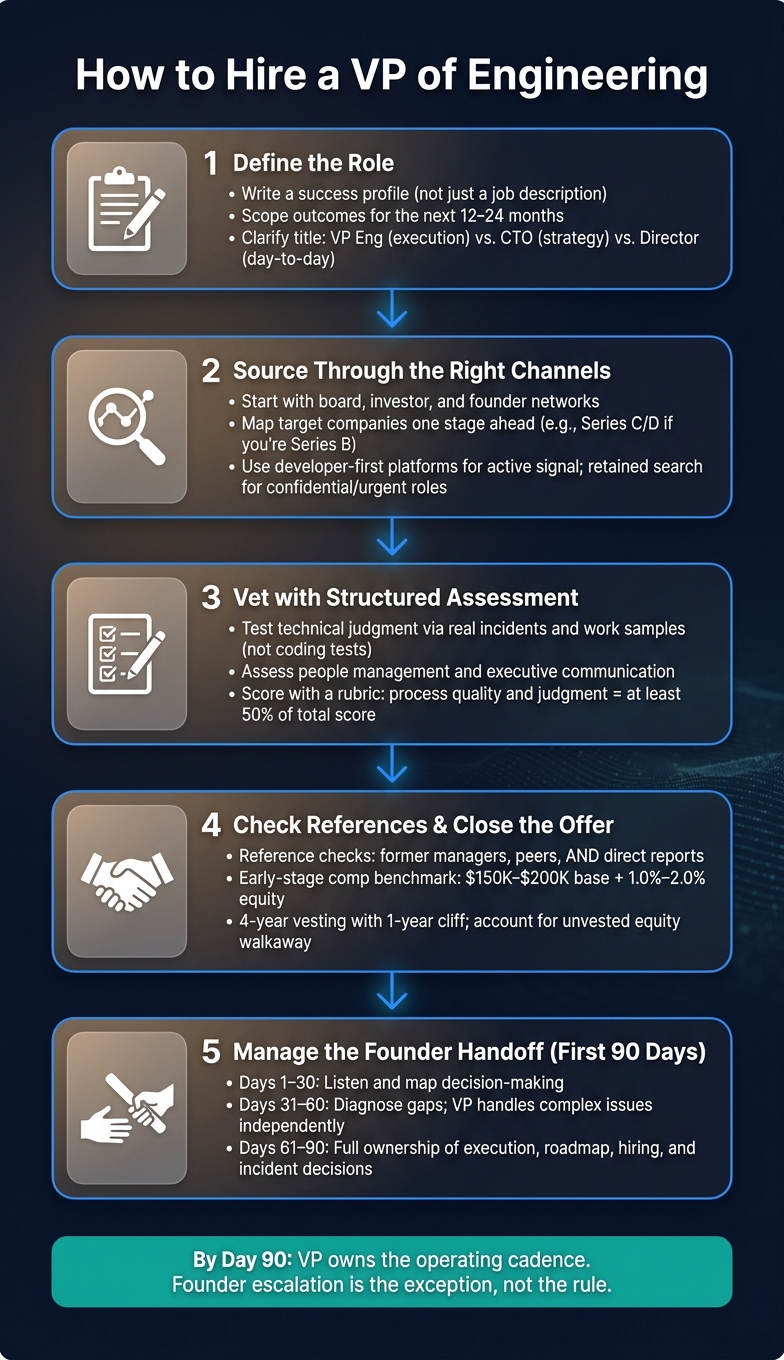
If I had to boil this down, I’d say this: hire for your stage, not the title. That means I’d define the job by the next 12 to 24 months, source from the right networks, use a structured interview process, check references from multiple angles, set compensation early, and hand off decision-making in the first 90 days.
Here’s the short version:
- Start with the business need: I’d write a success profile before writing the job description.
- Be clear on the title: VP of Engineering, CTO, and Director of Engineering are not the same job.
- Source in tight circles first: board members, investors, founders, and stage-matched company maps.
- Assess judgment, not just code: use scenarios, work samples, and a scorecard.
- Run deep references: talk to former managers, peers, and direct reports.
- Plan the close early: align on base pay, bonus, equity, and vesting before the final push.
- Make the handoff clear: transfer ownership of hiring, roadmap, performance, and incident decisions fast.
A few numbers stand out from the article:
- The role should be scoped around the next 12–24 months
- Interview scoring should put at least 50% of weight on process quality and judgment
- A sample early-stage VP Engineering package may include $150,000–$200,000 base pay and 1.0%–2.0% equity
- The first 30-60-90 days should focus on listening, diagnosing, and then taking full ownership
If you want the simple takeaway, it’s this: don’t run this like a normal hiring process. I’d treat it like a company-shaping decision with clear success metrics, a tight search, consistent evaluation, and a clean founder handoff.
1. Define the role before you start the search
Begin with the business problem, not the title.
Before you write a job description, define what success looks like over the next 12 to 24 months. Then spell out the role’s responsibilities, decision rights, and success metrics so every candidate is measured against the same target. That definition becomes your filter for sourcing and interviewing.
VP of Engineering vs. CTO vs. Director of Engineering
These titles are not interchangeable.
Pick the title based on your company stage, team size, product complexity, and whether the founder needs a strategic partner or a leader focused on execution. Use a CTO for technical strategy, architecture, and external technical leadership. Use a VP of Engineering for execution, hiring, delivery, and scaling the org. Use a Director of Engineering to manage teams and handle day-to-day execution within a set scope.
Once the role is clear, the search channels get much narrower.
Write a success profile tied to the next 12 to 24 months
A job description lists requirements. A success profile defines outcomes.
Those are not the same thing. Mixing them up is one of the most common founder-led hiring mistakes that slow engineering teams.
Start by writing down what this person needs to deliver in the next 12 to 24 months. Be specific. A vague goal like “improving engineering culture” doesn’t give you much to judge. Use outcome-based language tied to execution, team scale, and delivery.
After that, split those outcomes into two groups:
- Must-haves
- Nice-to-haves
That simple step keeps the search focused on the role you actually need.
2. Source VP candidates through the right channels
VP of Engineering candidates are often passive. That means your sourcing approach needs to reach them through channels they already trust and where privacy is respected.
Once the role is clear, narrow your search to leaders who have already handled the kind of scaling problems your company is facing. Use the success profile as a filter for every channel you use. Look at stage, team scope, and the kind of scaling work the person has done.
Start with board, investor, and founder networks
Start close to home. Your board and investors can help you build a tight target list of former engineering executives and second-degree referrals from operators they know well. That should be your first list.
Ask for intros to:
- Former VPs of Engineering
- Engineering leaders at peer companies
- Trusted operator referrals
Your founder network matters too. Founders who have already made this hire can often point you to leaders who have worked in a similar setting and know what the job actually demands.
If warm intros don't turn into a short list fast enough, shift to a more systematic company map.
Map target companies and use developer-first sourcing
Next, build a target list of companies that are one stage ahead of yours. If you're a Series B company, look at VPs and senior Directors of Engineering at Series C and D companies. These are the people who may have already worked through the scaling issues you're about to hit.
Resumes tell you where someone has been. They don't tell you what they're paying attention to right now. Developer-first platforms like daily.dev Recruiter can surface candidates based on what they're actively reading and building. For VP hiring, that kind of current signal can matter more than a polished resume.
Start with direct sourcing. If privacy concerns or talent scarcity start making the search harder, that's usually the point to look at retained search.
When to use retained search instead of direct sourcing
Retained search makes sense for VP hires that are confidential, urgent, or tough to fill. The downside is simple: less control and a higher bill.
If you go that route, pick a firm with a clear track record of placing engineering leaders at your stage. The right model comes down to how hard it is to find the exact stage-fit profile you need.
3. Vet candidates with a structured assessment
Once sourcing trims the pool, the next step is figuring out whether a candidate can actually lead at your stage. At this point, the goal isn't to test raw coding skill. It's to judge how they think. A strong VP of Engineering builds trust with senior engineers, founders, and the board.
Assess technical credibility without over-indexing on coding
A VP of Engineering doesn't need to out-code your senior engineers. What you want to test is technical judgment.
A simple way to do that is with work-sample exercises and scenario-based discussions built around recent incidents and architecture calls . Pull the last five incidents or tickets your team handled. Then watch how the candidate works through them. Do they ask sharp clarifying questions? Do they check assumptions? Do they explain tradeoffs before jumping to a fix?
That tells you a lot more than a whiteboard coding test ever will.
If you decide to include a hands-on exercise, keep the setup the same for every candidate so each person is evaluated under identical conditions .
After that, move the conversation toward how they lead managers and how they talk to the rest of the business.
Test people management and executive communication
A VP of Engineering needs to lead managers, grow teams, and communicate well with founders, peers, and the board.
Ask candidates to walk through how they've handled this before. Have them explain how they reported engineering progress to a CEO or board. Ask how they weighed hiring, delivery, and budget tradeoffs. Then push a little further: what happened when those goals ran into each other?
This is where many interviews get too shallow. A polished candidate can talk in broad terms. What you want are specifics.
Executive communication matters just as much as technical depth. The right person can explain messy, technical issues in plain English without losing the respect of engineers or senior leadership.
Use a hiring rubric to score candidates consistently
Use a two-part rubric that separates answer quality from judgment. If you rely on gut feel alone, it's easy to give too much credit to someone who sounds polished and too little to someone with better judgment.
For VP-level roles, process quality and applied judgment should count for at least 50% of the total score - not just whether they landed on the "right" answer.
Here's a simple scoring framework to anchor your interview loop:
| Rating | Label | Description |
|---|---|---|
| 4 | Exceptional | Identified constraints first; used a clear framework (impact/effort); made explicit trade-offs. |
| 3 | Strong | Used a reasonable method with minimal prompting; clear business rationale. |
| 2 | Developing | Prioritized based on gut instinct; trade-off reasoning was unclear or post-hoc. |
| 1 | Does not meet bar | Could not prioritize a backlog without significant guidance; no clear method applied. |
Have two reviewers score the same interview with the same rubric.
Then use that same scorecard to decide who moves on to references and offer design.
4. Check references, set compensation, and close the offer
Once your rubric points to a finalist, move on two tracks at the same time: reference checks and the offer. Mistakes at this stage can get expensive fast.
Run reference checks across managers, peers, and direct reports
After the interview rubric narrows the field, use references to test the candidate’s leadership story.
At the VP level, reference checks are often too surface-level. That’s a miss. You’re not just checking whether someone was well-liked. You’re trying to learn how they actually led when things got messy. Speak with a former manager, peers they worked with, and direct reports. Those talks help you confirm how they led teams, handled conflict, and scaled under pressure.
You should also use these calls to gauge growth across prior roles and how they deal with failure. When something went wrong, did they trace the problem step by step, or did they just guess?
Focus your questions on areas like:
- Team scaling
- Org design
- Hiring standards
- How they protect morale during change
Structure compensation around base, bonus, equity, and retention
VP of Engineering compensation in the U.S. usually includes base salary, annual bonus, equity, vesting, and retention terms. The right mix depends on the company’s stage and the candidate’s opportunity cost.
For early-stage companies, a typical VP of Engineering package looks like this:
| Company Stage | Base Salary Range | Equity Range | Key Retention Component |
|---|---|---|---|
| Seed / Early Stage | $150,000 – $200,000 | 1.0% – 2.0% | 4-year vesting with a 1-year cliff |
Before final negotiations start, get board approval for equity, bonus, and retention terms.
If the candidate is walking away from unvested equity, the offer should account for that. Otherwise, you may be asking them to take a bigger hit than you think.
The package should also make the shift from founder-led to VP-led engineering feel clean. Once the offer is signed, transfer decision rights fast and begin the founder handoff.
5. Manage the founder handoff and the first 90 days
Once the offer is signed, the focus changes. You’re no longer trying to close the hire. Now you need to hand over authority.
Transfer decision rights from founder to VP of Engineering
Before the VP starts, spell out which engineering decisions move from the founder to the VP. That usually includes the roadmap, hiring, performance, and incident escalation. Put those ownership lines in writing so there’s no gray area about who owns what. This shift should shape the first 90 days from the start, not happen later.
Build a 30-60-90 day plan for listening, diagnosing, and operating
The first 90 days should center on ownership transfer, not generic onboarding.
- Days 1–30: Listen and map how decisions get made.
- Days 31–60: Diagnose gaps and suggest changes. By day 60, check whether the VP can handle complex issues without founder help.
- Days 61–90: Take full ownership of execution and reporting.
Conclusion: Hire for the stage, not the title
By day 90, two things should be in place: the VP owns the operating cadence, and decision rights have moved over, with founder escalation kept to exceptions.
FAQs
When should I hire a VP of Engineering?
Hire a VP of Engineering when your team can’t keep pace with business goals or when it’s time to shift from founder-led management to a setup that can scale.
Because a bad hire here can cost years of engineering output and drag down team morale, this is a board-level decision. Start the search only after your long-term technical challenges and business strategy are clearly defined.
What signals show a candidate fits our stage?
Look for proof that they can handle what’s coming next, not just that they’ve built a strong resume. Good stage-fit signs include experience with the scale and complexity you’re about to face, a track record of adding structure to teams as they grow, and the ability to tie engineering work to business goals.
In interviews, bring up actual hurdles your team is dealing with right now. That gives you a clear view into how they weigh trade-offs, judge risk, and explain their calls. Strong candidates don’t stop at the technical side. They connect those choices to business outcomes.
How do I know if retained search is worth it?
Retained search is worth considering for highly specialized roles or senior leadership hires where quality, fit, and trust matter most. It can also make sense when building those relationships on your own would slow the hiring process.
It’s often less cost-effective than warm introductions or internal referrals. Still, if you don’t have the network or the time to run a deep, private search, it can be the right call. The main question is simple: does the cost of retained search make more sense than the risk of a bad leadership hire?
.png)