Hiring developers today can be expensive and time-consuming. LinkedIn Recruiter, priced between $8,999 and $15,000 annually, is a popular tool, but rising costs and low response rates (as low as 4.77% for software roles) make it less effective for some. Passive candidates, who make up 70% of the workforce, often have outdated profiles, adding to the challenge.
Other platforms like daily.dev Recruiter ($350/month per role) and GitHub Sourcing offer alternatives. They focus on developer activity and skills rather than static profiles, increasing engagement and reducing costs. For technical roles, GitHub and daily.dev often outperform LinkedIn in connecting with high-quality candidates.
Key takeaway: LinkedIn works best for large-scale hiring, but for niche tech roles, combining tools like GitHub and daily.dev can lower costs and improve results. Always calculate your cost per hire to choose the right strategy.
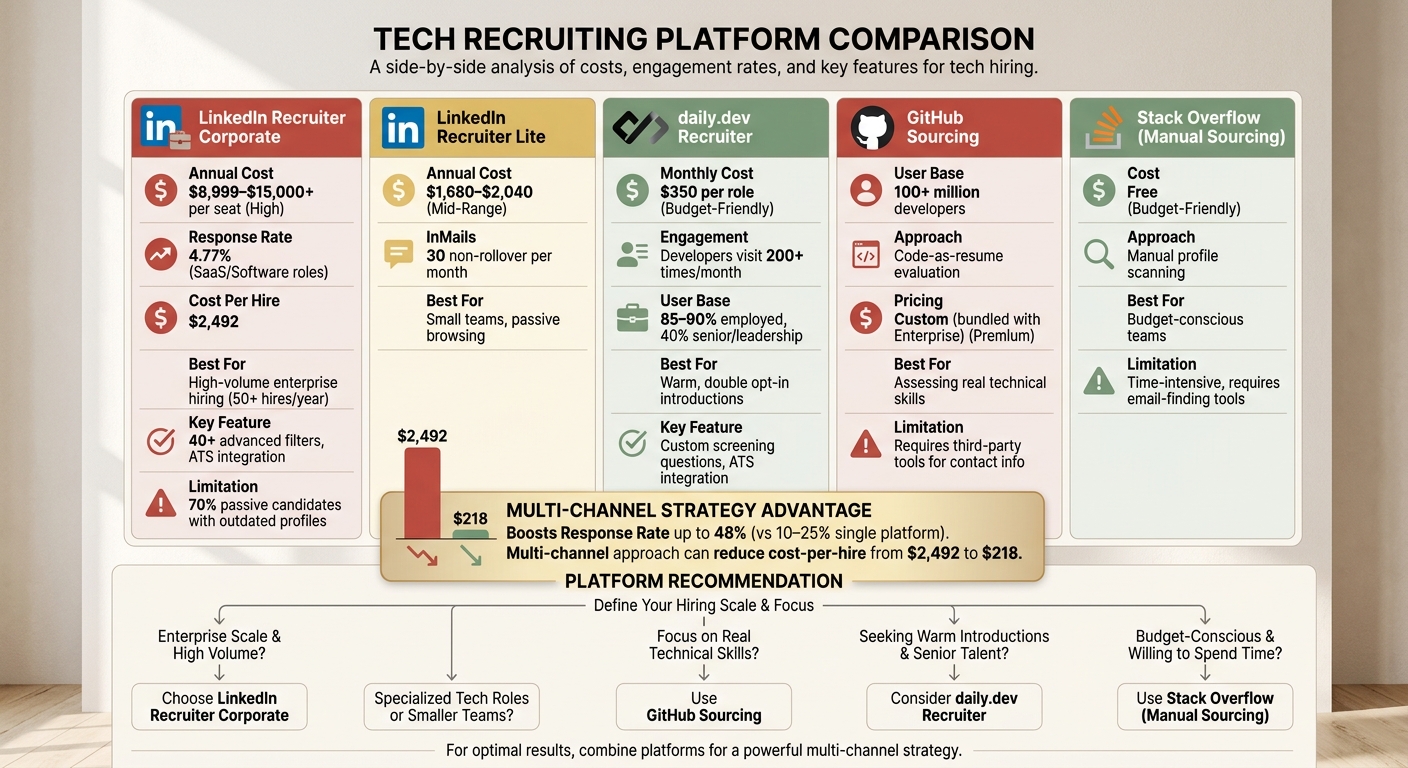
1. LinkedIn Recruiter
LinkedIn Recruiter offers a three-tier pricing model tailored to different hiring needs. Recruiter Lite is priced at $170 per month (or $1,680 annually) and includes 30 non-rollover InMails. Recruiter Professional Services costs between $500 and $1,080 per month (roughly $6,000–$12,960 annually), while Recruiter Corporate ranges from $750 to over $1,250 per month ($8,999–$15,000+ annually) . All plans require a per-seat license, and the higher tiers often involve annual contracts with auto-renewal . These costs form the foundation for assessing the platform's effectiveness in reaching developers.
However, expenses can escalate quickly. Corporate pricing has been increasing by about 15% annually, meaning a $10,800 seat in the first year could surpass $14,000 by the third year. Add-ons like Talent Insights (costing $6,000–$20,000 annually), extra InMails at $10 each, and promoted posts contribute further to the total .
When it comes to developer outreach, the challenges are clear. Response rates for SaaS and software professionals are just 4.77%, highlighting the fatigue caused by excessive automated messaging . Shorter messages - under 400 characters - perform better, achieving a 22% higher response rate. Additionally, AI-assisted messaging on Corporate plans can improve acceptance rates by 44%, though competition for attention remains intense .
"SaaS & Software only achieves 4.77% response rate – the hardest vertical due to overwhelming volume of automated outreach." - Sophie Ricci, Lead Generation Expert
Despite the costs, LinkedIn Recruiter offers advanced features that make candidate targeting more efficient. The platform shines with its extensive filtering options - over 40 are available in the Corporate tier - along with ATS integration for tools like Greenhouse and Lever, and team collaboration through shared projects and pipelines . These features are particularly valuable when working with a mostly passive candidate pool. For example, Spotlight filters can identify candidates who are "Open to Work" or have recently changed jobs, reducing the time it takes to fill challenging roles by half .
That said, it's worth noting that 70% of the workforce consists of passive candidates, many of whom might have outdated profiles or rarely log in. LinkedIn's algorithm tends to prioritize recently active users, which can inadvertently push highly qualified but less active senior developers further down the list .
2. daily.dev Recruiter
Unlike LinkedIn Recruiter, daily.dev Recruiter takes a different route by connecting roles with developers based on what they actively read and build, instead of relying on static resume keywords. Job postings appear directly on the daily.dev homepage - a space developers visit roughly 200 times a month (over six times a day) to stay updated on tech trends . This means your job listings are seen where developers are already engaged, avoiding the inefficiencies of traditional outreach.
The pricing is simple: $350 per role per month, with no limits on the number of seats. This straightforward model is especially appealing for startups or teams hiring for multiple positions .
daily.dev Recruiter uses a warm, double opt-in process that requires developers to answer up to three custom screening questions before connecting. This ensures every conversation starts with clear intent and a proper technical match. While platforms like LinkedIn often see 90% of engineers ignoring outreach, daily.dev stands out by presenting opportunities as part of a developer's daily tech routine, making them feel like trusted recommendations . With 85–90% of users already employed and 40% holding senior roles or leadership positions, the platform excels at reaching passive talent that traditional methods often miss .
"The engineers you want won't reply on LinkedIn. They won't apply on job boards. But they're on daily.dev every day." – daily.dev
Another advantage is its integration with major ATS systems, which prevents duplicate entries and offers actionable feedback when developers decline a role - something one-way InMail systems don’t provide . For teams aiming to stretch their recruitment budgets while improving candidate quality, daily.dev Recruiter offers a modern, data-driven way to measure ROI in tech hiring. This approach highlights how tech-focused hiring tools can streamline recruitment processes.
3. GitHub Sourcing
GitHub Sourcing takes a different route compared to traditional recruiting platforms, focusing on developers' actual code contributions instead of scanning through resume keywords. With access to a massive pool of over 100 million users, it allows you to search by programming languages, specific contributions, and even location. This "Code as Resume" method gives you a clear view of a developer's work quality, collaboration history, and technical expertise before you even reach out. It's a practical way to evaluate real skills while setting the stage for salary or budget discussions.
Pricing for GitHub Sourcing is often customized and frequently bundled with GitHub Enterprise. Understanding these pricing details is essential when comparing its return on investment to more traditional platforms. The real advantage? You’re tapping into passive talent - developers who may not be actively updating their LinkedIn profiles but are actively contributing to repositories. When your outreach references specific projects or code they've worked on, your chances of getting a response improve dramatically compared to generic LinkedIn messages.
That said, GitHub doesn’t always offer direct contact information for users, which means recruiters often turn to email-finding tools to make contact. These are just some of the best hiring tools for technical roles available to modern recruiters. While this adds an extra layer of cost and complexity, developers tend to view GitHub-based outreach as more genuine. Why? Because it shows you’ve taken the time to review their actual work.
For technical roles that demand deep expertise, GitHub Sourcing is a powerful way to find contributors whose project history and collaboration skills highlight their abilities and leadership potential. Unlike polished profiles on other platforms, GitHub focuses on active contributors, helping you connect with high-quality, passive talent who stand out for their real-world skills and impact.
4. Stack Overflow Talent
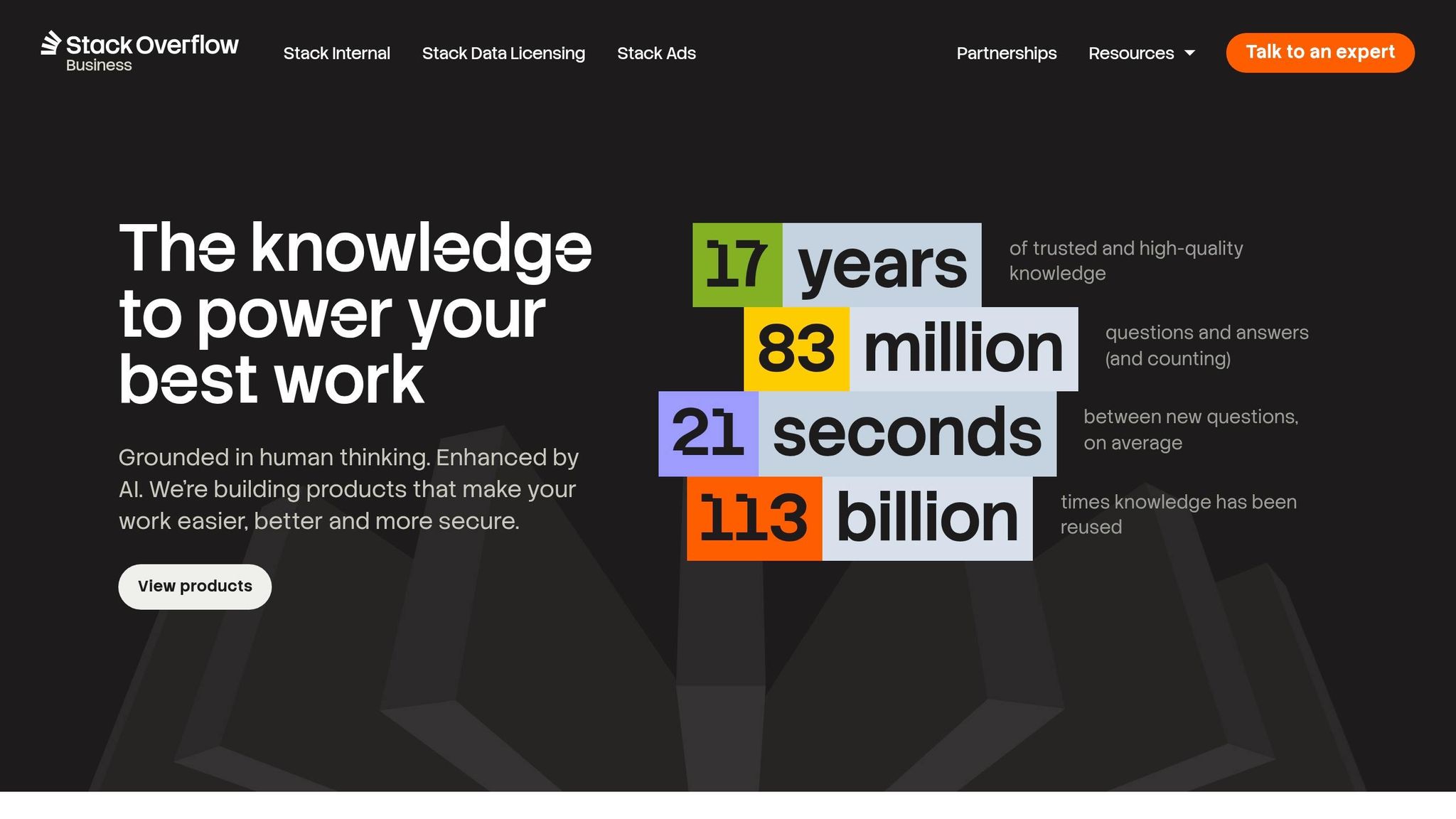
While Stack Overflow Talent is no longer available as a standalone product, the platform itself remains a treasure trove for identifying technical talent through public developer profiles . Many recruiters now use Stack Overflow for manual sourcing - scanning profiles to find contact details or links to personal websites. This method is completely free, making it especially appealing for teams with limited budgets.
Since direct contact information isn’t typically listed on Stack Overflow, tools like Hunter.io or Apollo.io can help locate verified personal emails for outreach. After verifying contact details, crafting personalized messages that reference a candidate’s code contributions can be far more effective than sending generic LinkedIn InMails .
"Stack Overflow Talent is dead, but Stack Overflow profiles still link to contact info and personal sites." - Augtal
To stand out, include specific details in your outreach, such as programming languages or notable projects the candidate has worked on. While LinkedIn InMail response rates hover around 18% to 25% , tailored messages that highlight a candidate's technical work often yield better engagement.
The trade-off here is clear: manual sourcing on Stack Overflow requires more time upfront to identify and verify candidates, but it avoids the costs associated with premium recruitment platforms. For startups or small teams hiring for niche technical roles, this approach can be a game-changer. It not only saves money but also allows for genuine, personalized candidate engagement. When combined with other sourcing methods, it can significantly enhance your recruitment strategy while keeping costs under control.
Strengths and Weaknesses
Different platforms come with their own set of benefits and challenges. For instance, LinkedIn Recruiter Corporate provides extensive reach but comes with a hefty price tag. Its algorithm focuses on recently active profiles, which can make it harder to engage passive senior talent - a limitation we touched on earlier in Section 1.
While LinkedIn struggles with high costs and limited access to passive candidates, GitHub sourcing stands out by offering a unique advantage: it allows you to assess a developer's skills through their code history. This "code-as-resume" concept resonates strongly with developers who are often put off by generic, impersonal outreach. However, GitHub has its own drawback - it doesn’t provide direct contact information. To connect with candidates, you'll need a third-party tool like Apollo.io to locate verified email addresses .
"Developers are fatigued by generic LinkedIn InMails. A message that references their actual code feels personal and credible." - PostKing
Cost is another critical factor. When you factor in labor and hidden expenses, LinkedIn Recruiter Corporate costs about $2,492 per hire on average . In contrast, manual GitHub sourcing is primarily a time investment. Additionally, newer AI-powered platforms that aggregate data from multiple sources can slash the cost-per-hire to approximately $218 . These differences highlight the importance of aligning your recruitment strategy with your team's specific needs and budget.
Ultimately, the right platform depends on your hiring goals. LinkedIn is ideal for large-scale enterprise hiring where brand visibility is crucial. On the other hand, GitHub and Stack Overflow excel in filling specialized technical roles where proven skills carry more weight than a polished profile. Platforms like daily.dev Recruiter offer a middle ground, providing warm, double opt-in introductions that reduce the cold outreach fatigue often associated with LinkedIn InMails and manual sourcing.
Conclusion
LinkedIn Recruiter works best for high-volume, enterprise-level hiring. If you’re managing 50 or more hires annually, need strong ATS integration, or require broad candidate visibility, the annual cost of $8,999–$15,000 can make sense. Enterprise teams that depend on shared pipelines and collaboration tools will likely find value in the Corporate tier's advanced features.
However, for specialized technical hiring, LinkedIn may fall short. When recruiting niche developers or passive senior talent - especially those with outdated profiles - LinkedIn’s algorithm and engagement challenges can lead to time-consuming manual follow-ups. InMail response rates in sectors like software and SaaS can dip as low as 4.77% , making it less effective for these roles.
To improve targeting and efficiency, consider integrating multiple recruitment tools. For example, LinkedIn Recruiter Lite (around $1,680–$2,040 annually) is a cost-effective option for passive browsing and maintaining visibility. Pairing this with developer-focused platforms can provide warm, double opt-in introductions to engaged candidates, fostering trust and better connections. This multi-channel approach aligns with where developers naturally spend their time.
Engagement rates can significantly improve with a multi-channel strategy. Combining platforms can increase response rates from 10–25% to as high as 48% . For technical roles, referencing candidates' actual code contributions in outreach messages can enhance credibility and encourage better responses.
Before committing, calculate your true cost per hire using a developer hiring checklist. Include factors like the "time tax" of manual searches (estimated at 380 hours annually per recruiter), InMail overage fees (about $10 each), and extra tools like Talent Insights. For teams making 30 hires per year, LinkedIn Recruiter Corporate averages $2,492 per hire, whereas optimized multi-channel strategies can lower costs to as little as $218 per hire . Ultimately, the right approach depends on your hiring needs, budget, and whether you're targeting broad roles or specialized technical talent. Be sure to account for hidden expenses when determining the best recruitment strategy for your organization.
FAQs
What’s the real all-in cost of LinkedIn Recruiter per year?
The annual cost of LinkedIn Recruiter in 2026 spans a wide range, starting at around $1,680 for Recruiter Lite and exceeding $15,000 for Corporate plans. For most corporate licenses, you can expect to pay between $8,999 and $10,979 per seat annually, depending on the specific plan and included features. Pricing is influenced by the level of functionality and tools each plan offers.
How do I calculate LinkedIn Recruiter ROI for tech hires?
To figure out the ROI of LinkedIn Recruiter for tech hires, start by looking at total costs. This includes everything from licensing fees and InMail credits to the time your recruiters spend using the platform. Then, compare these expenses to your hiring results.
Key metrics to track include the number of hires sourced through LinkedIn, cost per hire, time-to-fill positions, and retention rates. Once you have this data, use the formula: ROI = (Value of hires / Total costs) × 100. This approach gives you a clear, numbers-based way to assess whether LinkedIn Recruiter is helping you achieve your hiring goals.
When should I use LinkedIn Recruiter vs daily.dev Recruiter?
When it comes to hiring, LinkedIn Recruiter is a solid choice for scenarios like high-volume hiring, enterprise-level recruitment, non-technical positions, or industries where LinkedIn has a strong presence. It provides tools like advanced search capabilities, project management features, and collaboration options to streamline the hiring process.
On the other hand, daily.dev Recruiter shines for smaller teams, specialized developer roles, or engaging passive senior-level talent. This platform uses developers' reading behavior to make meaningful connections, helping to reduce the issue of InMail fatigue.
Both platforms have their strengths, depending on your recruitment needs and the type of talent you're targeting.
.png)