Tech hiring compliance is more critical than ever. With evolving laws and increased enforcement, recruiters must navigate challenges like AI bias, pay transparency, and data privacy to avoid costly penalties and build fair hiring processes.
Key takeaways:
- AI Tools: Employers are liable for discriminatory outcomes caused by AI, even if developed by third-party vendors. Annual bias audits are required in places like NYC.
- Pay Transparency: Over 16 states mandate salary ranges in job postings. Remote roles must comply with the candidate's location laws.
- Anti-Discrimination: Avoid age, disability, or gender bias in job ads, assessments, and interviews by using evidence-based approaches to reduce bias. Use structured interviews and validated tools.
- Data Privacy: Laws like California's CPRA and GDPR require clear candidate consent for data use and retention.
- State-Specific Laws: Local regulations, like Colorado's upcoming AI Act (June 2026), add layers of compliance for remote hiring.
Why it matters: Non-compliance can lead to fines, lawsuits, and reputational damage. With $660M in EEOC recoveries in 2025, staying compliant isn’t optional - it’s essential for protecting your company and candidates.
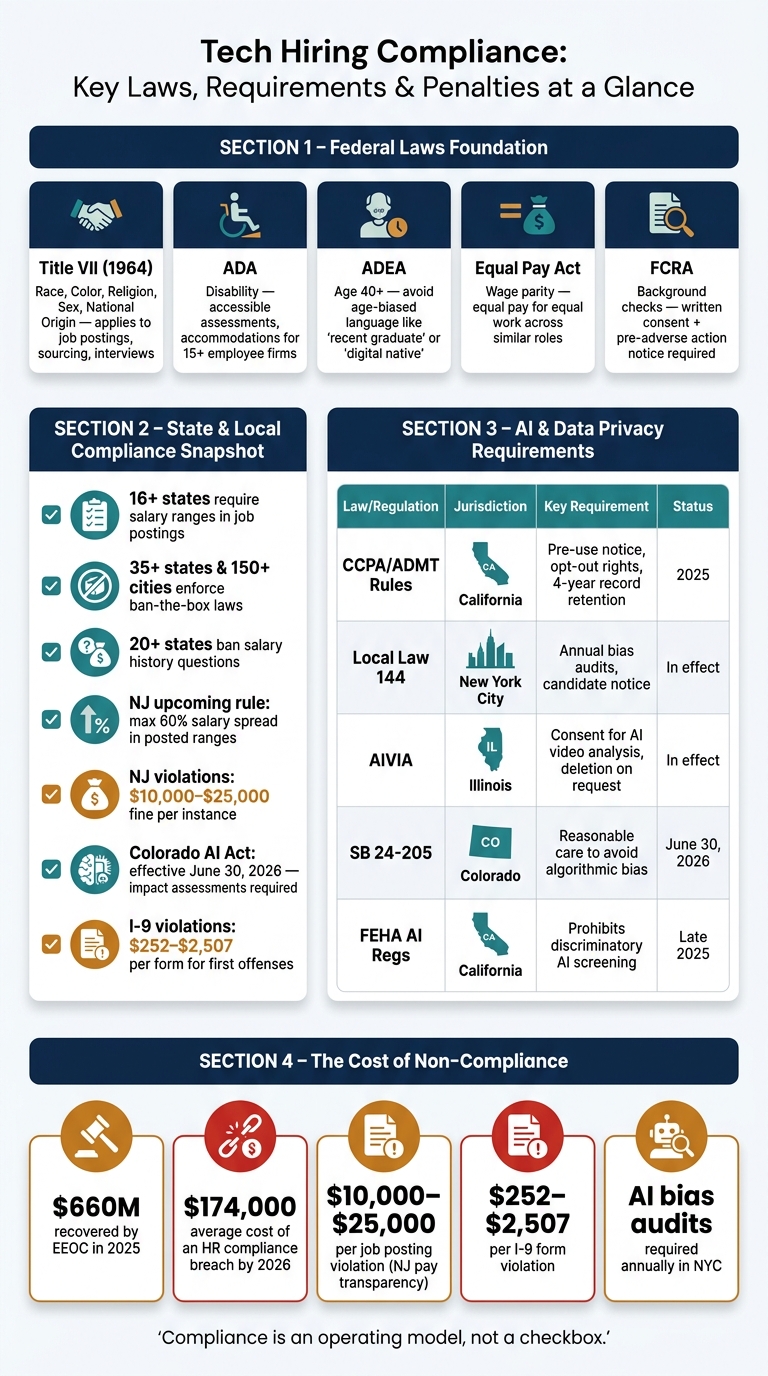
The Legal and Regulatory Framework for Technical Recruiters
Key Federal Employment Laws
Federal regulations lay the groundwork for compliant hiring practices in technical recruiting.
Title VII of the Civil Rights Act of 1964 prohibits discrimination based on race, color, religion, sex, and national origin throughout the hiring process. This includes everything from job postings to extending offers. The law addresses both overt discrimination (like intentional bias) and neutral policies that may inadvertently disadvantage certain groups .
"Title VII prohibits not only intentional discrimination, but also practices that have the effect of discriminating against individuals because of their race, color, national origin, religion, or sex." - U.S. Equal Employment Opportunity Commission
The Americans with Disabilities Act (ADA) ensures technical assessments, such as coding challenges, focus on job-relevant skills rather than creating barriers for individuals with disabilities. Similarly, the Age Discrimination in Employment Act (ADEA) protects candidates aged 40 and older, making it risky to impose strict experience caps or age-related criteria in job postings. The Equal Pay Act of 1963 mandates equal pay for equal work, a critical consideration when offering salaries for similar developer roles. Finally, the Fair Credit Reporting Act (FCRA) governs the use of third-party background checks, requiring clear candidate consent and proper disclosures .
| Law | What It Covers | Application in Tech Recruiting |
|---|---|---|
| Title VII | Race, Color, Religion, Sex, National Origin | Job postings, sourcing, interview questions |
| ADA | Disability | Accessibility in coding challenges, AI interviews |
| ADEA | Age (40+) | Avoiding bias against older candidates |
| Equal Pay Act | Wage disparities | Ensuring fair pay during salary negotiations |
| FCRA | Background check data | Requiring consent and providing disclosures for screenings |
These laws create a baseline, but additional state and local regulations often add complexity.
State and Local Compliance Requirements
While federal laws apply nationwide, states and cities often introduce their own employment regulations. For instance, salary transparency laws in California, Colorado, New York, and Washington require job postings to include pay ranges. This applies even to remote roles, where the candidate’s location dictates compliance.
Ban-the-box laws, now active in over 35 states and 150 cities, delay questions about a candidate’s criminal history until after a conditional offer is made. Additionally, certain states - like California, New York, New Jersey, and Washington - prohibit rejecting candidates for non-safety-sensitive roles based solely on positive marijuana tests, even though marijuana is federally illegal.
Another area of concern is I-9 compliance. Failing to meet documentation requirements for employment eligibility can lead to fines. For first-time offenses, penalties range from $252 to $2,507 per form .
These evolving laws mean that staying compliant often requires adapting to multiple layers of regulation.
Compliance Challenges Specific to Tech Recruiting
Tech recruiting, especially for remote roles, introduces unique challenges. For example, hiring remote candidates means complying with state-specific laws, even if the company is headquartered elsewhere. Colorado law, for instance, applies to out-of-state remote roles and includes regulations like the upcoming Colorado AI Act. This law, effective June 30, 2026, requires companies to conduct impact assessments for high-risk AI systems and ensure human oversight in decision-making processes .
Algorithmic bias is another pressing issue. Past incidents, such as Amazon’s discontinued hiring tool, highlight the risks of relying on vendor tools that may unintentionally discriminate . Employers bear responsibility for the outcomes of these tools, even if the discrimination is unintentional.
Sourcing candidates from platforms like GitHub, Stack Overflow, and Kaggle can also lead to data privacy concerns. Collecting personal information without clear disclosure or a valid purpose may violate laws like California’s CPRA or, for international candidates, the GDPR . It’s important to note that compliance obligations begin the moment data is collected - not when a candidate submits an application.
This intricate web of regulations makes a compliance-first approach essential for tech recruiters.
Anti-Discrimination and Fair Hiring Practices
Ensuring fairness in hiring isn't just about meeting legal requirements - it's about creating a diverse and inclusive workplace. Anti-discrimination measures play a crucial role at every stage of the hiring process, from drafting job ads to extending offers.
Writing Unbiased Job Descriptions and Ads
The words you choose in job postings do more than outline responsibilities - they can unintentionally signal preferences. For instance, phrases like "digital native", "recent graduate", or "young and energetic" may violate the Age Discrimination in Employment Act (ADEA) by suggesting age bias. Similarly, flashy titles like "Rockstar Developer" or "Code Ninja" can discourage women from applying. Instead, stick with neutral titles like "Software Developer" or "Backend Engineer."
Under the Americans with Disabilities Act (ADA), job descriptions should clearly distinguish between essential functions and secondary tasks. This distinction matters because courts often give significant weight to pre-written job descriptions when evaluating discrimination claims. For example, instead of vaguely requiring "must speak clearly on the phone", which could exclude candidates with speech or hearing disabilities, you could say "communicates effectively with clients." This phrasing sets the same expectation without creating unnecessary barriers.
"Courts give 'considerable weight' to a written job description prepared before advertising or interviewing." - Rachel Richardson, Head of Growth & Marketing, Grove HR
If you use AI tools to draft job postings, be cautious. AI can unintentionally introduce proxy discrimination, favoring candidates from certain schools or graduation years - criteria that may correlate with race, age, or socioeconomic status . Always review AI-generated content and include an Equal Employment Opportunity (EEO) statement. If language skills are required, replace "native English speaker" with "professional-level English proficiency" to avoid unintentional bias .
Creating unbiased job descriptions is just the first step. The same level of care is essential when designing technical assessments and interviews that don't rely solely on traditional coding tests.
Compliance in Technical Assessments and Interviews
Technical assessments should focus solely on the skills required for the job. For example, under the ADA, a coding challenge that inadvertently tests sensory or manual abilities rather than engineering skills could be discriminatory . Providing accommodations, such as extended time or compatibility with screen readers, is required for employers with 15 or more employees .
Structured interviews are another effective way to reduce bias. By using the same set of questions for all candidates and scoring answers against a predefined rubric, you can minimize subjectivity. Here's a quick look at common interview pitfalls and how to address them:
| Protected Category | Prohibited Question | Acceptable Alternative |
|---|---|---|
| Age | "When did you graduate?" | "Are you at least 18 years old?" (if legally required) |
| Disability | "Do you have any disabilities?" | "Can you perform this role's essential functions, with accommodations if needed?" |
| Religion | "Do you observe any religious holidays?" | "This role requires Saturday availability. Can you meet that requirement?" |
| National Origin | "Where are you from originally?" | "Are you authorized to work in the US?" |
| Salary History | "What was your salary at your last job?" | "What are your salary expectations for this role?" |
If you're using AI tools for screening or scoring, inform candidates and get their consent where required. Some states, like Illinois and New York City, already mandate this . As attorneys Beth Spain and Ted C. Theofrastous emphasize:
"The AI algorithm did it is not a defense."
Human oversight is essential at every decision point to ensure compliance and fairness. Transparency around compensation is another key element of fair hiring practices.
Pay Equity and Salary Transparency
As of early 2026, over 16 states and several major cities require pay transparency in job postings . For remote roles, it's safest to follow the strictest state laws - often referred to as the "highest common denominator" approach. For example, if a role could be performed in California or Colorado, their disclosure requirements should apply, regardless of the company's main office location.
Vague salary ranges like "$70k+" or "up to $120k" fail to meet compliance standards and could invite regulatory scrutiny. New Jersey's upcoming rules go even further, introducing a "60% maximum spread rule": the highest salary in a posted range cannot exceed the lowest by more than 60% (e.g., $100,000–$160,000 is compliant; $100,000–$170,000 is not) . Violations in 2026 could result in fines ranging from $10,000 to $25,000 per instance .
Internally, you can take proactive steps to ensure compliance. Configure your Applicant Tracking System (ATS) to lock pay range fields, preventing unapproved figures from being posted. Conduct annual pay equity audits to identify and address any race- or gender-based pay gaps before they become visible in public salary disclosures . Eliminating salary history questions - already banned in over 20 states - also helps reduce pay inequality and reinforces a fair hiring approach across your organization.
Candidate Data Privacy and AI Tool Compliance
Continuing the discussion on ethical hiring, this section focuses on managing candidate data responsibly and ensuring compliance when using AI tools in recruitment.
US and Global Data Privacy Laws That Affect Recruiting
In the United States, there isn't a single federal law regulating data privacy in recruitment. However, state laws like the California Consumer Privacy Act (CCPA), updated with California Privacy Protection Agency (CPPA) regulations, impose specific requirements. For instance, if you're using tools that automate or significantly influence hiring decisions, you must provide candidates with a clear pre-use notice explaining the tool's purpose and the data it processes. Candidates also have the right to opt out of automated decision-making for critical matters like hiring or pay .
California also mandates that employers retain AI-related hiring records, including notices and decision logs, for at least four years . Other states are enacting their own rules. Indiana's new privacy law takes effect on January 1, 2026, while Colorado's SB 24-205, effective June 30, 2026, requires employers to exercise "reasonable care" to avoid algorithmic bias in hiring .
| Law/Regulation | Jurisdiction | Key Requirement | Effective Date |
|---|---|---|---|
| CCPA (ADMT Rules) | California | Pre-use notice, opt-out rights, risk assessments | 2025 |
| Local Law 144 | New York City | Annual bias audits, public posting, candidate notice | Already in effect |
| AIVIA | Illinois | Consent for AI video analysis, deletion on request | Already in effect |
| SB 24-205 | Colorado | "Reasonable care" to avoid algorithmic bias | June 30, 2026 |
| FEHA AI Regs | California | Prohibits discriminatory AI screening and medical inquiries | Late 2025 |
A practical first step is to map where your candidates are located, as compliance requirements are usually based on the applicant's location during the application process .
With the legal backdrop in place, the next section explores how to use AI responsibly in technical hiring.
Responsible AI Usage in Technical Hiring
AI tools can streamline sourcing and screening processes. For example, automated scheduling chatbots can reduce time-to-hire by up to 50% in high-volume hiring scenarios . However, faster processes don't eliminate legal accountability. Under laws like Title VII, the ADA, and the ADEA, employers are fully liable for discriminatory outcomes caused by AI tools .
"The EEOC treats AI like any other selection procedure under Title VII and the Uniform Guidelines; employers remain responsible for adverse impact and must ensure job-relatedness, business necessity, and accommodation processes." - Christopher Good, Everworker
To avoid proxy discrimination, focus AI screening on measurable skills rather than indirect factors like ZIP codes or graduation years. For technical roles, prioritizing code portfolios or verified project work provides more reliable and defensible insights than background data that may inadvertently correlate with race or socioeconomic status .
Human oversight is non-negotiable. As one legal expert explains:
"Meaningful human oversight means a trained reviewer who understands the tool's outputs and can override them; rubber-stamping won't comply." - Robinson & Cole
Assign an internal reviewer to monitor selection rates quarterly using the four-fifths rule. If a protected group's selection rate is less than 80% of the highest group's rate, it signals a potential issue with adverse impact .
The next step is to assess recruitment platforms for embedded compliance features.
Choosing Recruitment Platforms With Compliance Features
When evaluating recruitment platforms, look for documented validation studies and evidence of bias-mitigation practices . Vendor contracts should include a Data Processing Addendum (DPA), audit rights, data deletion clauses, and proof of bias-reduction measures .
On the security front, require vendors to meet SOC 2 Type II or ISO 27001 standards. They should also support features like end-to-end encryption, Role-Based Access Control (RBAC), and Single Sign-On (SSO) . Platforms like daily.dev Recruiter use a double opt-in model, ensuring developers actively choose to participate, which helps maintain consent-based data handling and reduces the risk of collecting unsolicited data.
"Employers remain accountable under anti-discrimination laws even when vendors provide the AI, so assign internal ownership, require vendor transparency, and document your testing and remediation steps." - Ameya Deshmukh
To simplify compliance, build what professionals call a "modular compliance baseline". Start with the strictest requirements, such as NYC Local Law 144 or California's ADMT rules, and layer on additional state-specific rules like Illinois' video consent or Colorado's appeal rights . This approach ensures a consistent recruitment process while meeting regulations wherever your candidates are located.
Building a Compliance-First Recruitment Workflow
Once your compliance framework and AI governance policies are ready, the next step is weaving those requirements directly into your hiring process. Compliance shouldn't be an afterthought - it needs to be part of every step.
Planning and Sourcing Candidates
Compliance starts well before posting a job. Begin with a job analysis that links each responsibility to a measurable skill or competency. This provides a clear legal foundation for your screening process .
When crafting the job posting, some universal rules apply. Clearly distinguish between essential functions (core tasks required for the role) and marginal functions (secondary, less critical duties). The ADA only allows disqualifying candidates based on essential duties . Avoid terms like "recent graduate", "digital native", or gendered language, as these can introduce bias. Also, remove criminal history questions from the initial application stage - over 35 states and 150 cities now enforce "ban-the-box" laws prohibiting such inquiries early in the process .
Pay transparency is increasingly mandatory in many areas. By 2026, at least 11 states will require salary ranges in job postings, including California (15+ employees), New York (4+ employees), Washington (15+ employees), Illinois (15+ employees, effective 2025), and Colorado (for any role that can be performed in the state) . For remote roles, adhere to the strictest applicable laws based on candidate locations.
When sourcing candidates, focus on consent-driven methods. Platforms like daily.dev Recruiter use a double opt-in system, where candidates actively agree to engage before any outreach occurs. This reduces the risk of contacting individuals without their consent, which is especially important in states like Illinois or under GDPR regulations.
"Compliance isn't a tax on innovation - it's how you make AI recruiting scalable, fair, and trusted." - Ameya Deshmukh
Once your job postings and sourcing methods align with compliance standards, the focus shifts to reducing time to hire for technical roles while maintaining these principles consistently during screening and assessments.
Screening, Interviews, and Assessments
Fair and defensible assessments start with accurate job descriptions and consent-driven sourcing. Structured interviews are one of the most effective ways to ensure consistency. Ask all candidates for the same role the same set of questions, and score their responses using a defined rubric. This minimizes subjective judgment and provides documentation that evaluation criteria were applied equally .
For technical assessments, the U.S. Department of Justice emphasizes the importance of relevance:
"Employers must ensure that any such tests or games measure only the relevant skills and abilities of an applicant, rather than reflecting the applicant's impaired sensory, manual, or speaking skills that the tests do not seek to measure."
This means tools like timed coding tests or logic games must be validated as job-relevant. Additionally, you must offer alternative formats for candidates who request accommodations. Ensure that testing platforms are compatible with assistive technologies.
Here’s a quick-reference table to guide compliant screening practices:
| Protected Category | Prohibited Question | Acceptable Alternative |
|---|---|---|
| Age | "When did you graduate?" | "Are you at least 18 years old?" |
| Disability | "Do you have any disabilities?" | "Can you perform the essential functions of this role with or without accommodation?" |
| Religion | "Do you observe religious holidays?" | "This role requires Saturday availability. Can you meet that?" |
| Salary History | "What was your last salary?" | "What are your salary expectations for this role?" |
Track selection rates by demographic group on a quarterly basis using the four-fifths rule. If the selection rate for any protected group falls below 80% of the highest-selected group, it’s a red flag to review your screening process for potential bias .
Extending Offers and Onboarding
Once you’ve identified the right candidate through compliant screening, it’s time to focus on the final hiring steps.
Before conducting background checks, secure a standalone written disclosure and signed authorization as required by the FCRA. If a report disqualifies a candidate, issue a pre-adverse action notice and allow five business days before finalizing the decision .
Your offer letter should include four key elements:
- An at-will employment statement to clarify that the letter isn’t a fixed-term contract.
- The role’s FLSA status (exempt or non-exempt).
- Any contingencies, such as drug screenings.
- A salary range, if required by state law .
For remote roles, default to the strictest pay transparency laws among the states where your candidates are based.
On the employee’s first day, ensure Form I-9 Section 1 is completed. You must verify their documents and complete Section 2 within three business days of their start date . Federal law also requires new hires to be reported to your state’s designated agency within 20 days of hire - some states have shorter timeframes . If you’re hiring across multiple states, you can consolidate reporting to a single state by filing electronically and notifying the Department of Health and Human Services.
When transitioning candidate data from your ATS to your HRIS, ensure proper mapping of data, delete unnecessary information, and update consents for payroll and benefits . Limit third-party access to only what’s essential.
Maintaining Compliance Over Time
Staying compliant is a constant effort, especially as laws evolve, AI tools advance, and team dynamics shift.
Recruiter Training and Policy Development
Clear, documented policies are the backbone of compliance. Recruiters need a reliable reference that connects legal requirements to their daily tasks. One effective approach is creating a "law-to-process" map - a guide that links specific laws, like NYC Local Law 144 or Illinois AIVIA, to actionable steps, such as when to notify candidates or obtain consent .
Regular training is crucial. Recruiters should stay updated on AI's limitations, learn to spot biased outcomes, and understand when to step in and override AI-driven decisions. As Christopher Good from Integrail Corp. puts it:
"Human oversight means qualified reviewers can understand, contest, and correct AI-driven recommendations... and make final employment decisions when needed, with traceable approvals."
To ensure collective accountability, establish a cross-functional council that includes Talent Acquisition, Legal, HR Operations, and Security. This team can regularly review bias reports and approve new tools to maintain compliance .
Finally, measure the effectiveness of these efforts to ensure fairness and accuracy throughout the recruitment process.
Tracking Compliance Metrics and Improving Processes
Tracking the right metrics is key to maintaining a fair and compliant hiring process. Teams can use real-time dashboards to monitor hiring stages, ensuring parity across locations, roles, and demographics. Automated alerts can flag deviations, prompting manual reviews when necessary .
| Metric Category | Specific Indicator | Purpose |
|---|---|---|
| Fairness | Four-fifths ratio | Highlights potential adverse impact on protected groups |
| Accuracy | False rejection rate | Identifies qualified candidates wrongly filtered out by automation |
| Governance | Human override rate | Tracks when and why manual corrections are made to AI decisions |
| Stability | Model drift | Monitors changes in AI decision patterns over time |
| Transparency | Notice/Consent rate | Ensures compliance with disclosure laws specific to various jurisdictions |
Additionally, linking hiring criteria to post-hire outcomes, like performance and retention, can demonstrate the fairness and relevance of your process if it’s ever challenged . AI models should be re-tested annually or whenever new job types or data sources are introduced .
This data-driven approach is essential for selecting platforms that align with compliance requirements.
Using Developer-Focused Platforms to Support Compliance
The recruitment platform you choose plays a major role in compliance. For example, daily.dev Recruiter uses a double opt-in model, ensuring developers give explicit consent before any outreach. This reduces risks under privacy laws like GDPR and similar frameworks.
The platform’s permission-based introductions connect recruiters with candidates who are genuinely interested in new opportunities. Integration with ATS tools further supports compliance by creating an auditable workflow, complete with timestamped records, consistent screening methods, and clear data flows throughout the hiring process.
"Compliance is an operating model, not a checkbox." - Ameya Deshmukh
Treating compliance as an ongoing process - not just a last-minute task - helps teams stay ahead of regulatory changes and avoid bias-related issues. By building compliance into everyday operations, recruitment teams can confidently adapt to legal and technological shifts without missing a beat.
Conclusion: Key Takeaways for Tech Hiring Compliance
Tech hiring compliance touches every step of the recruitment process, from crafting job postings to onboarding new hires. With at least 11 states now requiring pay transparency disclosures and an ever-growing patchwork of state and local hiring regulations , navigating this landscape is becoming increasingly demanding.
The stakes are high. By 2026, the average cost of an HR compliance breach is projected to hit $174,000 . And that's just the financial hit - it doesn’t account for the reputational damage or the erosion of candidate trust.
"The organizations that avoid enforcement actions aren't the ones with the cleanest AI. They're the ones with the most credible evidence that they took the problem seriously - before a complaint was filed." - Employment Law Counsel, 2023 SHRM Tech Conference
To reduce these risks, recruiters should focus on a few key practices: validate hiring tools, thoroughly document decisions, and ensure human oversight remains part of critical processes. Rely on skills-based criteria instead of proxies like school reputation, and conduct annual adverse impact analyses to identify and address potential disparities. When in doubt, design workflows to comply with the strictest regulations - such as NYC Local Law 144 - to cover all jurisdictions effectively .
Ultimately, compliance isn’t just about avoiding fines or penalties. It’s an opportunity to build trust with candidates, promote fairer hiring practices for underrepresented groups, and create a hiring process that’s defensible and transparent.
FAQs
What hiring laws apply when I recruit remote developers in multiple states?
When bringing remote developers on board from different states, it's crucial to follow each state's specific regulations regarding anti-discrimination, bias audits, consent, transparency, and data privacy. These rules differ depending on the jurisdiction. For example, some locations require bias audits, like New York City under Local Law 144. Others mandate explicit candidate consent, as seen in Illinois, or demand impact assessments, such as in Colorado. This creates a challenging and varied compliance environment that employers need to navigate carefully.
How can I prove my AI screening tool isn’t creating illegal bias?
To show that your AI screening tool operates without illegal bias, you’ll need to take several steps. Start with bias testing and adverse impact analyses, ensuring you document every part of the process. Ask vendors for studies that include demographic data, and use tools like the four-fifths rule to measure fairness. Also, validate the tool by confirming it aligns with job-related criteria.
Keep an eye on outcomes for protected groups by regularly monitoring results. Maintain detailed audit trails to track your compliance efforts and ensure transparency by informing candidates about the use of AI in the hiring process. Lastly, make sure accommodations are available when needed to promote both fairness and compliance.
What’s the minimum candidate-data notice and consent I need before sourcing?
Before starting the sourcing process, it's essential to inform candidates and get their consent, particularly when using AI-powered tools. Be transparent by sharing details about the use of AI, the steps involved in the process, and any accommodations available. Keep in mind that regulations differ depending on the location. For instance, Illinois requires consent for video interviews, while New York City mandates bias audits and notices. Always check the local laws to ensure you're following the rules.
.png)