Hiring Go engineers in 2026 is mostly about role focus, proof of shipped work, and hiring speed. Only 13.5% of professional developers use Go often, and many strong candidates show up under titles like Platform Engineer, SRE, or DevOps instead of “Go Developer.”
If I were hiring, I’d keep it simple:
- Pick the track first: API/backend Go vs. infrastructure/systems Go
- Set pay to match the track: infra roles often cost $10,000–$25,000 more
- Look past titles: GitHub work, Kubernetes, cloud tooling, and Go community activity often say more than a résumé keyword
- Test for shipped Go: concurrency, cancellation, error handling, testing, modules, and observability
- Use short, job-like assessments: not trivia
- Move fast: many strong candidates drop out if the process stretches past 3–4 weeks
Here’s the short version: a résumé that says “Golang” is not enough. I’d look for signs of production use, such as context.Context, race testing, pprof, worker pools, go.mod, and service work in Kubernetes or gRPC stacks.
A big mistake is hiring for a vague “Senior Go Developer” role. That often mixes two different jobs. One person may be strong in APIs and weak in Kubernetes controllers. Another may be great at infra tooling but not your best fit for product backend work. Same language, different job.
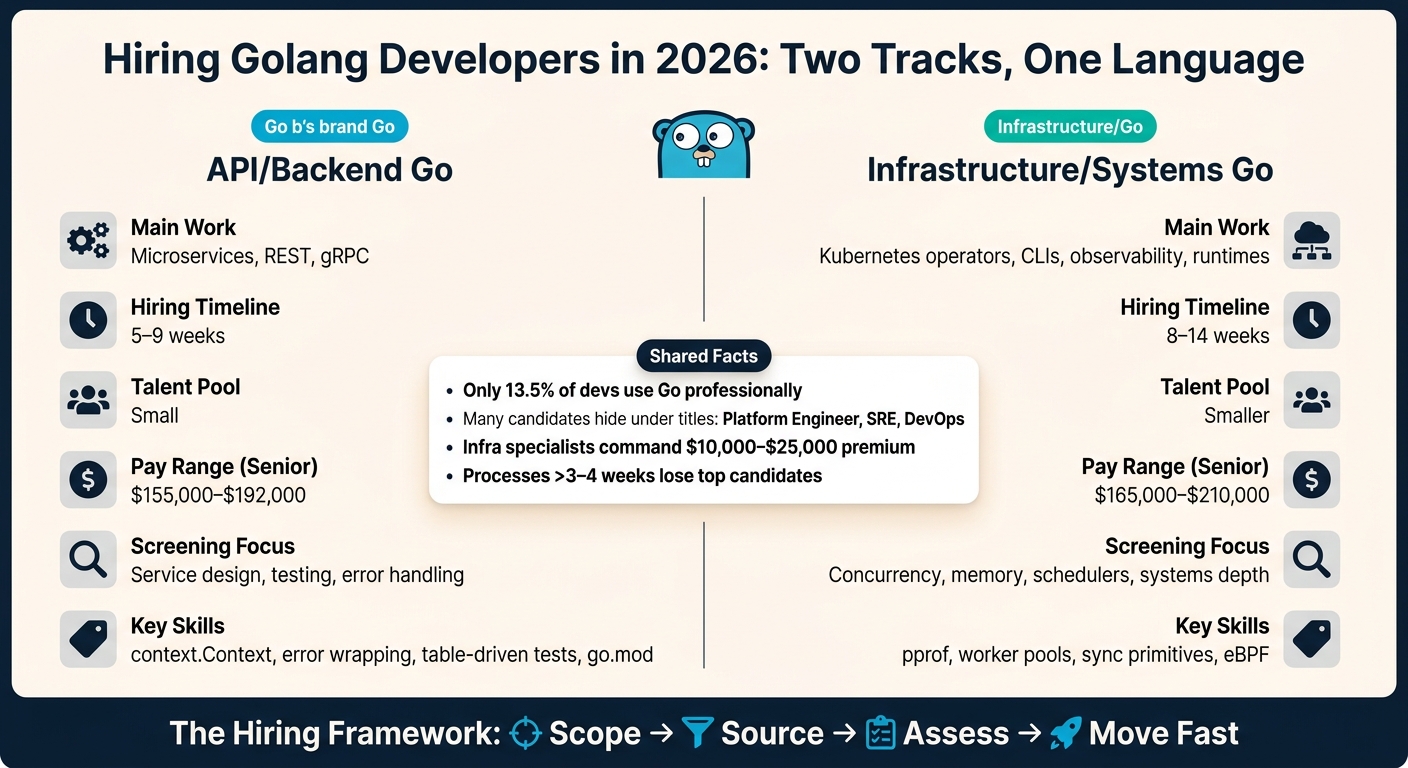
Quick Comparison
| Area | API/Backend Go | Infrastructure/Systems Go |
|---|---|---|
| Main work | Microservices, REST, gRPC | Kubernetes operators, CLIs, observability, runtimes |
| Hiring timeline | 5–9 weeks | 8–14 weeks |
| Talent pool | Small | Smaller |
| Pay range | Lower | Often $10,000–$25,000 higher |
| Main screening focus | Service design, testing, error handling | Concurrency, memory, schedulers, systems depth |
I’d read the article as a hiring playbook: define the job clearly, source from the Go ecosystem, run interviews around production judgment, and keep the process tight so you don’t lose people.
1. Understand the 2026 Golang hiring market before opening a role
Where Go demand is concentrated and where talent comes from
The 2026 Go hiring market has split into two clear tracks: API/backend Go and Infrastructure/systems Go .
API/backend roles usually focus on microservices plus REST or gRPC services. Infrastructure/systems roles lean more toward Kubernetes operators, CLI tools, observability pipelines, and container runtimes . Same language, different day-to-day work. And that difference matters when you hire.
Demand is heaviest in CNCF cloud-native infra, high-throughput API services, distributed databases like CockroachDB, and security and systems tooling such as eBPF-based agents . Platform engineering is also pushing more companies toward Go for internal developer platforms and cloud-native tooling .
Before you write the job description, lock down which track you need using a modern engineering talent acquisition framework. A well-scoped API role usually closes in 5 to 9 weeks. Infrastructure-heavy roles often take 8 to 14 weeks because the talent pool is thinner . If you blur the two, the search can drag on for weeks. That split should shape the skills you screen for next.
US salary bands and budget planning by role scope
Pay in 2026 lines up with both seniority and role track. Infrastructure and systems roles usually come with a $10,000 to $25,000 premium over similar API roles because engineers who know Go internals, memory layout, and scheduler behavior are hard to find .
| Level | API/backend | Infrastructure/systems |
|---|---|---|
| Junior (0–2 yrs) | $90,000 – $120,000 | $100,000 – $130,000 |
| Mid-Level (3–5 yrs) | $115,000 – $145,000 | $125,000 – $160,000 |
| Senior (5–8 yrs) | $155,000 – $192,000 | $165,000 – $210,000 |
| Staff / Principal | $195,000 – $240,000+ | $230,000 – $300,000+ |
In New York and San Francisco, base pay can go past $250,000 for HFT and AI platform roles. Primary on-call often adds about $500 per week .
Use these ranges to set the level you want and the depth of Go fluency you expect.
2. Define the Go skills that matter when hiring
Core Go skills beyond syntax: concurrency, error handling, and testing
Once you move past syntax, the next step is figuring out what actual Go fluency looks like.
In production, the clearest signals usually come from three areas: concurrency, error handling, and testing.
Concurrency is the biggest separator. A casual Go user can start a goroutine and call it a day. A production engineer thinks about how that goroutine stops, what happens when requests time out, and how resource use stays under control. That usually means using context.Context for cancellation and timeouts, sync.WaitGroup for coordination, and worker pools to limit how much work runs at once.
If a candidate can't explain a goroutine leak, a deadlock, or how they tracked one down with pprof or runtime/trace, that's a weaker sign for production Go .
Error handling tells you a lot too. Thin Go experience often shows up in swallowed errors or bare string messages with no context. Production engineers treat errors as values. They wrap errors with fmt.Errorf and %w, then inspect them with errors.Is and errors.As when they need type-safe checks .
Testing is the third big signal. You're looking for table-driven tests, go test -race in CI to catch data races, integration tests with testcontainers-go, and benchmarks for parts of the code where speed matters .
Of course, none of that means much if the candidate has only seen these patterns in toy projects. The point is whether they've used them in a live production stack.
Production stack signals: microservices, modules, cloud, and observability
Strong Go candidates usually have production stack experience to back up those core skills. They’ve built HTTP or gRPC services, worked with multi-stage container builds, and shipped apps to Kubernetes. They’ve also used Prometheus metrics, structured logs, and distributed tracing to watch latency, traffic, errors, and saturation .
go.mod is another clear signal. So is semantic versioning. It helps to ask whether the candidate understands private module registries and strict versioning discipline .
Heavy framework use matters less here. What matters more is whether they know the standard library well, especially net/http .
That’s the difference between someone who has studied Go and someone who has shipped it.
| Dimension | Shallow Go Experience | Production-Grade Go Engineering |
|---|---|---|
| Concurrency | Starts goroutines without exit strategy; uses channels for everything | Uses worker pools, capped concurrency, and sync primitives; manages leaks |
| Error handling | Swallows errors with _; uses panic for flow control |
Wraps errors with context; uses errors.Is and errors.As |
| Testing | Basic unit tests; no race detection | Table-driven tests; benchmarks; -race detector in CI |
| Modules | Unfamiliar with go.mod or semantic versioning |
Manages private modules; strictly follows SemVer |
| Observability | Relies on basic print logs | Implements structured logging, metrics, and distributed tracing |
| Performance | Assumes Go is fast by default | Uses pprof flame graphs and runtime/trace for data-driven tuning |
3. Find Go talent where ecosystem signals are visible
Community channels, GitHub, and events that surface serious Go engineers
Knowing what good Go looks like matters. But it only helps if you can find the people who write it day in and day out.
A stronger signal is where someone contributes. Once you know what strong Go code looks like, it makes sense to source from places where that work leaves public traces.
GopherCon and regional Go user groups are useful for that. Showing up in those communities points to time spent learning Go idioms and best practices in a way a résumé bullet never can .
GitHub lets you go a layer deeper. Check contributions to core Go projects such as golang/go, kubernetes/kubernetes, hashicorp/terraform, and prometheus/prometheus . A public contribution says more than a self-reported Go résumé line.
When you review a repository, look for production habits that experienced Go engineers tend to show:
- explicit error wrapping with
%w - table-driven tests
- steady
context.Contextpropagation - small interfaces with one or two methods
Those public signals help you separate real production experience from résumé-only Go exposure.
The CNCF DevStats dashboard at devstats.cncf.io also helps here. It surfaces top contributors across more than 180 Go-based projects, including etcd, containerd, and Istio .
It also helps to widen the title search. Look at Platform Engineer, SRE, and Cloud Infrastructure Engineer profiles with Kubernetes or distributed systems experience. That often brings up strong Go talent that a plain "Golang" keyword search misses .
Using daily.dev Recruiter to find Go developers through behavior and stack signals
daily.dev Recruiter surfaces Go talent by tracking repeated engagement with Go-specific technical content, including Go internals, microservices, Kubernetes, distributed systems, pprof, and reliability, instead of leaning on static résumé keywords .
That difference matters. It helps separate developers who are actively keeping up with the Go ecosystem from those who simply list Go on a résumé.
Recruiters can target the Go stack directly at /stacks/go, match candidates to backend needs at /roles/backend-engineer, and sharpen outreach with /resources/developer-recruitment-strategies-2026 .
| Dimension | Traditional Outbound Sourcing | Behavior-Based Sourcing (daily.dev Recruiter) |
|---|---|---|
| Signal Quality | Keyword-based; high risk of "tutorial-only" experience | Based on active reading and engagement with production-grade content |
| Candidate Intent | Low; often targets passive candidates with generic messages | High; identifies developers actively staying current with the Go ecosystem |
| Time-to-Screen | High; requires manual vetting of "Resume Go" vs. "Production Go" | Low; stack signals pre-validate technical interest and depth |
| Reply Quality | Low; generic outreach is often ignored by senior talent | High; outreach can be personalized based on specific reading and stack interests |
Because responses are double opt-in, interested developers self-select into the conversation. That gives recruiters a much easier starting point for outreach built around the candidate's actual stack interests.
4. Run Go-specific assessments and interviews that test real engineering judgment
Assessments that reveal Go fluency instead of trivia recall
Once sourcing narrows the pool, use assessment to check production judgment. Skip syntax trivia like make vs. new. What matters more is whether a candidate can reason through a goroutine leak or pass context.Context the right way through a call stack .
A short practical exercise works much better. Give candidates a 2- to 3-hour HTTP or gRPC task that feels like work they might do on the job: a rate-limited API, a queue worker, or a stream fan-in. The task should require a worker pool, graceful shutdown, and context.Context propagation. That mix shows how they think about concurrency, resource use, and failure modes in one shot . If a take-home goes past 3 hours, pay for it.
Pair that exercise with a code review task. Show 50–80 lines of flawed Go code with swallowed errors, missing cancellation checks, and shared-state races . A strong engineer should spot correctness and lifecycle problems fast. They should also call out red flags like oversized interfaces and tests that never use the -race detector .
Interview question bank: concurrency, reliability, and system design
Use a 60-minute technical screen, the hands-on exercise, a 60-minute system-design panel, and a senior-level architecture deep dive. In the technical screen, skip dictionary-style questions. Ask candidates to walk through a service they built that failed in production. Strong engineers usually get specific fast: connection pool saturation, a missing cancellation signal, or GC pauses they traced with pprof .
Then use the panel to test production tradeoffs, not just syntax. The table below shows the main interview themes and what strong answers tend to look like at different levels.
| Theme | Question Topic | Junior Signal | Mid/Senior Signal |
|---|---|---|---|
| Concurrency | Worker pools vs. spawning goroutines | Can explain what a goroutine is | Discusses resource exhaustion and bounded concurrency |
| Concurrency | Channels vs. mutexes | Channels are for communication | Channels for ownership; mutexes for shared state |
| Reliability | Context cancellation | Knows it's for timeouts | Explains ctx.Done() in select blocks and propagation |
| Error Handling | Error wrapping | Uses if err != nil |
Ask when they wrap errors with %w and when they use errors.Is/errors.As |
| Testing | Table-driven tests | Writes individual test functions | Ask them to write a table-driven test |
| Systems | Observability | Mentions logging | Discusses pprof flame graphs and distributed tracing |
For the system design session, ask candidates to design a distributed component such as a rate limiter, job scheduler, or message queue. Then dig into how they handle partial failures, backpressure, and observability . For senior roles, add an architecture deep dive into a complex system they built. Ask about trade-offs between channels and mutexes, or how they used pprof to cut GC pauses from 50 ms to 2 ms by pooling allocations .
Use the same scoring lens in the next stage so you don't screen out strong people for the wrong reasons or let weak signals slide through.
5. Avoid common Go recruiting mistakes and build a better hiring process
Mistakes that produce weak pipelines or false negatives
Most hiring misses start with a simple problem: the role, the sourcing filters, and the interview scorecard don't line up with the kind of Go engineer you need.
Go work tends to split into different tracks. So a broad title like "Senior Go Developer" can hide a lot. In practice, that kind of title often pulls in too many API candidates and misses the infrastructure people you may need for Kubernetes operators or custom controllers .
Keyword-only sourcing makes this worse. If you search only for "Golang developer", you'll miss a lot of strong people. Many Platform Engineers, SREs, and Cloud Infrastructure Engineers write Go every day, even if that exact title never appears on their profile .
It's also a mistake to screen out candidates just because they built their career in C++, Java, Python, C, or Rust, or came up through SRE work. A lot of them can ramp into Go API or infrastructure roles fast . The interview should check judgment and transferability, not just whether someone's last title had "Go" in it.
Speed matters too. Senior Go engineers don't sit around for long. If your hiring process drags past 3 to 4 weeks, or you leave more than 48 hours between stages, strong candidates often disappear. Adopting technical hiring best practices like faster loops is now the baseline for success. .
Recruiter fluency helps more than people think. When recruiters can talk in real Go terms - goroutines, channels, modules, and the standard library - instead of leaning on broad backend buzzwords, candidates notice. That kind of language builds trust early in the process .
Conclusion: a practical go developer recruitment framework for 2026
When the role is scoped the right way and the pipeline is built around actual Go signals, hiring gets a lot easier.
Go's talent pool is small, so vague specs and slow processes can cost you hires. There's also a pricing angle here: infrastructure specialists often command a $20,000–$35,000 premium over API-focused engineers . If your pipeline is pointed at the wrong group, fixing that mistake gets expensive.
The framework is pretty simple:
- Scope the role by track
- Source through ecosystem-based sourcing tactics, not just title keywords
- Run assessments that test production judgment instead of syntax trivia
- Keep the loop tight
- Put weight on adjacent systems experience
That sequence - scope, source, assess, and move fast - helps teams hire Golang developers with fewer false positives.
FAQs
How do I choose between API Go and infrastructure Go roles?
Decide this before you write the job description. API Go roles center on microservices, REST endpoints, and gRPC services. The work usually leans on business logic, database interactions, and service-to-service communication.
Infrastructure Go roles sit in a different lane. They deal with things like Kubernetes operators, CLI tools, and automation pipelines. That means the job often calls for deeper knowledge of system internals, binary portability, and scheduler behavior.
These two profiles don’t overlap much in practice. If you bundle them into one role, you often cast the net in the wrong direction and make hiring take longer.
What proves real production Go experience?
Real production Go experience tends to show up in how someone talks about failure under load and systems-level debugging, not just whether they know the syntax.
That’s why it helps to look for specific examples from live systems, such as diagnosing memory leaks or fixing race conditions under real traffic. Those stories usually tell you a lot more than a clean whiteboard answer ever will.
Strong candidates should also be able to explain:
- performance tuning with pprof
- goroutine worker pools
- idiomatic error handling
- context propagation
- the trade-offs between mutexes and channels
How long should a Go hiring process take?
For a well-scoped Go role, expect four to nine weeks from job post to signed offer.
Cloud and API-focused roles often wrap up in five to nine weeks. More specialized infrastructure or systems roles usually take eight to 14 weeks.
Speed matters. Go engineers are in high demand and often juggle multiple offers. If more than three weeks pass between interview stages, you can lose top candidates.
.png)