If I rely on one sourcing channel, I limit reach, lower reply rates, and pay more for weaker matches. In 2026, a better plan is simple: use a small mix of channels, match each one to the role, and track results with clear numbers.
Here’s the short version:
- I should not treat LinkedIn as my whole sourcing plan
- I need different sourcing channels for different hiring goals
- I should judge each channel by:
- cost per qualified candidate
- time to first response
- candidate quality rate
- diversity impact
- I need to change outreach based on where I message people
- I should track both first-touch and last-touch sources
- I should start with 2 to 3 channels, not every channel at once
A few facts stand out from the article:
- GitHub and Stack Overflow tend to give stronger technical proof than self-written profiles
- Referrals often move the fastest, but can narrow pipeline mix
- Slack, Discord, and events can bring faster replies when I join the space the right way
- Community-first tools can add interest and reading signals, not just resume data
- A channel that looks cheap at the top of the funnel can still cost more if few people pass the tech screen
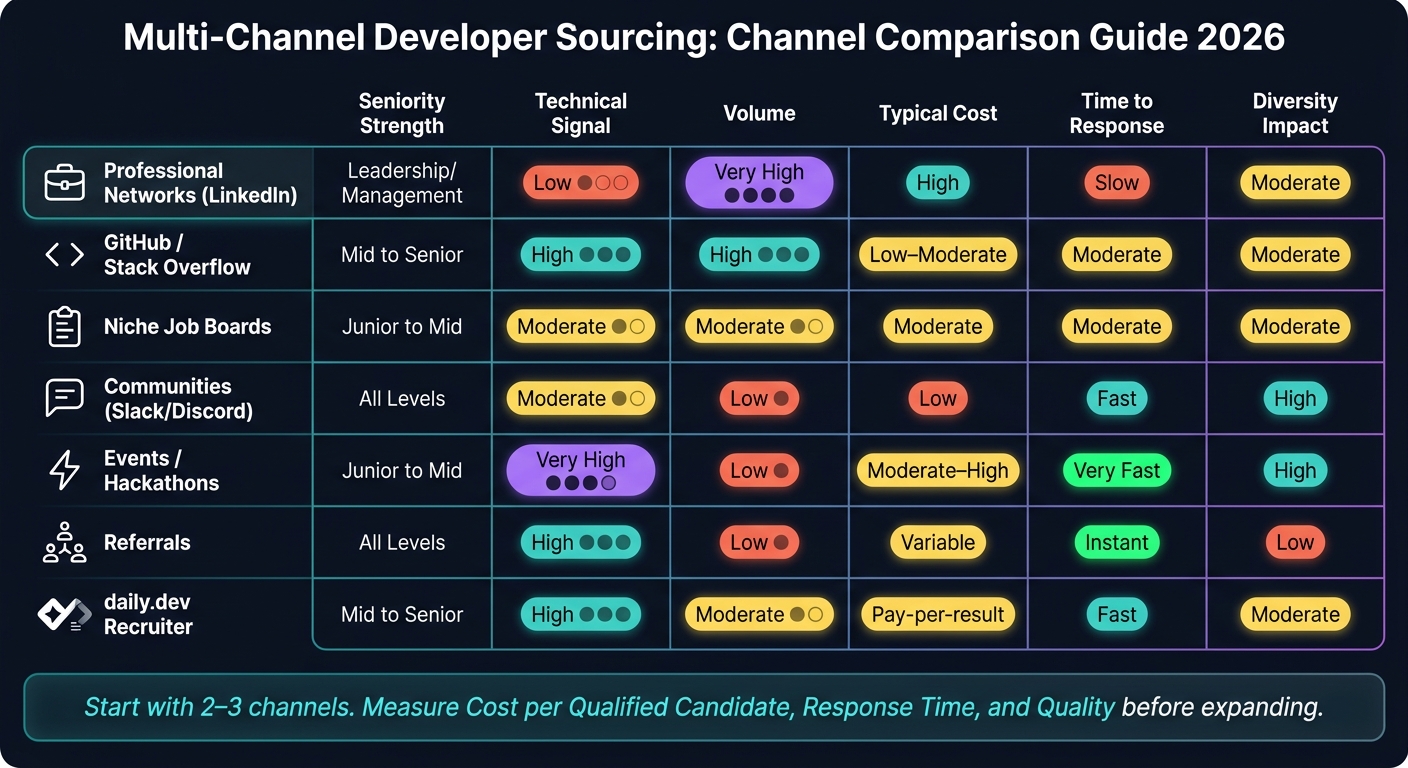
Quick Comparison
| Channel | Best for | Signal strength | Reply speed | Main risk |
|---|---|---|---|---|
| LinkedIn / professional networks | Leadership, management | Low | Slow | Same crowded pool |
| GitHub / Stack Overflow | Mid-to-senior engineers | High | Medium | Cold outreach feels off if I lack context |
| Niche job boards | Junior-to-mid roles | Medium | Medium | More volume, less depth |
| Slack / Discord communities | Many levels | Medium | Fast | Poor fit if I post before joining in |
| Events / hackathons | Junior-to-mid hiring | Very high | Very fast | Lower volume, more time per lead |
| Referrals | Most role types | High | Immediate | Same-network bias |
| daily.dev Recruiter | Mid-to-senior developers | High | Fast | Best used as part of a mix, not alone |
My takeaway: the goal is not more channels. The goal is a small, measured channel mix that fits the role, the stack, the timeline, and the budget.
If I do that - and keep outreach tied to each channel’s norms - I give myself a much better shot at finding developers who both reply and pass the screen.
1. The risk of depending on a single sourcing channel
How LinkedIn-only sourcing loses effectiveness over time
When a team leans on one sourcing channel and one outreach style, it ends up fighting for attention in the exact same pool as everyone else. Over time, that starts to wear thin. Reply rates fall, the cost per qualified candidate goes up, and passive developers get harder to reach. And generic replies? They don't tell you much about fit.
The issue isn't LinkedIn on its own. The issue is channel concentration. Relying on a single channel chips away at both reach and fit over time.
That's why the next move is mapping new candidate sourcing tactics for the 2026 landscape.
Why developers expect different behavior on each channel
Developers don't use every channel the same way. On LinkedIn, a professional message about a role feels normal. On GitHub and Stack Overflow, people are there to build, contribute, and get feedback, so outreach has to match that setting. In developer communities, the norm is relationship-first and tied to learning. If your message doesn't fit the channel, trust drops fast, and response rates usually follow.
The table below shows how developer intent and outreach norms shift based on where you find them:
| Channel | Developer intent | What Works | What breaks trust |
|---|---|---|---|
| Career networking, passive browsing | Direct, role-relevant outreach | Generic outreach | |
| GitHub / Stack Overflow | Building, contributing, seeking feedback | Context-aware messages that reference specific work | Unsolicited job pitches with no context |
| Developer communities | Learning, relationship-first engagement | Engaging before asking | Dropping job links without contributing |
These differences shape which channels belong in a multi-channel developer sourcing strategy.
Mismatched outreach hurts trust and response rates.
2. The 2026 channel map for finding developers
No single channel reaches every developer. Each one brings a different mix of signal, cost, and response speed. The goal isn’t to show up everywhere. It’s to avoid leaning too hard on one source and spread your recruiting effort across channels based on signal, role, and budget. Use this map to match each channel to the role, stack, and signal you need.
| Channel Category | Seniority Strength | Technical Signal | Volume | Typical Cost | Time to Response | Diversity Impact |
|---|---|---|---|---|---|---|
| Professional Networks | Leadership / Management | Low | Very High | High | Slow | Moderate |
| GitHub / Stack Overflow | Mid to Senior | High | High | Low to Moderate | Moderate | Moderate |
| Niche Job Boards | Junior to Mid | Moderate | Moderate | Moderate | Moderate | Moderate |
| Communities (Slack/Discord) | All Levels | Moderate | Low | Low | Fast | High |
| Events / Hackathons | Junior to Mid | Very High | Low | Moderate to High | Very Fast | High |
| Referrals | All Levels | High | Low | Variable | Instant | Low |
| daily.dev Recruiter | Mid to Senior | High | Moderate | Pay-per-result | Fast | Moderate |
Professional networks, GitHub, Stack Overflow, and job boards
Professional networks give you the biggest pool of developers, but there’s a catch: profiles are self-reported, so the signal is weak. They tend to work best for leadership and management roles, where title history and network reach often matter more than hands-on code samples.
If you want proof of actual developer work, high-signal channels do a better job. GitHub and Stack Overflow flip the script. GitHub commits, pull requests, and repository contributions show what a developer builds. Stack Overflow reputation shows how well someone explains technical ideas in public technical discussion. That’s a big difference. A polished profile can say a lot, but code and answers say more. On GitHub, look for depth of contribution. On Stack Overflow, look for steady, useful answers over time. Those are the signals that count.
Niche job boards are a practical option for junior-to-mid roles with broad skill matches. They make sense when volume and ease of access matter more than deep technical screening up front.
Developer communities, events, open source, and referrals
Some channels give up raw volume in exchange for stronger intent and faster trust. That trade can be worth it.
Developer communities in Slack and Discord are useful for relationship-based sourcing. The social rules matter here. Engage before you ask - that’s the norm, and if you skip that step, you can lose trust fast.
Events and hackathons work well for junior-to-mid hiring because they create fast, high-intent responses. You’re not just reading a profile. You’re seeing people show up, build, and interact in real time. That can tell you a lot, fast.
Referrals are the fastest channel in the mix and can be very efficient. But there’s a downside: they can hurt diversity because they often pull from the same circles again and again.
Where daily.dev Recruiter fits as a community-first channel
Community-first channels add another layer of signal. They show what developers read, learn, and spend time with, not just what they list on a profile.
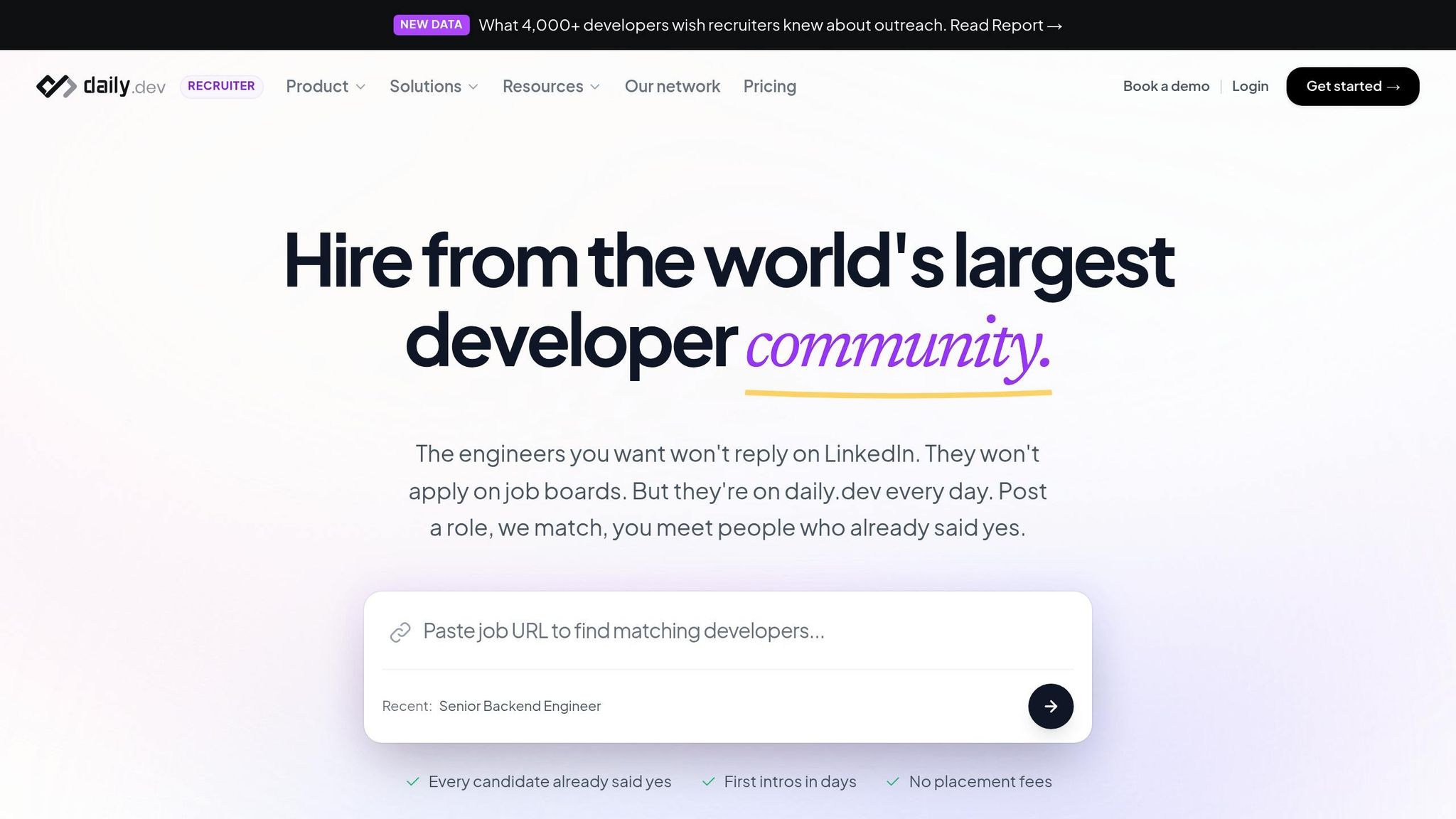
daily.dev Recruiter plays a different part in the mix. It’s built on a network where developers already spend time reading and engaging with technical content every day. That activity creates reading and engagement signals - useful context beyond a static profile. Because both sides opt in, outreach starts warmer. This approach aligns with what developers want from recruiters today. For mid-to-senior roles, that makes it a strong complement to GitHub and community channels when signal quality matters more than raw volume.
3. How to evaluate and prioritize sourcing channels
Once you know where developers spend time, the next step is simple: figure out which channels are worth keeping.
A lot of recruiting teams focus on volume. That tells you how many people you reached. It does not tell you whether those people were any good for the role. To judge channel performance in a more useful way, look at four core metrics.
Four core metrics to judge channel performance
| Metric | Formula | What It Helps You Decide |
|---|---|---|
| Cost per Qualified Candidate (CPQC) | (Direct Spend + Labor Costs) ÷ # Candidates passing tech screen | Whether a channel's cost justifies the quality of talent it produces |
| Time to First Response | Timestamp of 1st reply − Timestamp of outreach | Which channels facilitate the fastest engagement |
| Candidate Quality Rate | Candidates passing tech screen ÷ total sourced from channel | Whether the channel produces qualified talent |
| Diversity Impact | % Underrepresented candidates from channel vs. your pipeline average | Whether a channel supports your DEI goals or reinforces existing gaps |
Review these metrics on a set schedule. A channel can look cheap at the top of the funnel and still end up costing more if very few people pass the tech screen. That’s the trap. Low upfront spend doesn’t always mean good results.
Build a channel mix by role, stack, and budget
Not every role should use the same channel mix, so it helps to follow a developer hiring checklist to keep your process structured.
Match your channels to the role, tech stack, hiring speed, and budget. Senior and specialized roles need a stronger technical signal. Junior roles usually call for broader reach and lower cost. Leadership hiring is different again. You need channels that surface people with the right scope, team history, and judgment.
Urgency matters too. If you need to hire fast, put more effort into channels that get replies sooner. If you have more time, you can spend more on channels that move slower but may bring in stronger candidates.
This is where multi-channel sourcing starts to make sense. Different hiring needs call for different places to find developers, not one default channel for every search.
Use those priorities to decide how much effort each channel gets before outreach begins.
Track attribution across the full hiring funnel
Source tracking needs to be clean and consistent across every candidate and every channel. If tagging is messy, your attribution data won’t mean much.
The other big mistake is stopping at first-touch. That’s rarely how developer hiring works. Someone might see your role in one place, check out your company somewhere else, and apply later through another channel.
Clean tracking helps you avoid giving too much credit to the first place a developer saw you. It also shows how multi-channel sourcing turns into actual hires. Track both first-touch and last-touch, then compare the channels that appear in hire paths, not just application volume.
That gives you a much better read on which channels deserve more of your sourcing budget and team time.
4. Channel-specific tactics that improve response rates and candidate quality
Every channel has its own norms, shaped by evolving technical hiring best practices. Developers are more likely to respond when your outreach fits the setting instead of feeling copied and pasted.
Once you know which channels to use, the next step is to shape your outreach for each one.
What works on GitHub, Stack Overflow, and open source
On GitHub, mention specific work before you reach out. A quick note about a repo, commit pattern, or project area shows you paid attention.
On Stack Overflow, point to an answer or topic they know well that lines up with the role. That makes the message feel grounded, not random.
In open source, start in public when it makes sense, then follow up in private with clear context. That approach tends to land better than jumping straight into a cold message.
What works in communities, referrals, job boards, and events
In developer communities, contribute before you promote. And only post roles where job posts are allowed.
For referrals, give people a tight brief so they know who to send your way:
- tech stack
- team structure
- problem the person will work on
- compensation
Your job post should do some of the filtering for you. State the stack, team size, remote policy, and salary range up front. That saves time on both sides.
At events, lead with a conversation. Talk about what the person is building before you bring up the role. It feels more natural, and you learn a lot more that way.
How to use daily.dev Recruiter effectively
Community-first channels tend to work best when outreach starts with what developers already spend time reading and discussing.
daily.dev Recruiter works best as a warm, opt-in channel. Use reading and engagement signals to shape the first message, tie the role to what the developer already follows, and reply within a few hours. Keep the brief short: stack, team context, and the problem the role solves.
5. Common mistakes and how to build a stronger sourcing plan
Once your channels and outreach are set, execution errors are often the reason performance drops. One of the fastest ways to weaken your sourcing mix is to treat every channel the same. Each one has its own norms, intent, and success metric. If you ignore that, results tend to slip.
Mistakes that weaken a multi-channel sourcing strategy
A few mistakes show up again and again.
- Using the same outreach template everywhere ignores how people use each channel and can drag down response rates. This is especially true when deciding between cold emails and warm intros for different platforms.
- Spreading effort too thin makes it tough to keep up with channels that need steady participation.
- Messy source tracking ruins attribution and makes it hard to see which channels are leading to hires.
The answer isn't adding more channels. It's better discipline within the channels you already use.
Key takeaways for building a lasting sourcing mix
Start with two or three channels you can run well. Then expand only when you can compare **cost per qualified candidate, response time, and quality across each one. Channels built on relationships tend to work best when you can support steady participation and proper follow-up.
A strong developer sourcing strategy isn't broad just to look busy. It's deliberate, measurable, and matched to the channel.
FAQs
How do I choose my first two or three channels?
Start with a verification channel and a relationship/signal channel.
For most teams, that means GitHub to assess coding contributions and collaboration, plus a community or signal space like Stack Overflow or Discord/Slack to gauge engagement and communication.
If you need faster, warm, opt-in sourcing beyond manual outreach, add daily.dev Recruiter as a third channel. It helps you reach developers who are already active and have shown interest through opt-in behavior signals.
What should I track to compare sourcing channels fairly?
Track more than candidate volume. Pay close attention to cost per hire, time to fill, response rate, pipeline-to-hire ratio, and 12-month retention. Those numbers give you a clearer view of both efficiency and hire quality.
It also helps to track the conversion rate from initial contact to phone screens. That one metric can tell you a lot about whether a channel is bringing in people who are actually interested and worth pursuing.
A simple weekly scorecard or spreadsheet is usually enough. It makes it easier to compare channels on equal terms and move time and budget away from sources that aren't performing well.
How can I diversify recruiting channels without lowering candidate quality?
Audit your current channels based on hire quality, not just applicant volume. That shift matters. A channel that sends a flood of resumes can still fall flat if the people you hire don’t stick, don’t perform, or just aren’t the right fit.
As you move into developer communities, take a skills-first approach. Look at real work, not just polished profiles. Open-source contributions, code quality, and architectural decisions can tell you far more than a resume ever will.
When you enter new communities, slow down a bit. Spend time adding value before you start outreach. It shows respect for community norms, helps you build trust, and keeps your team from looking like it just dropped in to poach talent.
It also makes sense to put more weight on intent-based platforms and referrals. Those channels often bring in candidates who are more qualified and more motivated, which usually beats a bigger top-of-funnel every time.
.png)