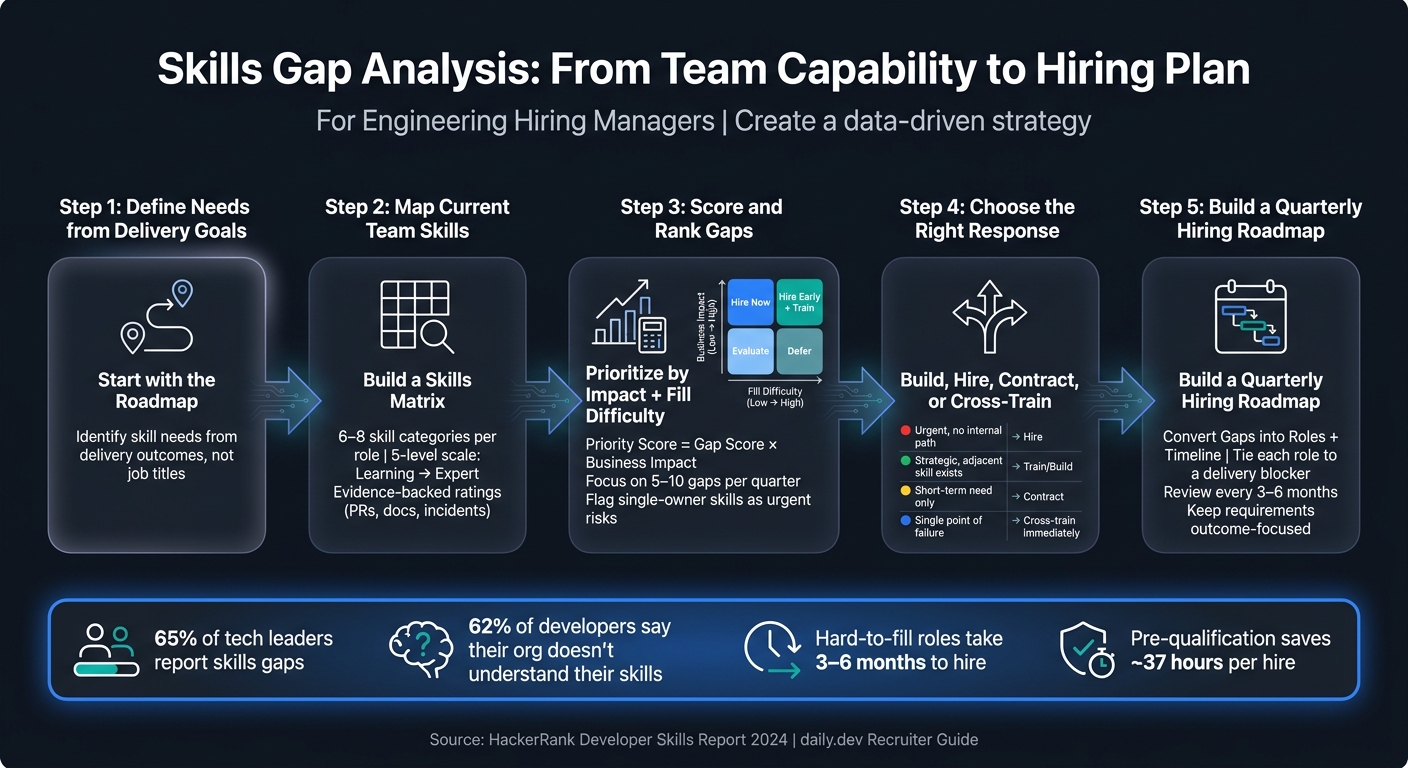
If I open a role before I know the exact skill gap, I’m guessing. A better path is simple: I start with the roadmap, map the team’s current skills, score gaps by impact and hiring difficulty, and then decide whether to train, hire, contract, or cross-train.
Here’s the article in plain English:
- I define needs from delivery goals, not job titles
- I map current team skills across tech, security, delivery, and people skills
- I use a shared 1–5 rating scale with proof from shipped work
- I rank gaps by business impact and time to fill
- I turn top gaps into job requirements and a quarterly hiring plan
- I keep the list short: usually 5–10 gaps per quarter
- I review the plan every 3–6 months
A few numbers stand out. 65% of tech leaders report skills gaps. 62% of developers say their company does not understand their skills well. And some hard-to-fill engineering roles can take 3–6 months to hire, which can throw off a roadmap fast.
What I like about this approach is that it cuts out vague hiring. Instead of saying, “We need a senior engineer,” I can say, “We need someone who can reduce failed releases, improve AWS automation, or remove a security bottleneck by a target date.”
The core idea is simple: define the work first, then decide who or what is needed to get it done.
Map what your team can actually do today
Start with a capability map your team can use, not one that looks good in a slide deck. A practical version has 6–8 core skill categories per role. A solid setup uses seven categories: programming languages, frameworks and libraries, cloud and infrastructure, architecture and design, data and analytics, security and compliance, and collaboration and delivery practices.
That last category matters more than teams often admit. Things like code review quality, technical documentation, and on-call participation tell you a lot about whether someone is ready to ship and support work in production. These aren't side items. They're direct signals of delivery readiness.
Build a skills matrix by role, skill, and proficiency level
Once the categories are set, use one five-level scale across the team: Learning, Applying, Proficient, Leading, Expert. The key is to define each level with clear behavioral anchors so people don't rate the same skill in totally different ways.
For example, Proficient shouldn't mean "has seen this before." It should mean an engineer can independently design a new REST API, implement it end to end - including tests and monitoring - and resolve most production incidents independently.
According to HackerRank's 2024 Developer Skills Report, 62% of developers believe their organization does not accurately understand their skills.
That's why a written matrix works better than relying on memory, gut feel, or whoever speaks up most in planning meetings.
Rate skills using evidence from real work
Self-assessments are a good starting point, but they shouldn't stand on their own. Ask each engineer to rate themselves and attach one piece of proof - a pull request, design doc, incident, or shipped feature - for any Proficient-or-higher rating.
Then managers review those ratings against work artifacts such as code reviews, incident logs, architecture docs, and delivery history. A short 30–60 minute calibration conversation per engineer is usually enough, especially if you focus only on ratings that differ by more than one level. That keeps the process light and stops it from turning into an all-day exercise.
Skills matrix template you can use right now
A spreadsheet with the columns below gives you what you need for gap analysis and hiring decisions:
| Column | Example Entry |
|---|---|
| Role | Senior Backend Engineer – Payments |
| Skill Category | Cloud and Infrastructure |
| Skill | AWS Lambda |
| Required Level (1–5) | 4 |
| Current Level (1–5) | 2 |
| Gap Score | 2 |
| Business Impact Weighting (0.0–5.0) | 4.5 |
| Priority Score (Gap × Impact) | 9.0 |
| Response Type | Hire |
| Owner | Payments Team Lead |
| Target Date | 03/31/2027 |
| Notes / Evidence Links | PR #1452 – initial Lambda integration; needs guidance on IAM and error handling. |
Sort by Priority Score first. That gives you the biggest gaps right away. Then filter by Response Type so you can split your hiring roadmap from your training plan.
In practice, the highest-scoring gaps tell you where to act next: what to build in-house, where to vet technical skills, and where coaching or training will do the job faster.
Turn your skills inventory into a build, hire, or train decision
Once you’ve ranked the priority scores, the next step is simple: turn each gap into a clear action. The point is to make a decision, not to run another audit.
Score each gap and pick the right response
For each gap linked to a roadmap outcome, weigh urgency against the time it would take to train someone internally. If you need the skill in 1–2 sprints and internal development would take 3+ months, you’ll usually need to hire or bring in short-term help. If the skill matters to your product over the long run and someone on the team already has nearby experience, internal training is often the lower-cost move.
Also, treat single-owner skills as urgent gaps, even when the current owner is highly skilled. If only one person can handle a critical area, that’s a risk.
Use the same evidence-based scores to choose the response:
| Condition | Recommended Response |
|---|---|
| Urgent need, no internal path | Hire |
| Strategic skill, adjacent internal skill | Build / Train |
| Short-term project need, no clear long-term need | Contract / External support |
| Single point of failure | Cross-train immediately |
Rank gaps by business impact and fill difficulty
Even high-priority gaps aren’t all equal. Some are much harder to fill than others. In the U.S., hiring for senior platform engineers with deep Kubernetes experience, security engineers, and ML engineers can take 3–6 months. That can throw off a quarterly roadmap fast.
So don’t just score for impact. Add a fill difficulty score too, then use both scores together to decide what to do and when to do it.
Here’s the basic idea:
- High impact + low-to-moderate difficulty: hire now
- High impact + very high difficulty: start recruiting early and train internally at the same time
- Low impact + high difficulty: defer it
That last point matters. Don’t burn recruiting time on gaps that won’t change delivery.
| Gap | Impact Score (1–5) | Fill Difficulty (1–5) | Recommended Action | Target Quarter |
|---|---|---|---|---|
| Cloud infrastructure security | 5 | 5 | Hire + interim external support | Q3 2026 |
| AI/ML model validation | 5 | 4 | Hire | Q3 2026 |
| Cloud infrastructure (AWS) | 4 | 4 | Hire (remote-friendly to widen pool) | Q4 2026 |
| Database performance tuning | 4 | 3 | Mentorship / build internally | Q4 2026 |
| Legacy system maintenance | 2 | 3 | Train / mentorship | Q1 2027 |
| New frontend framework adoption | 3 | 2 | Internal upskilling | Q1 2027 |
Keep the list tight: only the gaps that directly affect this quarter’s roadmap. In most cases, that means no more than 5–10 per quarter. Tie each one to a specific roadmap outcome or risk, then use that shortlist to write job requirements and identify qualified technical candidates for your quarterly hiring plan.
Convert gap data into job requirements and a hiring roadmap
Write job requirements from must-have outcomes
Turn gap scores into role requirements by starting with the highest-priority gaps. Lower-priority skills can wait for training plans or later quarters. The goal is simple: tie each gap to a role and a business result.
Say the gap is stronger AWS infrastructure automation to reduce release risk. Start with the outcome first - fewer failed releases and more consistent environments. Then spell out the skills needed to get there: infrastructure-as-code, CI/CD reliability, and incident reduction.
A clean way to write requirements is to group them into three layers:
- Must-have skills
- Nice-to-have skills
- Collaboration, ownership, and incident response habits
If someone can learn a skill during ramp-up, move it to nice-to-have. That keeps the must-have list tight, which helps cut false negatives and stops good candidates from screening themselves out too early.
A useful gut check is this: would the team miss a delivery commitment without this skill? If the answer is no, that skill should sit in nice-to-have - or in a training plan, not as a hiring filter.
If your analysis shows different needs across backend scaling, mobile release engineering, and data pipelines, split them into separate roles. Bundling unrelated gaps into one role creates a wish list that few people match, and it slows the search. For a deeper look at how this turns into the job brief itself, clear job briefs attract better developers.
Once the role is clear, place it in the quarter where it removes a delivery blocker.
Build a quarterly hiring roadmap from your gap data
After writing the requirements, map each priority gap to a quarter. Sort by must-have outcome first, then by role and seniority. A practical roadmap should include quarter, team, role, seniority, core skills, must-have outcomes, and target start date as part of your developer hiring checklist .
| Quarter | Team | Role | Seniority | Core Skills | Must-Have Outcome | Target Start |
|---|---|---|---|---|---|---|
| Q4 2026 | Platform | Senior DevOps Engineer | Senior | Terraform, Kubernetes, CI/CD | Reduce deployment failures and improve environment consistency | November 2026 |
| Q1 2027 | Frontend | Frontend Engineer | TBD | Design systems, Core Web Vitals | Support design-system adoption | Q1 2027 |
Review this roadmap every 3–6 months, or sooner if a key team member leaves or a product priority changes . Treat it like a living document tied to product planning and budget reviews. That helps you avoid stale openings that no longer match what the team needs. For a broader look at how this fits into sourcing, developer recruitment strategies for 2026 covers how focused, outcome-driven roles beat generic requisitions in competitive talent markets.
Use this roadmap to choose assessment tools and matching signals next. Comparing the best developer assessment tools can help you validate these specific skills during the interview process.
Tools, templates, and daily.dev Recruiter: putting the analysis to work
Pick the right assessment tool for your team size
Use the same skills matrix from the previous section as your source of truth. If you're working with one team, a spreadsheet is enough. If you're dealing with three or more squads, or teams spread across locations, move to a dedicated tool with role-based access, centralized tracking, and dashboards that show coverage by area like security, observability, or data infrastructure.
You can use this setup as a downloadable skills matrix template.
Template tabs:
- Instructions & Legend
- Team Skills Matrix
- Roadmap Skills Requirements
- Analysis & Priorities
- Action Plan
The Action Plan tab should connect each gap to a response: upskill, hire, contract, or defer. It should also include estimated cost ranges ($) and expected time to fill. That way, the matrix helps with planning and budget discussions.
Once the matrix is up to date, use it to define the exact skills and signals you want in sourcing.
Use behavioral matching to reach the right engineers
Once you've pinned down the gap, the next step is simple: find engineers who already show that pattern in their work. daily.dev Recruiter uses behavioral matching based on past work and demonstrated skills, current interests, and emerging interests that show up before they make it onto a resume .
That means you can enter your job requirements and have the AI pull out the skills, seniority, and stack needed to spot relevant engineers. You can also add up to three custom screening questions to check must-haves and replace early phone screens . After that, the workflow is double opt-in. Developers review the role details, including the tech stack and expectations, before they choose to engage. If they do, you get a candidate brief with their behavioral signals and screening answers before the first conversation .
In practice, that kind of pre-qualification can save about 37 hours per hire by cutting interviews with poor fit . Just as important, it keeps the process centered on engineers who actually want the work.
Conclusion: Hire from real team needs, not headcount pressure
The process comes down to one habit: define the work before you define the role. Start with your roadmap. Map what the team can do today. Score each gap by business impact and how hard it is to fill. Then decide whether to build, train, contract, or hire. From there, turn the top gaps into focused job requirements and place each role in the quarter where it clears a real delivery blocker.
Engineers respond better when hiring is tied to actual problems, not padded requisitions. That keeps hiring connected to delivery instead of vacancy pressure.
Define the work, map current capability, score each gap, and choose build, train, contract, or hire. Then turn the highest-priority gaps into focused roles and a quarterly hiring plan.
FAQs
How do I start a skills gap analysis with a small engineering team?
Start by defining the technical and soft skills each role needs based on business goals and upcoming projects. Tie those skill needs to the work ahead, not just job titles on paper. A backend engineer for a scaling product may need system design and performance tuning, while a team lead may also need hiring, feedback, and cross-team communication.
Then work with engineering leadership to assess current team capabilities. You can do that through self-assessments, manager evaluations, or hands-on tests. Using more than one method usually gives a clearer picture, because people don’t always rate themselves the same way their day-to-day work does.
Next, compare current skills with role requirements and document the gaps. Keep it simple: what’s missing, who needs it, and where that gap affects delivery. After that, prioritize those gaps based on business impact and how easy they are to fill.
From there, choose the right move for each gap:
- Train when the skill can be built inside the team in a reasonable amount of time
- Mentor when people have the basics but need guidance and repetition
- Hire when the gap is urgent, specialized, or too large to close internally
That way, you’re not guessing. You’re matching team development and hiring decisions to the work the business actually needs done.
When should I train the team instead of hiring for a gap?
Put training first when the gap is in core engineering skills, not narrow tool or platform knowledge. Developers with a strong grasp of system design and algorithm optimization can usually get up to speed fast.
Training also makes sense if you care about team dynamics, retention, and the ability to shift as business needs change.
How often should I update our engineering skills matrix?
Update your engineering skills matrix on a regular basis so it stays in step with your team’s current strengths and changing project needs.
A solid rhythm is to check in with engineering leaders every two to four weeks. Then do a formal review any time you notice bottlenecks or your tech direction starts to shift. That way, hiring needs stay aligned with business impact and what the team actually needs right now.
.png)